Before Turning Ancestors into a Database, Ask: Who Has the Right to Press Enter?
Original Chinese title: 把祖靈變成資料庫之前,先問:誰有權按下 Enter?
When governments, schools and tech teams excitedly say they want to digitize Indigenous traditional knowledge, the real question is not how many PDFs to scan or Chatbots to build, but who decides which knowledge can be seen, searched, trained on and commercialized.
Aciang Iku-Silan
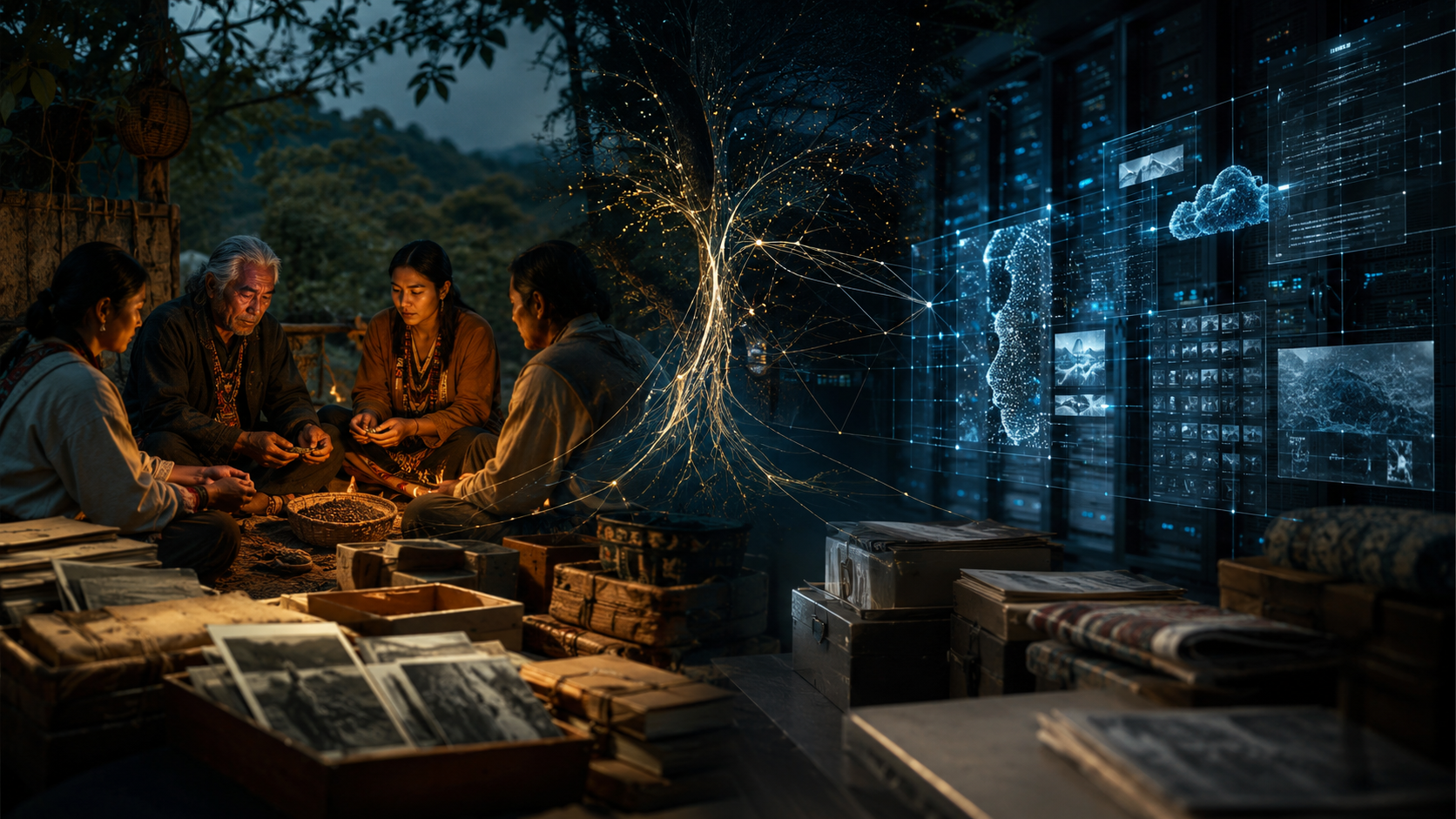
Database is Not Ancestors' Warehouse
In recent years, whenever cultural preservation is discussed, many institutions immediately shout about AI, databases, digital archives and knowledge graphs. These terms sound like civilizational upgrades, but in reality they may just be repackaging old problems: before it was field notes being taken away; now it's vector databases being taken away; before researchers spoke for the community; now models answer for them.
In black humor, ancestors might not have agreed to go to the cloud yet, and engineers are already asking whether embedding dimensions should be 1536. The issue is not that technology cannot be used, but that technology often assumes it has no place, no power, no stake—as if it were just a neutral scanner. Yet any database decides what gets collected, what gets deleted, what gets searched and what ends up ranked first in answers.
Not Whether to Digitize, But Who Decides
Traditional knowledge is not ownerless data. Dreams, rituals, medicinal plants, place names, hunting trails, genealogical titles and ancestral narratives all have different levels of publicness and restriction. If general open-data logic is applied, "readable" gets mistaken for "reusable", and "recorded" for "authorized".
AI systems are especially dangerous because they can reassemble fragments into seemingly complete answers, making errors sound elegant. Once traditional knowledge is absorbed by a model, it does not naturally remember the people, lands, taboos and responsibilities behind the data; it only learns probabilities, then smooths out context in very polite language.
CARE Principles Can Fill FAIR's Blind Spots
Scientific data often discusses FAIR: findable, accessible, interoperable, reusable. This is important for general research data, but Indigenous data governance needs CARE more: collective benefit, control, accountability and ethics. For Indigenous knowledge, "reusable" is not always good; some knowledge requires relationships, some require age grades, some require ritual positions, and some even require silence.
Silence is not missing data—it is part of governance. Not everything that remains unpublicized waits to be mined; some knowledge stays complete precisely because it is not displayed without limit.
Minimum Governance Design for AI Systems
A responsible traditional-knowledge AI system must have at least four layers of mechanism.
First, source-level classification: public, restricted, community-internal and prohibited. Second, answer context display: cross-community knowledge cannot be mixed into ethnographic stews. Third, retain community review and withdrawal rights. Fourth, model outputs must indicate uncertainty, especially for medicine, rituals and dream divination—never pretend to be a physician or priest.
These are not administrative decorations; they are the minimum defense line. An ungoverned AI cultural database easily becomes a new data-mining site, with miners now wearing cloud uniforms.
AI Can Organize Data but Cannot Inherit Relationships
No matter how strong AI is, it cannot replace relationships between people and lands, ancestors, elders and languages. The future of traditional knowledge is not rejecting technology, but refusing to be smuggled into ownerless mineral wealth by it. True digital preservation does not mean stuffing ancestors into tokens; it means keeping the community's right to say "yes", "no", "not yet" or "rewrite".
Before publication, a reminder: content involving medicinal plants, bodies, illnesses, dreams, rituals and sacred objects cannot be simplified into AI Q&A products. Databases can help memory, but they cannot replace responsibility.
AI use and content-safety disclosure
This article was reviewed by the author before publication; AI assisted with draft organization and formatting. Sections involving Indigenous traditional knowledge, rituals, medicine and data sovereignty still require human review within community context.