Two-Eyed Seeing: When Science Meets Local Knowledge, Climate Crisis Finds New Answers
Original Chinese title: 雙眼看世界:當科學遇見地方知識,氣候危機才有新的答案
Climate change is not a problem that can be solved by data models alone. From forests to oceans and agriculture to disaster governance, science needs local experience, and local knowledge must dialogue with modern research.
Yuan Media AI Editorial Desk
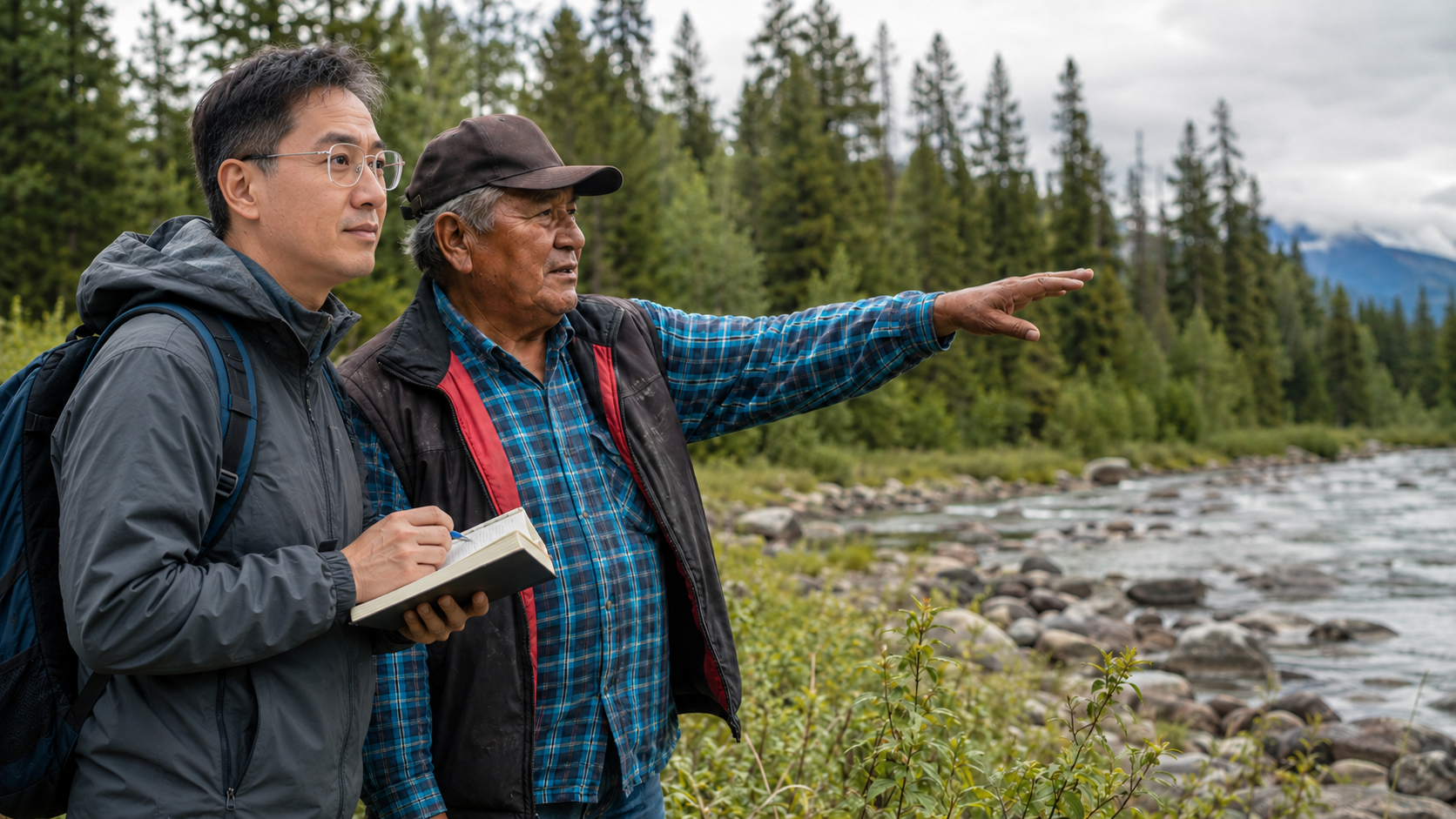
The most difficult part of the climate crisis is not just that the Earth is warming, but that humans are accustomed to understanding the world in too narrow a way. When forest fires increase, we look at temperature, rainfall, wind speed, and satellite imagery; when marine ecosystems change, we examine water temperature, fish movement, and model predictions; when crop yields become unstable, we review soil data, pests, and market prices. These data are important—without science, we cannot comprehend global-scale changes.
But science alone is not enough.
Many local residents have long observed the environment through lived experience. They know which wind signals a change in sea conditions; they notice when certain bird calls become rare, indicating an off‑kilter seasonal rhythm; they see slopes that were once stable now loosening; they detect changes in stream water colour that may signal upstream problems. This knowledge is not always written up as papers, yet it often accumulates over decades or even longer.
Two-Eyed Seeing Is Not Anti-Science
Two-Eyed Seeing is commonly translated as Two-Eyed Vision or Two-Eyed Seeing. It reminds us to use one eye to see the strengths of modern science and another eye to see the strengths of local knowledge and long‑term lived experience, then let both work together toward shared goals.
This concept matters because climate change is not purely a technical problem. It involves land, industry, memory, risk distribution, and ways of life. Scientific models can tell us that rainfall in a place may increase, but local residents might know which drainage route has long been problematic; satellites can show forest cover, yet mountain dwellers may know that when certain tree species decline, animal activity follows suit; governments can draw risk maps, while community elders remember exactly where past floods reached.
Two-Eyed Seeing does not deny science. Rather, it calls for greater humility and completeness in scientific practice. It also does not romanticize local knowledge as if every experience were automatically correct. A mature Two-Eyed Seeing allows different knowledge systems to check and complement each other respectfully.
Forests, Oceans, and Agriculture All Need Two Eyes
In forest management, modern forestry can provide fire‑risk models, vegetation analysis, and carbon‑sink calculations; local knowledge fills in details about water distribution, seasonal variation, plant–animal interactions, and road accessibility. Together, forests become not just carbon stores but places where people live, with history and species relationships.
In ocean governance, scientists can track sea surface temperature and fish data; maritime workers contribute nuanced experience of different seasons, tides, wind directions, and fish behaviour. If policy relies only on statistics, it may miss on‑the‑ground realities; if it depends solely on personal experience, it might overlook long‑term trends driven by global warming. Hence both eyes are needed.
In agricultural adaptation, weather forecasts, soil monitoring, and smart irrigation matter, but a farmer’s tactile sense of the land is irreplaceable. When a field begins to hold water, when certain weeds suddenly proliferate, or when pests appear earlier than usual—these are frontline signals of climate change. If AI systems can combine scientific data with local observations, they may build more sensitive early‑warning systems.
AI Needs Relationships and Authorization
For Taiwan, Two-Eyed Seeing is especially meaningful. The terrain is mountainous and waterways swift; typhoons, torrential rain, earthquakes, debris flows, droughts, and coastal erosion are real threats. At the same time, Taiwan holds rich local knowledge: mountain villages, farming villages, fishing villages, Indigenous communities, offshore islands, and communities on the urban fringe each carry distinct environmental experiences. If climate policy is decided only by central agencies, engineering consultants, and model experts, on‑the‑ground differences risk being ignored. Effective adaptation requires local participation and knowledge translation.
The arrival of AI makes this issue more urgent. Future large‑scale environmental decisions may depend on AI models—for disaster warnings, land use, farm management, ecological monitoring, and resource allocation. If AI can only ingest official data and satellite feeds without local experience, its judgments might be precise yet disconnected from reality.
But local knowledge is not free data. It involves community memory, land relationships, lived experience, and cultural context. Not all knowledge should be public; not all data are suitable for model training. Two-Eyed Seeing truly emphasizes not just knowledge integration but also relationships, authorization, and respect.
A More Complete Future
Facing the climate crisis ahead, we need three capacities. First, scientific capacity: without data, models, and long‑term monitoring, large‑scale changes remain incomprehensible. Second, local listening capacity: without on‑the‑ground experience, policy loses detail and trust. Third, knowledge collaboration capacity: different knowledge systems must find common language, yet they need not be forced into a single tongue.
Two-Eyed Seeing does not mix two kinds of knowledge; it acknowledges that the world is never seen in only one way. Confronting climate change, humanity does not lack information; it lacks the wisdom to connect information, experience, ethics, and action.
Science lets us see that Earth is changing; local knowledge shows how those changes land in concrete lives. When both eyes open together, we may finally glimpse a more complete future.
AI use and content-safety disclosure
This article and its main visual were co-produced with Yuan Media AI, edited and verified by human editors before publication.