Chips are hot, data centers hotter — the model economy of AI infrastructure: who pays the electricity bill?
Original Chinese title: 晶片很熱,資料中心更熱——AI基礎建設的模型經濟,誰在付電費?
AI is often packaged as cloud services: clean, fast, invisible, like intelligence that grows naturally from a browser. But every model training, inference and image generation depends on chips, data centers, cooling systems, power grids, water resources and land use. This article does not oppose AI; it reminds us that if AI becomes new infrastructure, the public cannot listen only to tech company press conferences — it must also see electricity meters, the grid and local costs.
鄭淑禎
# Chips are hot, data centers hotter — the model economy of AI infrastructure: who pays the electricity bill?
When model competitions burn into data centers, society should ask who bears computing power, electricity and knowledge costs
Author: 鄭淑禎 / Full-time Assistant Professor, Shih Chien University
Editorial Preface
AI is often packaged as cloud services: clean, fast, invisible, like intelligence that grows naturally from a browser. But every model training, inference and image generation depends on chips, data centers, cooling systems, power grids, water resources and land use. This article does not oppose AI; it reminds us that if AI becomes new infrastructure, the public cannot listen only to tech company press conferences — it must also see electricity meters, the grid and local costs.
AI is not cloud magic, but a system that eats electricity, water and land
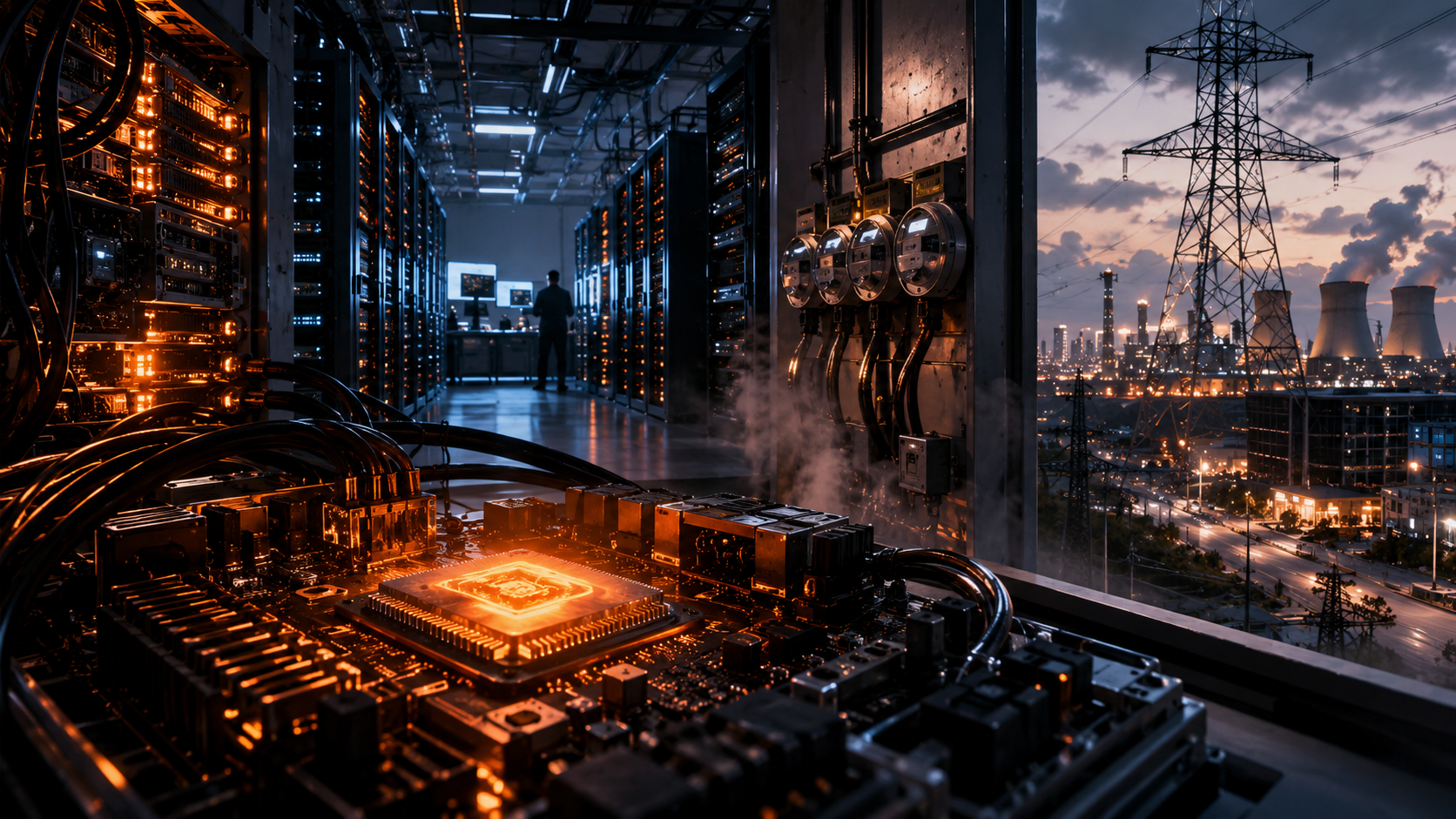
The word "cloud" is too gentle. It conjures sky, freedom, weightlessness — nothing like the humming servers, cooling equipment and backup power in server rooms. AI's cloud is actually heavy: it requires land to bear it, grid supply, cooling systems to lower temperature, and a global chip supply chain to keep breathing.
As models grow larger, social discussion still lingers on whether chatbot answers are funny — that is somewhat dangerous. AI does not exist only as products on screens; it is becoming part of industrial policy, energy policy and urban governance. AI reads the world into vectors, but electricity meters remain honest. They do not understand philosophy; they only know how to charge.
Chip shortage is just surface: data centers are the new mines
Recent AI competitions are often framed as chip competitions, as if whoever gets more GPUs gets the future. Chips certainly matter, but chips are merely an entry point; what truly ties up social resources over the long term are data centers and their underlying energy, land, network and water resource demands.
Data centers are like new mines — they do not dig coal or gold, but compute power and attention. They may bring investment, jobs and industrial upgrading, but also grid pressure, local land competition and public resource allocation issues. Without transparent planning, communities will only discover after press conferences that "AI upgrades" will appear in their own electricity bills, land and water discussions.
Data center costs often do not appear in corporate financial statements
Tech companies calculate training costs, inference costs, chip depreciation and cloud revenue, but public costs often sit elsewhere: grid reinforcement, energy transition, local infrastructure, environmental impact, community communication, power resilience under extreme climate.
These costs do not necessarily mean data centers should not be built; rather they signal that public discourse cannot be absent. Society needs to know: who uses electricity? How much? When? Does it compress civilian and other industrial demands? Is it paired with renewable energy and demand management? If answers are always hidden behind commercial secrets, AI infrastructure becomes invisible public decision-making.
Should the public grid pay for a few model competitions?
The AI industry often claims to create the future, but if that future is trained by only a few companies, sold on only a few platforms and controlled by only a few models at entry points, then what the public grid bears is not just industrial upgrading — it is powering a centralized knowledge market.
The question is not "whether we need AI" but "which kind of AI deserves public resource support." Education, healthcare, disaster response, language revitalization, agriculture and local governance may all benefit from AI; but if most energy is used to generate advertising images, optimize click-through rates and stack larger closed models, society has the right to ask about priorities.
Model economy: bigger does not automatically mean more public
Large models have technical value, but "bigger" does not automatically equal "more public." Knowledge accessibility, data governance, language diversity, local needs and open ecosystems are equally important. If all computing power flows toward a few giant models, small research institutions, public agencies, Indigenous languages and non-mainstream knowledge will be pushed to the margins.
Taiwan especially cannot think of AI only as hardware exports or chip glory. Chips are an advantage, but public governance decides who that advantage serves. If we can put energy planning, data center review, open models, local applications and education empowerment on the same table, AI is more likely to become a public capability rather than a pretty power-hungry signboard.
Conclusion: talking about AI also means talking about politics behind the socket
AI's future lies not only in laboratories but in grid maps, land-use plans, energy transition pathways and public budgets. Every model upgrade is not purely a technical event; it is simultaneously a resource allocation event.
Therefore good AI policy should not ask only "do we have the strongest models" — it must also ask "do we have reasonable computing power distribution," "do we protect local and public interests," and "does knowledge accessibility improve." True wisdom is not handing all electricity to models, but knowing which problems deserve to be lit up.
AI use and content-safety disclosure
This article was compiled and edited by Yuan Media AI editorial process.