AI Data Centers Are Not Clouds: Are They Heat-Generating Colonial Factories?
Original Chinese title: AI 資料中心不是雲,是一座會發熱的殖民工廠?
AI is described as cloud services, floating in the sky; but data centers are physical beasts that consume electricity, water, and land. As the model economy expands, local communities may bear heat, grid stress, and environmental costs.
Lowerence Lee
AI Product Manager
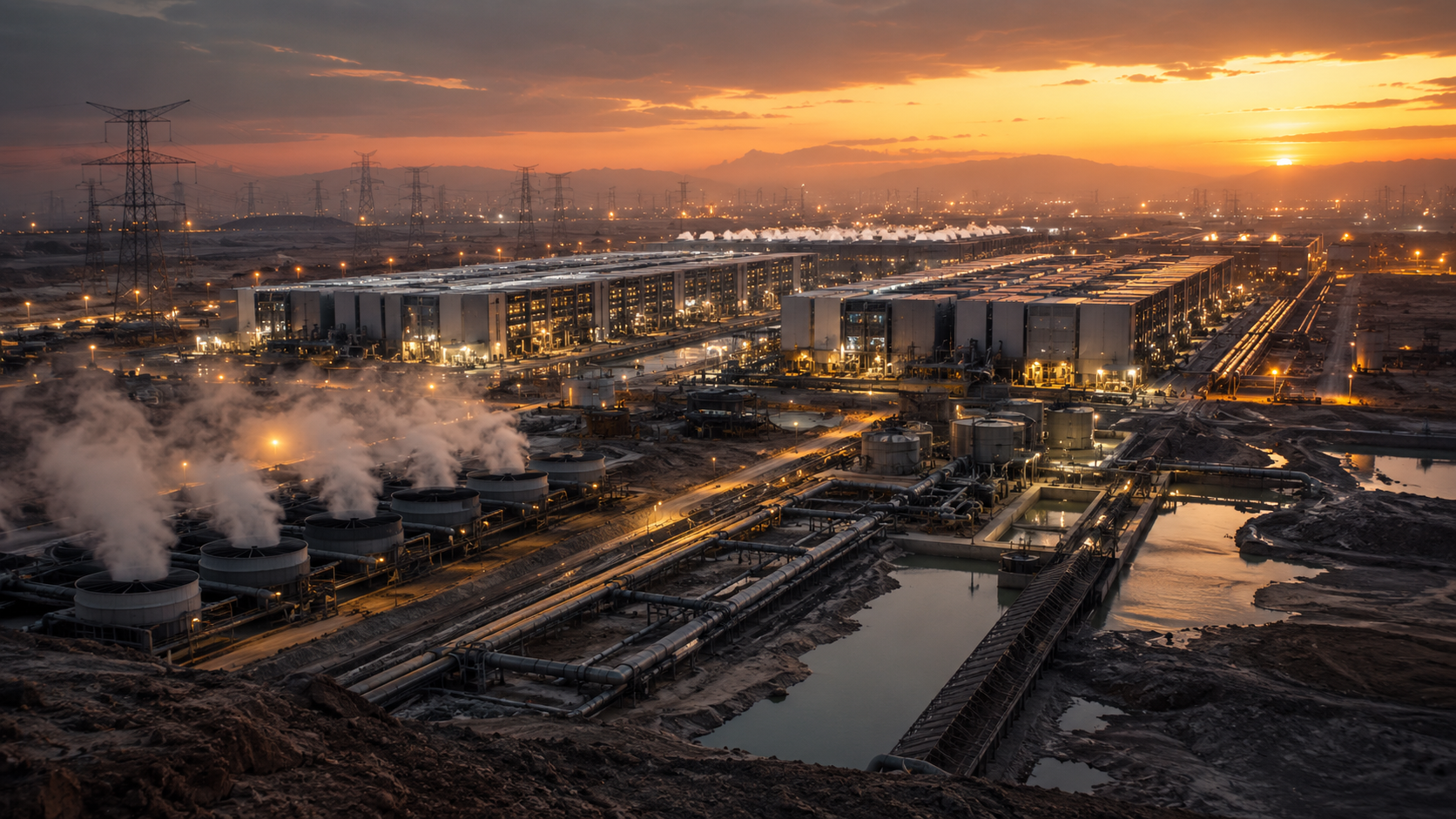
AI is often described as 'cloud services', as if it floats in the sky, occupying no space, drinking no water, consuming no electricity. But recent data center controversies remind us: AI is not a cloud; it is a massive machine built jointly by land, power grid, water resources, cooling systems, chip supply chains, and political subsidies.
We Thought AI Was in the Cloud, Actually It's Next to Someone's Home
Every time we enter a prompt, draw an image, or generate a report, behind it is not a magical cloud. It is rows of GPUs, cooling pipes, substations, land leases, tax incentives, and local government investment brochures. The tech industry likes to call these 'infrastructure', sounding like roads, bridges, hospitals—public goods. But the publicness of AI data centers must be questioned: Where lies the public interest? Who pays the public costs? Who participates in public decision-making?
The Problem with Data Centers Is Not Just Electricity Consumption, It's Risk Redistribution
Recent international reports indicate that AI is driving rapid increases in electricity use, water consumption, and carbon emissions by data centers; studies and reports estimate that the environmental footprint of data centers can already rival national-level energy consumption and may increase substantially before 2030. This is not just an environmental news story, but a governance one. When a data center enters a locality, it brings job promises as well as grid load, water resource scheduling, cooling waste heat, local electricity price changes, and land use alterations. AP reports and United Nations University-related research point out that the electricity, water, and emissions footprints of data centers are expanding rapidly, with AI usage share also rising.
AI Says It's Light, Yet Needs a Power Plant to Support It
In the past, platform companies said data is the new oil. A more precise formulation might be: data is the new oil, models are the new refineries, and data centers are the new industrial parks. They just wear white server racks, tie 'cloud', 'innovation', and 'smart city' ties, making them look less likely to dirty hands. But where does electricity come from? Where does water come from? Where does the dissipated heat go? These questions do not disappear because a presentation uses blue gradient backgrounds.
Indigenous Land Ethics Ask Different Questions
Mainstream tech governance often asks: 'How much investment can this data center bring?' Indigenous land ethics ask several more: What is the relationship of this land and water system? Who has the right to consent? Who has the right to refuse? Does the community receive short-term rent or long-term risk? Can future generations still use the same water, electricity, forest, and coast?
This is not anti-technology; it refuses to package technology as unquestionable destiny. The spirit of Two-Eyed Seeing does not force Western engineering and Indigenous knowledge together, but lets both ways of seeing jointly examine the same question: one eye looks at performance, investment, and system reliability; the other eye looks at land relationships, cultural responsibilities, and intergenerational justice.
The Real Cost of the Chip Economy Is Not on Model Price Sheets
Now AI companies compete on model capabilities, inference speed, and cloud pricing. But price sheets usually do not list local water rights, heat island effects, grid stress, resident electricity bill increases, nor Indigenous consultation time costs. This is like a restaurant menu listing 'free soup', but the kitchen sends the bill to the neighboring village.
Reuters reports that Texas grid operators have raised concerns about large data centers and crypto mining farms' grid connection reliability, because large users suddenly disconnect from the grid during voltage anomalies, potentially causing system risk. This reminds us: AI infrastructure is not purely an internal corporate cost, but a public system risk.
Cultural Data Sovereignty and Energy Sovereignty Are Actually Linked
When discussing Indigenous data sovereignty, we often care about how data is collected, labeled, stored, trained, and commercialized. But if data is stored in centers requiring massive water and electricity, data sovereignty should also extend to infrastructure sovereignty: Where is the data preserved? Who controls servers? Which jurisdiction protects it? Which community bears environmental costs?
The CARE Principles emphasize Collective Benefit, Authority to Control, Responsibility, Ethics. These four words applied to AI infrastructure become very sharp questions: Does collective benefit truly return to communities? Do communities have control? Do enterprises bear responsibility? Is ethics just an ESG report decoration page?
Don't Just Ask If the Model Will Answer, Ask Where It Lives
The next stage of AI critique cannot stop at bias, hallucination, copyright. Those matter, but are not enough. We must pull AI from cloud to ground: Where does it live? Whose water does it drink? Whose electricity does it use? Who bears the heat? Who is asked to believe 'this is progress'?
Truly responsible AI is not merely about making model outputs more polite, but that its infrastructure can be examined by local democracy, Indigenous rights, environmental justice, and cultural data sovereignty. Otherwise so-called smart societies merely replace old-style colonialism with liquid-cooled server racks.
AI use and content-safety disclosure
This article was compiled according to approved editorial direction and verified through Yuan Media AI's editorial process; specific cases involving energy, land, and local governance should still be based on official sources, community input, and publicly available field data.