AI-Generated Indigenous Portraits: They Look Beautiful, But Whose Face Did It Actually Steal?
Original Chinese title: AI 生成的原住民肖像:看起來很美,問題是它到底偷了誰的臉?
AI-generated portraits of Indigenous people are often strikingly appealing, but precisely because they are so beautiful, they more easily mask the underlying issues of mixing, misidentification, unclear data sources, and cultural appropriation.
Yuan Media AI Editorial Desk
Image ethics observer
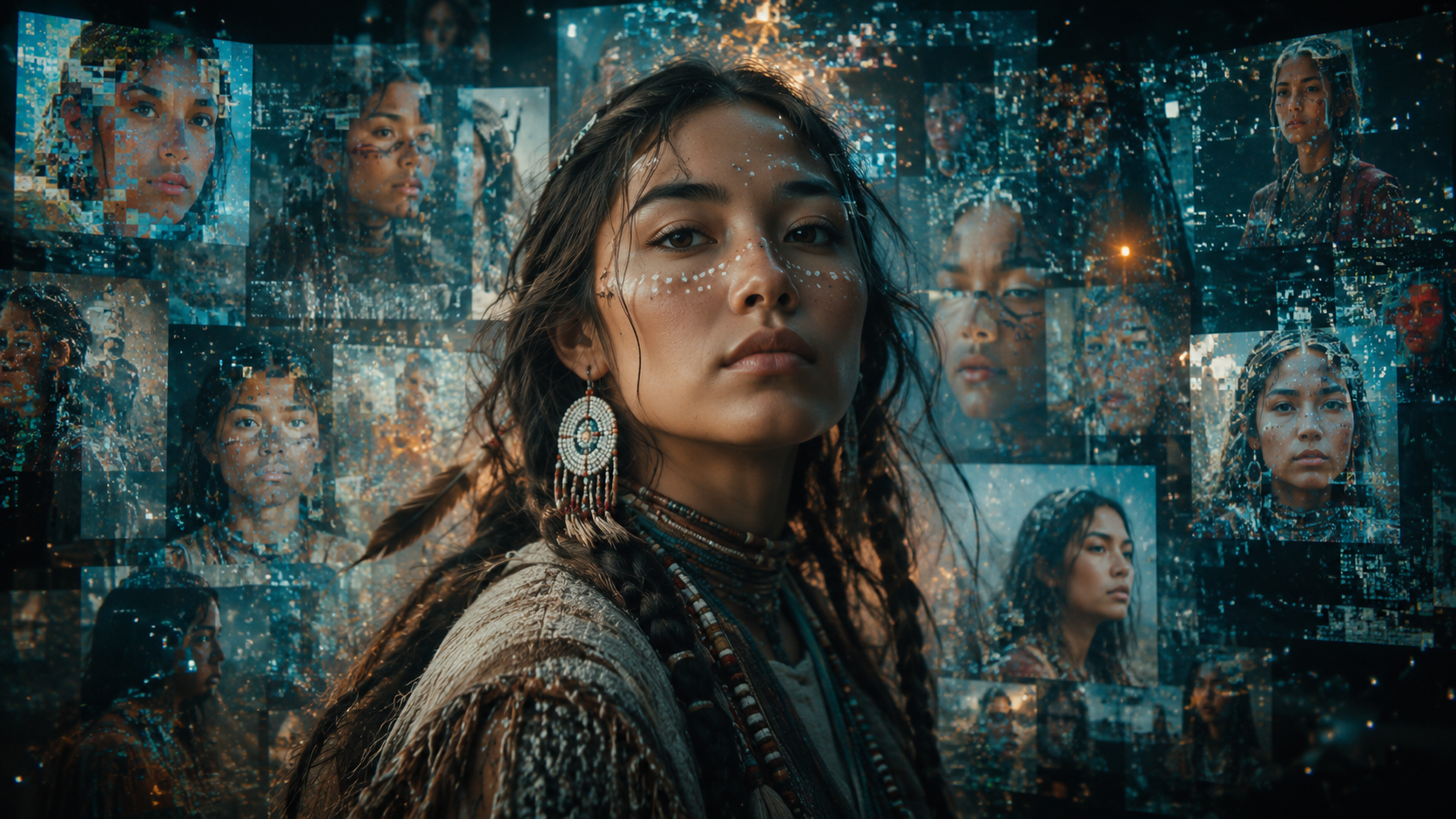
AI image generation turns 'Indigenous style' into a keyword that can be input: feather ornaments, mountains and forests, elders, mystery, ancientness, totems, warriors, festivals. Within seconds, a beautiful, sharp, advertisement-like image appears.
AI is very good at painting 'Indigenous people', but often doesn't know who it's painting
Open any image generation tool, input 'Indigenous elder, traditional clothing, cinematic light', and soon a seemingly solemn face will appear. Wrinkles just right, deep gaze, misty background, clothing that resembles traditional attire but cannot be identified with any particular Indigenous People or community. This is the problem: AI images often create a 'pan-Indigenous aesthetic'. It appears respectful, actually mixing different Indigenous Peoples, histories, forms of dress, ceremonies and geographic contexts into one high-resolution cultural soup.
The most dangerous thing isn't caricature, it's beautification
In the past, media representation of Indigenous peoples commonly had problems of stereotypes, backwardness, barbarization. In the AI era a new smoother problem has been added: beautification. The image is beautiful, lighting professional, figures solemn, so viewers don't easily notice that it's actually inaccurate, irresponsible, even offensive.
This is a visual sugar coating. It packages cultural misplacement as art, unlicensed data as inspiration, historical inequality in datasets as 'model capability'. In black humor terms, AI may be the most polite cultural appropriator in history: it won't mock you, it will just paint your ancestors onto high-end tablecloths.
Datasets aren't dropped from the sky
The capabilities of AI image models come from massive amounts of images. These data may include news photos, museum collections, travel photography, social media, academic records, product images, film festival posters, educational materials. Many images were not consented to be used for training commercial generative models when they were shot, uploaded or archived.
For Indigenous peoples, images are not purely visual material. Costumes, face painting, tattoos, headdresses, ritual scenes, body postures, objects and spaces may all carry identity, age, gender, family, hierarchy, ritual and taboos. Taking them to be modeled is not just a copyright issue, it's an image sovereignty issue.
Cultural Co-Creation, Not Culture Generated on Someone Else’s Terms
Recent cross-cultural AI ethics discussions point out that culture should not only be seen as differences needing management, but as ethical sources of co-generation. In other words, culture is not the 'sensitivity check' before a product goes to market, but must participate as co-author from problem setting, data collection, model design, evaluation methods to usage norms.
This is especially important for Indigenous image work. Communities are not people providing 'feature material', but governance subjects deciding how images should be used, when they cannot be used, which symbols cannot be mixed, which scenes cannot be simulated.
How to implement Two-Eyed Seeing in image generation?
From one eye, AI images are creative tools: they can assist education, exhibitions, storyboards, language textbooks, cultural activity design. From the other eye, it's also representation power: who is depicted? Who writes the prompt? Who reviews it? Who gets paid? Who is misidentified?
Two-Eyed Seeing reminds us to use the strengths of different knowledge systems simultaneously. Technically we can establish data source markers, authorization mechanisms, style limits, community review, sensitive symbol blocking; culturally we must point out which images cannot be generated, which need contextual explanation, which can only be used by specific members.
Minimum guidelines for media and education fields
First, do not use 'pan-Indigenous' as image prompts unless the article itself is critiquing this problem. Second, do not treat AI-generated images as real ethnic photographs. Third, if using AI images, clearly label them as generated. Fourth, do not simulate real rituals, funerals, sacred objects or restrictive costumes. Fifth, do not mix symbols from different Indigenous Peoples into a 'more Indigenous feel'. Sixth, educational materials should prioritize community-authorized real data over generative substitutes.
Otherwise we will quickly enter an absurd world: students see many 'Indigenous images' but encounter no living Indigenous communities.
The core of image ethics isn't whether it can be painted, but who has the right to decide how it's painted
AI-generated images are not original sin. The problem is that they continue old media viewing power while adding new technology scale and automation. In the past one wrong poster affected an event; now one wrong prompt can generate a thousand 'seemingly reasonable' wrong cultural images.
Truly respectful creation won't turn Indigenous peoples into style kits. It will first ask: does this image need to exist? Who participated? Where did data come from? Does it conflate distinct Indigenous Peoples? Does it violate taboos? Will viewers mistake it for real culture?
AI can paint beautifully, but beauty is not ethics. Beauty sometimes is just error wearing a tuxedo.
AI use and content-safety disclosure
This article's cover image is an AI-generated conceptual illustration, not documentary photography, and does not represent any specific real person, ethnic costume, or ritual; the article argues that generated images should be subject to source, authorization, context, and community review.