Chips are overheating, rivers are sweating: Who pays the infrastructure bill for AI model economies?
Original Chinese title: 晶片在發燒,河流在冒汗:AI模型經濟的基礎設施帳單誰來付?
The AI industry loves to talk about how big models are, how many parameters they have, and how cheap inference is. But it rarely writes electricity grids, water resources, land, and local communities onto the same invoice. Cloud computing isn't in the sky; it's beside a river, next to a substation, or inside a local government's investment promotion brief.
Balriwakes
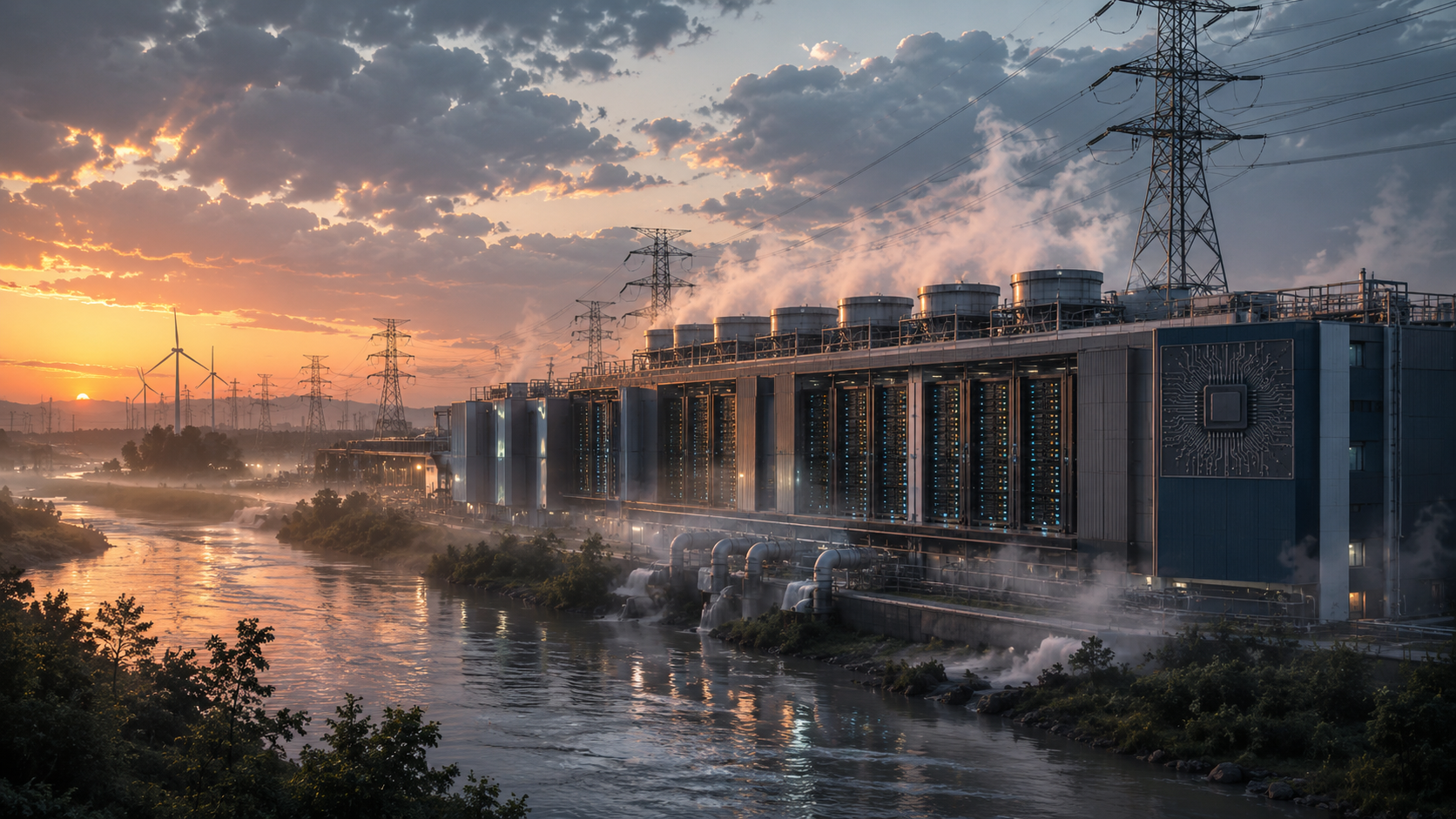
The language of the AI industry is always light: cloud, models, weights, inference, virtual assistants. It seems as if pressing send makes answers drift down from the sky. In reality, every training run and inference cycle lands on the ground: chips must be manufactured, servers powered, data centers cooled, transmission lines expanded, equipment occupying land, and local communities bearing noise, heat, and water pressure.
Cloud has no clouds; it is someone else's electricity bill. When the industry talks up how cheap computing costs are, we should ask harder questions: Are the savings real technological progress, or have they been shifted onto power grids, rivers, local budgets, and residents' lives?
Three Bills of the Model Economy
The first is the energy bill. Large AI systems consume not only during training but also continuously during deployment for inference, storage, and redundancy; stable electricity supply is required.
The second is the water and environmental bill. Cooling methods, climate conditions, and site selection affect water use and heat discharge. The issue cannot be judged solely by annual totals; it must consider dry seasons, competition within the same river basin, and cumulative impacts of heat release and facilities on local environments.
The third is the land and fiscal bill. Data centers require land, roads, fiber optics, substations, and safety zones. Local governments may offer tax incentives and fast-track approvals, but they do not always disclose each long-term cost. Investment promotion briefs list investment amounts; the back of the invoice often bears small print that only residents can see.
AI Is Not Merely a Software Industry
Treating AI as a software industry leads policy to focus on talent, entrepreneurship, and computing power; viewing it as heavy infrastructure immediately makes the problems less romantic: Where does electricity come from? Who competes for water? How is decommissioned equipment handled? When supply chains or grids fail, who is prioritized?
The model economy is bound up with semiconductors, construction, energy, communications, finance, and land governance. Companies showcase chat windows; behind them stand rows of transformers. The cleaner the interface, the more hidden the infrastructure becomes.
Data Center Site Selection and Local Inequality
Data centers are often sited where land is cheaper, energy is available, and policy actively promotes investment. These conditions may also mean fewer resources for local negotiation, less transparent environmental information, and residents finding it harder to negotiate on equal footing with multinational corporations, central policies, and large utilities.
Employment promises must be scrutinized. Construction-period jobs differ from long-term positions; high-skill roles are not always filled by locals. Conversely, water use, grid engineering, landscape changes, and opportunity costs remain in the locality for the long term. If benefits flow across regions while risks accumulate locally, this is not digital transformation but geographically precise externalization of costs.
Indigenous traditional territories and local communities affected by facilities, transmission lines, or water resource allocation cannot be listed merely as attendees at engineering briefings. Consultation, consent, and co-governance must occur before site selection, not after earthmoving to fill out a cultural sensitivity form.
Beyond Chip Shortages: A Governance Deficit
The industry can quickly calculate how many chips, server racks, or megawatts are missing; governments often lack cross-departmental data to answer: What is the cumulative regional electricity demand? How are dry-season risks allocated? What public interest do tax incentives purchase? Can locals access real-time monitoring?
Governance deficits also manifest as commercial secrecy. Companies must protect technology but cannot bundle water use, heat discharge, and public subsidies into a black box. When public systems bear capacity for industry, society has the right to know who uses that capacity and how costs are calculated.
Policy Recommendations: Bring AI Infrastructure Under Public Review
First, establish tiered data center review with cumulative impact assessment, not just case-by-case evaluation of individual facilities. Second, require disclosure of electricity use, water consumption, cooling methods, backup power generation, heat discharge, and reduction plans in comparable formats updated regularly. Third, incorporate grid and water resource costs into tariffs and investment conditions to prevent public agencies from silently absorbing them.
Fourth, before site selection there must be local participation, traditional territory review, and benefit-sharing mechanisms so communities can propose alternatives or refuse. Fifth, when governments procure AI services they should assess infrastructure footprints, not just compare model prices; cheap APIs may simply shift expensive parts to someone else's address.
Conclusion: The Bigger the Model, the More We Need to See the Ground Clearly
AI cannot be developed without data centers, nor are data centers inherently sinful. The problem is that when industry writes profits into the cloud and leaves costs on the ground, people who never saw the contract end up paying its visible costs.
The larger the model, the smaller policy vision must not become. When chips overheat and rivers sweat, we do not need another technology vision map; we need a complete invoice: electricity, water, land, public funds, local rights, and long-term risks all listed, with the payer no longer written as "other".
AI use and content-safety disclosure
This article was generated as a draft by Yuan Media AI's daily article factory, then reviewed by human editors before publication; data concerning data centers, energy, water resources, and model economies should still be verified against the latest publicly available information.