AI, Multimodal and Cultural Archives: Design Thinking for the Next-Generation Knowledge Graph Platform
Original Chinese title: AI、多模態與文化典藏:下一代知識圖譜平台的設計思維
The future of cultural archives is not a bigger filing cabinet, but a knowledge graph that understands relationships, retains provenance, respects permissions, and supports multiple interpretations. AI assists in linking; humans and communities retain naming, authorization, and correction authority.
Yuan Media AI Editorial Desk
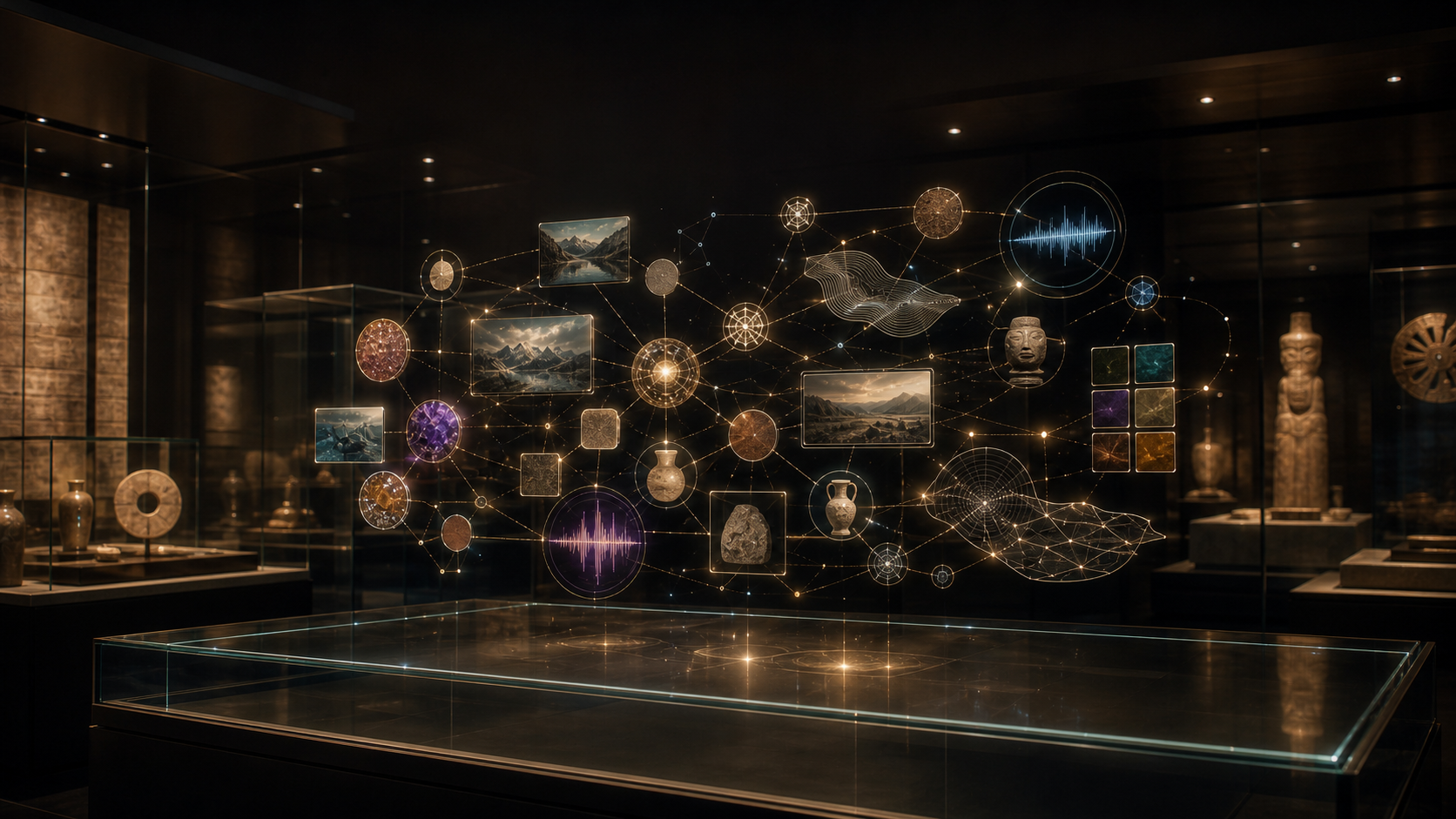
The first task of digital archives was to preserve data that is easily lost; the second was to make it searchable. The next-generation platform must answer harder questions: what relationships exist between a sound recording, a photograph, an artifact, and a place? Who defines these relationships, and who can see them?
Combining multimodal AI with knowledge graphs gives platforms the chance to move from file management to knowledge linking. But cultural data is not a general product catalog; technical design must simultaneously handle semantics, provenance, permissions, and interpretive responsibility.
From File Fields to Relationship Networks
Traditional databases often center on single records: name, date, author, place, format. Knowledge graphs treat people, events, places, artifacts, languages, concepts, and files as different nodes, then describe the relationships between them.
The same song can link to performers, recorders, communities, seasons, ritual contexts, language versions, and licensing conditions; a photograph can simultaneously link to shooting location, subjects, family memories, and later research interpretations. Archives thus become not isolated objects but a knowledge network that can be continuously supplemented and corrected.
Multimodal Is Not Just Putting Files Together
Images, sounds, text, maps, and three-dimensional objects each have different information structures. The value of a multimodal platform is not to play videos on the homepage alongside images and text, but to establish interpretable links across media.
For example, a system can locate place names mentioned in interview audio files, then link them to unlabeled historical photographs and map locations; it can also assist in matching artifact images with oral descriptions. But these links should be marked as human-confirmed, model-inferred, or pending verification—they must not let AI inference masquerade as established fact.
Provenance Tracing Must Become a Core Function
The most important fields of cultural data are often not the content itself but its provenance: who provided it, when it was obtained, under what circumstances it was recorded, what original permissions apply, and what later modifications were made. If a platform only preserves the final version, it compresses complex history into a seemingly clean file.
Therefore, every node and relationship should retain versions, creators, evidence, and modification records. When different researchers or community members propose alternative interpretations, the platform need not rush to select a single answer; it should preserve differences and their contexts.
Permissions Should Enter the Knowledge Graph
Cultural sensitivity cannot be handled by a download button alone. Whether data is visible, citable, usable for model training, or commercially exploitable may depend on user identity, purpose, timing, and community norms.
The next-generation platform must treat permissions as part of relationships. For example, certain content may be suitable for educational use but not commercial models; an image might be viewable only within a community; knowledge may require additional explanation or application. If the system cannot express these conditions, it cannot claim to understand cultural data.
AI Assists with Prompts, Humans Define Meaning
AI is well-suited to assist with transcription, image recognition, similar-data recommendations, entity alignment, and gap-filling prompts, enabling small archive teams to organize large volumes of material more quickly. But names, classifications, cultural meanings, and public boundaries cannot be automatically decided by models alone.
A good workflow should let AI propose candidate links, then have knowledge holders, archivists, or researchers confirm them. Each confirmation or rejection also becomes a basis for improving the system later. Such AI is not an authority but a governed assistant.
The Platform’s Success Must Be Measured by Trust
Cultural knowledge graphs should not be evaluated only by node count, search speed, or model accuracy. More important questions are: can data providers correct content? Can users understand provenance? Can communities control sensitive material? Can different viewpoints coexist?
The design goal of the next-generation cultural archive platform is not to compress the world into a perfect answer, but to make relationships visible, preserve differences, and ensure accountability. When AI helps us find connections, the platform must still guarantee that the people who decide the meaning of those connections remain in view.
AI use and content-safety disclosure
This article and its main visual were co-produced by the Yuan Media AI editorial workflow, confirmed by human editors before publication.