AI Is No Miracle Cure but the New Apprentice in the Molecular Lab: The Next Hard Battle for RNA Drugs and AI for Science
Original Chinese title: AI 不是藥神,是分子實驗室的新學徒:RNA 新藥與 AI for Science 的下一場硬仗
AI is an apprentice in the molecular lab: it can help search for patterns and propose candidate directions, but new drugs must still pass experimental, clinical, regulatory, and ethical validation.
山海資料庫筆記
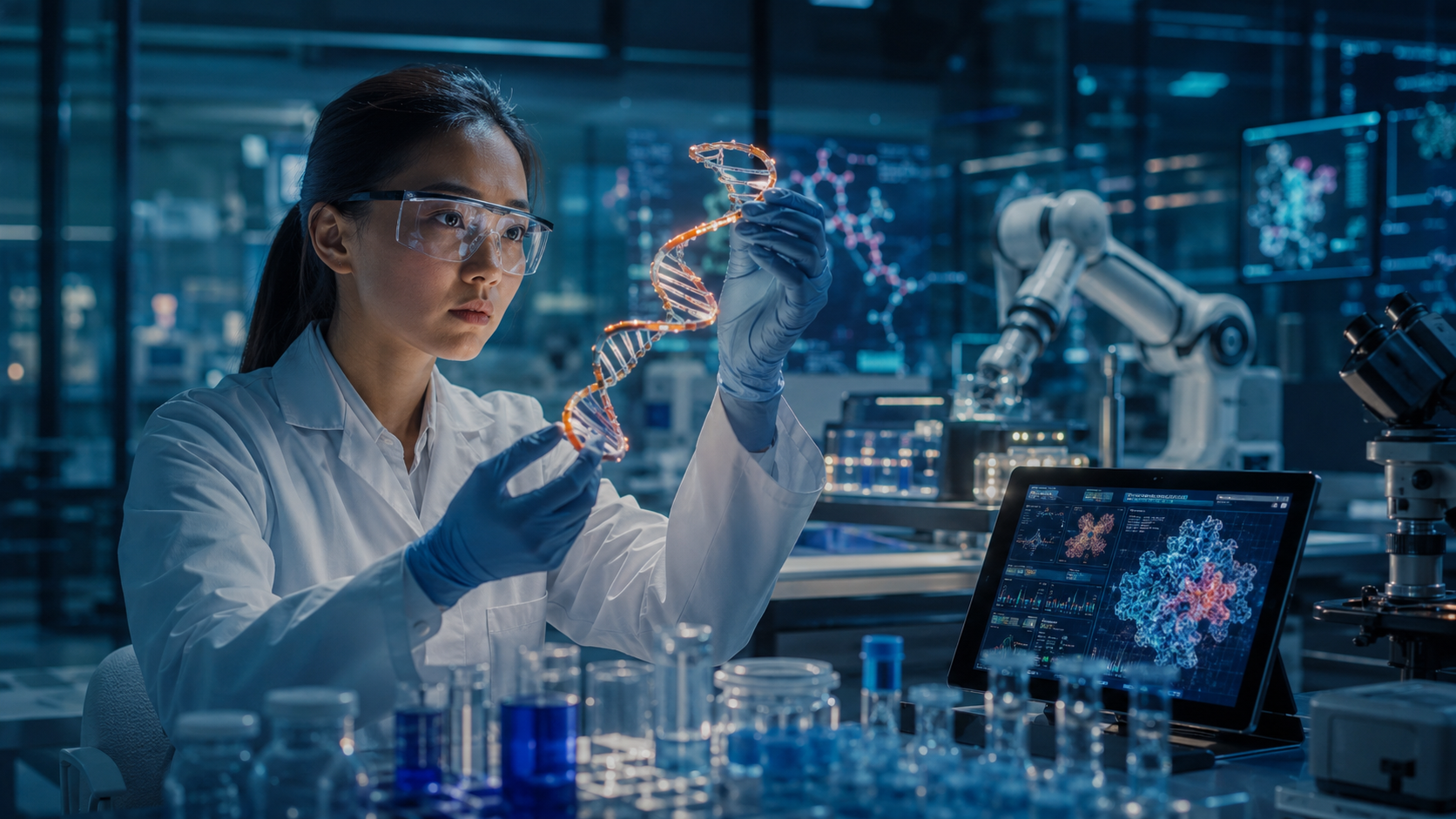
After entering the medical field, AI is most often portrayed by media as a myth: models discovering new drugs, algorithms defeating diseases, molecular design compressed from years to days. Headlines sound like humanity has finally found the gateway to immortality—waiting only for an investor to press the transfer button.
But new drugs are not posters. Molecules are not prompts. The human body is not a picture that can be regenerated by pressing a reset key.
In recent years, AI for Science has indeed advanced rapidly. From protein structure prediction, protein language models, RNA drug design, to automated laboratories and molecular screening, artificial intelligence is beginning to enter the new drug development process—once extremely expensive, slow, and failure-prone. This is no small matter. Traditional drug development often takes many years, passing through numerous candidate molecules, cell experiments, animal studies, clinical trials, and regulatory reviews; ultimately, only a very low proportion succeed in reaching market. If AI can help eliminate unsuitable directions early or propose more promising molecular designs, it could indeed transform the entire industry.
RNA drugs are especially noteworthy. Technologies such as mRNA, siRNA, gene silencing, and RNA editing shift medicine beyond merely "finding a small molecule to block a protein"—they approach regulation of life's information itself. RNA therapeutics bring treatment down to the cellular message level: instead of just fixing pipes, we alter the blueprints. This is why major pharmaceutical companies and AI biotech firms are investing in RNA drug design; AI excels at searching through vast sequence, structure, and functional spaces for possibilities.
Yet the more miraculous a technology appears, the cooler it must be treated.
AI can generate candidate molecules but cannot guarantee safety within the human body. AI can predict structures but cannot automatically resolve immune responses, toxicity, delivery systems, dosing, metabolism, manufacturing stability, or long-term side effects. Many molecules look beautiful on computers; once they enter cells, things become awkward; promising in mice, they turn into an expensive breakup when tested in humans. The cruelest aspect of biology is that it does not respect the straight arrows drawn on slides.
Therefore, calling AI a "miracle cure" is dangerous. A more accurate description: AI is an apprentice in the molecular lab. It reads literature well, searches for patterns adeptly, proposes hypotheses skillfully, and helps scientists narrow scope; yet it still needs teachers—experimentation, clinical trials, regulatory oversight, and ethics. Without these four mentors, AI easily becomes an overconfident intern, holding a few beautiful molecular diagrams and believing it has cured the world.
Here we can also make an interesting Two-Eyed Seeing comparison with traditional medicine. Western molecular medicine excels at breaking down the body into cells, proteins, RNA, receptors, and signaling pathways; Indigenous traditional medicine often returns the body to land, seasons, taboos, family, spirit, and community relations. The two seem distant, yet both ask the same question: where does illness come from? How must treatment restore order?
The difference lies in where each places order—molecular medicine within cells; traditional medicine within relationships. A truly mature public health system should not eliminate one side with the other but recognize that different problems require different scales. Infections, cancer, rare diseases, and genetic disorders demand rigorous clinical evidence; yet pain, anxiety, chronic illnesses, community health, and loss of land often also require cultural context and lifestyle understanding. AI medicine focusing only on molecules may become precise yet narrow; traditional medicine rejecting modern evidence may expose patients to unnecessary risks.
Thus, when Yuan Media AI discusses new drugs in the future, we should not merely chase "a company's valuation skyrocketing" or "AI discovering a miraculous molecule." We must ask better questions: what kind of disease does this technology address? How far is it from clinical application? What level of evidence does it have? Will it exacerbate health inequities? Who can afford expensive AI drugs? Indigenous peoples, rural communities, and low-income individuals—will they only see the future in news headlines while waiting for treatment in hospitals?
What truly makes AI-driven new drugs worth anticipating is not that capital markets gain another story, but that scientists may more quickly eliminate errors, find directions faster, and open new pathways for rare and hard-to-treat diseases. Yet this path must pass through laboratories, hospitals, regulatory agencies, and social ethics—not directly from press releases to miracles.
The molecular world is small, but responsibility is large. AI can enter the medicine cabinet but cannot become a physician itself. It may help humans seek treatment clues, yet it cannot bear patients' suffering for them.
A genuine medical revolution is not measured by how many molecules an AI model generates, but whether it enables more people to receive safe, affordable, and dignified care. Otherwise, even the smartest AI remains merely a marketing copywriter in white coat.
AI use and content-safety disclosure
This article was collaboratively prepared through Yuan Media AI's editorial workflow and confirmed by human editors; the main visual is an AI-generated concept image.