Fire Is Not a Disaster but a Ritual of the Earth: Australian Cultural Fire and Taiwan's Mountain-Forest Ethic of Cleansing
Original Chinese title: 火不是災難,是大地的禮儀:澳洲文化火與台灣山林潔淨觀
The core of cultural fire is not burning but a land care system composed of timing, wind direction, terrain, plant and animal conditions, and community norms.
Yuan Media AI Editorial Desk
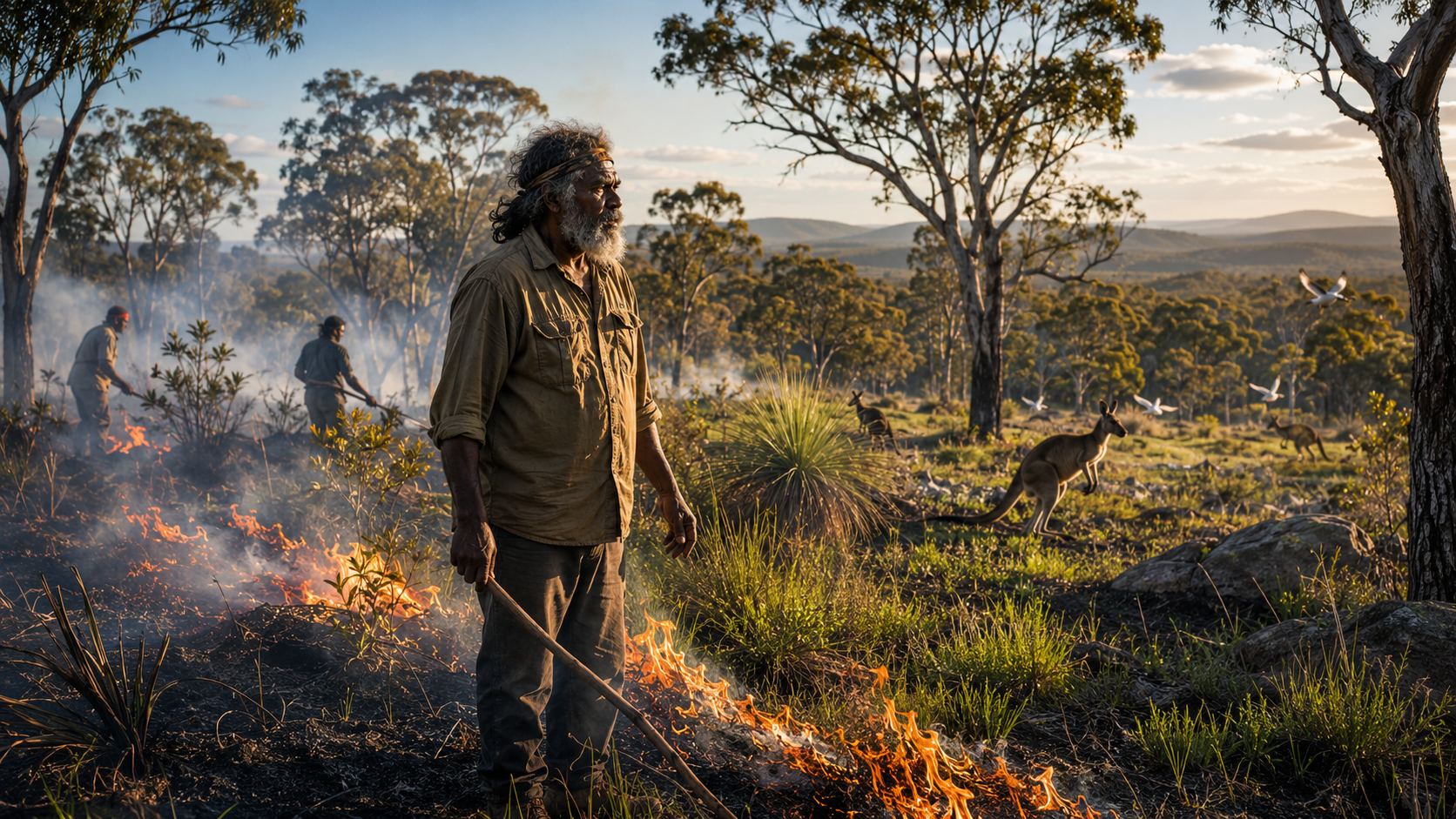
Modern people have a strange single-minded imagination about fire: fire is dangerous, fire is disaster, fire is something that needs to be extinguished. So whenever we hear "Indigenous peoples burning land," many of us react not with understanding but with tension: Is this destroying the environment? Is this air pollution? Isn't this backward?
This reaction is very modern and very confident; the problem is it may not understand the land.
For many Australian Indigenous cultural fire practices, fire is not a monster that can be set off at will, but a land technology that requires knowledge, timing, wind direction, terrain, plant condition, animal behavior, and elder norms to decide. Fire is not "burn whenever you want," it is "knowing when to invite fire out to work." That difference matters a lot. The former is destruction; the latter is ritual.
Cultural fire is most often understood by outsiders as "reducing disaster risk"—that is, through low-intensity burning, clearing excessive accumulation of dead branches and leaves and flammable shrubs, preventing them from becoming fuel for future out-of-control wildfires. That is certainly important, but if we stop there it remains too narrow. Because for Indigenous knowledge, fire is not just firefighting engineering; it is also ecological management, land cleanliness, reorganization of plant-animal relationships, and a system of human restraint over desire.
After burning, the ground does not simply turn black. The shrubland opens up, certain animals gain passage routes; dead plants return to the soil, new shoots begin to appear; overly dense grasses, insect eggs, pathogens, and decaying accumulations may also be reorganized. In Western scientific language this involves fuel load, pest control, nutrient cycling in soil, habitat heterogeneity, and biodiversity. In Indigenous language it is called letting the land breathe again, making the earth clean, redistributing life's positions.
Taiwan Indigenous peoples' mountain forest knowledge also has a similar perspective. Fire is not simply turning plants into fertilizer; it also involves concepts of "clean" versus "unclean." A clean earth is not abstract religious language; it can simultaneously be understood as clearing decay, killing germs and insect eggs, blocking certain bad odors and disease accumulations. That is to say, the "cleanliness" in traditional knowledge does not have to be translated into superstition to hold true; it may also encompass ecological, hygienic, psychological, and ancestral spirit order.
This is where Two-Eyed Seeing comes in. With one eye we see fire's temperature, fuel, humidity, wind speed, and disaster models; with the other eye we see fire's ritual, taboos, land ethics, and community responsibility. Only when both eyes look together do we know: what is truly dangerous is not fire but unregulated fire; what is truly backward is not traditional burning but believing modern firefighting systems can completely replace local knowledge.
The most terrifying thing is that modern states often first ban Indigenous peoples from using fire, then after disasters become severe use more brutal, higher-temperature, less understanding of local life cycles methods to "manage fire." This is a bit like kicking the teacher out of the classroom before asking why students won't learn. Many cultural fires are not unscientific; it is that science has not yet been humble enough to admit it came too late.
Of course, cultural fire cannot be romanticized. Not anyone walking into the forest with a lighter can claim to be a traditional knowledge practitioner. The core of cultural fire is not fire but regulation. Who may burn? Who must not burn? When to burn? How large? What animals seen require stopping? Which patches of land are off-limits? Which wind directions are forbidden? These questions constitute the knowledge. Unregulated fire is merely disaster; regulated fire can be ritual.
In Yuan Media AI's future discussions of natural phenomena, we should not only talk about "spectacles." Volcanoes, starry skies, forests, rivers, migratory birds, butterflies, coral reefs are not just natural landscapes but knowledge systems. Australian cultural fire lets us see: fire can be disaster or medicine; it can be destruction or cleanliness; it can be fear or a hand that cares for the land.
The most common mistake modern people make is thinking not touching the land means protecting it. Yet many landscapes called "natural" are actually results of long-term, restrained, taboo-laden human care. When this care is interrupted, shrubs thicken, fuel accumulates, animal routes disappear; what finally comes is not pure nature but catastrophe.
Therefore, fire is not the problem. The problem is who has lost the ritual of living with fire.
A society that truly understands fire will not only ask how to extinguish it, but also ask: do we still remember how fire once taught us to care for the earth humbly?
AI use and content-safety disclosure
This article was collaboratively organized by Yuan Media AI editorial workflow and published after human editorial verification; the main visual is an AI-generated concept image.