The Seven Sisters Are Not a Constellation but a Path That Moves: From Australian Songlines to Atayal Knowledge of Mars and the Etiquette of the Sky
Original Chinese title: 七姐妹不是星座,是一條會走路的路:從澳洲 Songlines 到泰雅火星的天空禮儀
The Seven Sisters are more than just the Pleiades; they are living cultural pathways. Indigenous astronomical knowledge transforms the starry sky into navigation, seasonal order and community memory.
全明正
Writer-director / 布農巒社
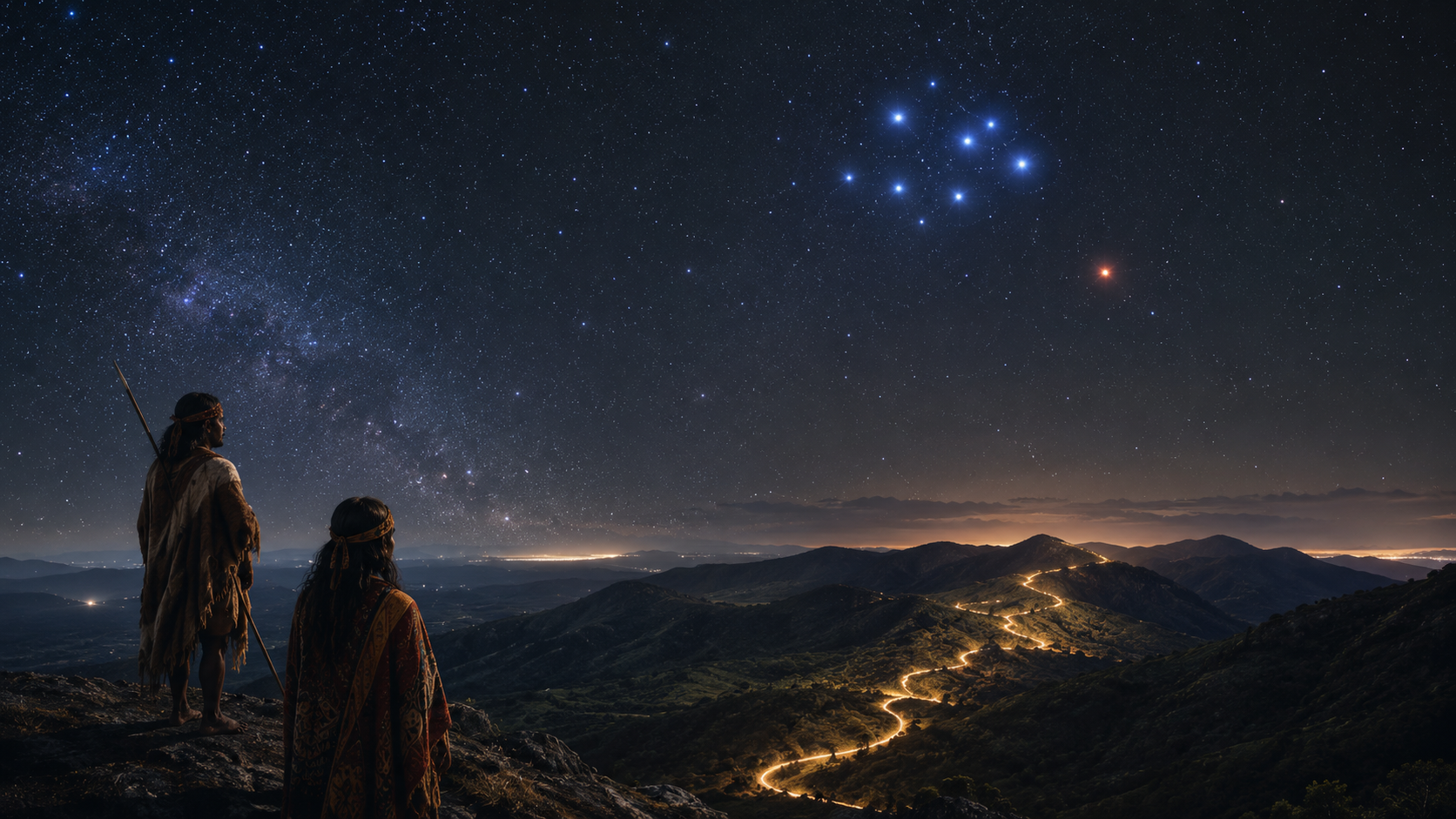
Modern people looking at the starry sky often first open an app. Pointing a smartphone at the sky, the screen immediately tells you: that's the Pleiades, that's Orion, that's Mars, that's Venus. Technology is convenient, but the problem is when smartphones name the sky for us, we often think we have already understood the sky.
But Indigenous astronomical knowledge reminds us: knowing what a star is called does not equal knowing what it does in life.
The Australian Indigenous Seven Sisters story is the best example. Western astronomy maps the Seven Sisters to Pleiades, that is, the Pleiades star cluster; but in many Indigenous peoples' Songlines of Australia, the Seven Sisters are not a set of bright spots marked on a star map, but a moving path, a sung-out map, a narrative linking sky, earth, gender norms, pursuit, escape, danger and taboos. Different peoples, different languages, different regions: the names and story details of the Seven Sisters are not entirely identical. Some public versions mention seven female ancestral spirits and pursuers; some versions involve deeper gender, ritual and taboo elements that are unsuitable for outsiders to casually retell as myth stories.
This point is very important. Because modern media loves to compress Indigenous cosmology into "beautiful legends." As long as there are stars, beautiful women, pursuit, ancient times, they can be put into tourism copy. But for knowledge holders, the Seven Sisters are not romantic material; they are living cultural pathways. A Songline is not just a song; it is a map; not just a myth; it is navigation; not just art; it is an institution that passes place memory to the next generation.
In other words, the Seven Sisters are not constellations only. They are "paths".
This can form good dialogue with Taiwan Indigenous peoples' astronomical knowledge. For example, observations by the Atayal people or other groups on Mars, the Big Red Star, seasonal star signs and weather omens should not be simplified into "old people's sayings." For past mountain forest societies, the sky was a timetable, an action prompt, also part of the taboo system. Stars appearing is not just an astronomical event; it may remind planting, hunting, migration, rituals or stopping to wait.
Western astronomy is certainly important. It can measure distance, spectrum, orbit and brightness changes. It tells us why Mars appears red, how far the Pleiades star cluster is from Earth, which star in Orion might dim. But Indigenous astronomical knowledge asks another set of questions: when does this star appear? Which animal activity is it related to? What seasonal transition does it remind? Can it become a path memory? Is its appearance taught together with certain taboos or stories?
This is the Two-Eyed Seeing perspective. With Western science eyes, stars are physical celestial bodies; with Indigenous knowledge eyes, stars are relational nodes. The two do not negate each other. On the contrary, when both are looked at together, we will know that the sky is both universe and textbook; both astronomy and ritual.
The most regrettable thing about modern education is teaching the sky too cleanly. Solar system, stars, nebulae, star clusters, constellations: classifications clear, exams convenient, but rarely tell students why humans look up at the sky. Ancient people did not look at stars out of boredom; it was because the sky was related to life. Stars determine direction, seasons determine food, astronomical phenomena determine action, stories determine memory. Peoples without writing may still have knowledge; they might write knowledge in songs, paths, mountain contours and night skies.
When we appreciate the Seven Sisters as "ancient legends," we easily ignore their underlying knowledge depth. They are not museum specimen story labels waiting for explanation; they remind us: the sky can become a knowledge repository, and this knowledge repository is not maintained by cloud servers but by songs, dances, travel, taboos, elder teaching and repeated memory.
Talking about astronomical phenomena in the AI era requires more caution. Today's models can quickly generate "Seven Sisters myth" summaries, mix stories of different peoples together to produce an article that looks complete but is actually offensive. Indigenous astronomical knowledge fears most not being forgotten, but being incorrectly published, beautifully misread, and unauthorizedly organized into a "World Myth Encyclopedia." Some knowledge can be shared; some only need to be touched briefly; some must return to the knowledge holders to decide.
Therefore, this article is not about crudely merging Australian Seven Sisters, Atayal Mars and ancient Chinese Big Red Star into one big pot. On the contrary, it reminds us: different civilizations have once taken the sky as a source of life order, but each set of astronomical knowledge has its own land, language and taboos.
We can compare, but not lazily mix. We can translate, but not pretend to possess. We can look up at stars, but remember that under the stars there are people guarding stories.
The Seven Sisters are not astronomy textbooks. They are paths in the sky. And truly those who understand paths never just know directions; they also know which places cannot be walked randomly.
AI use and content-safety disclosure
This article was collaboratively organized by the Yuan Media AI editorial process and published after human editorial verification; the main visual is an AI-generated concept image.