The Five-Section Reed Grows, and Its Name Grows: What Teacher 高德生 Taught Me About Tsou Etiquette
Original Chinese title: 五節芒會長大,名字也會長大:高德生老師教我的鄒族禮儀
Tsou mountain forest knowledge does not compress plants into efficacy lists, but understands how people enter the land through life stages, uses, taboos, and ritual relationships.
高德生
Tsou ritual ecology expert, hunter school instructor and cultural historian / author of 'The Tsou Book of Plants and Animals'
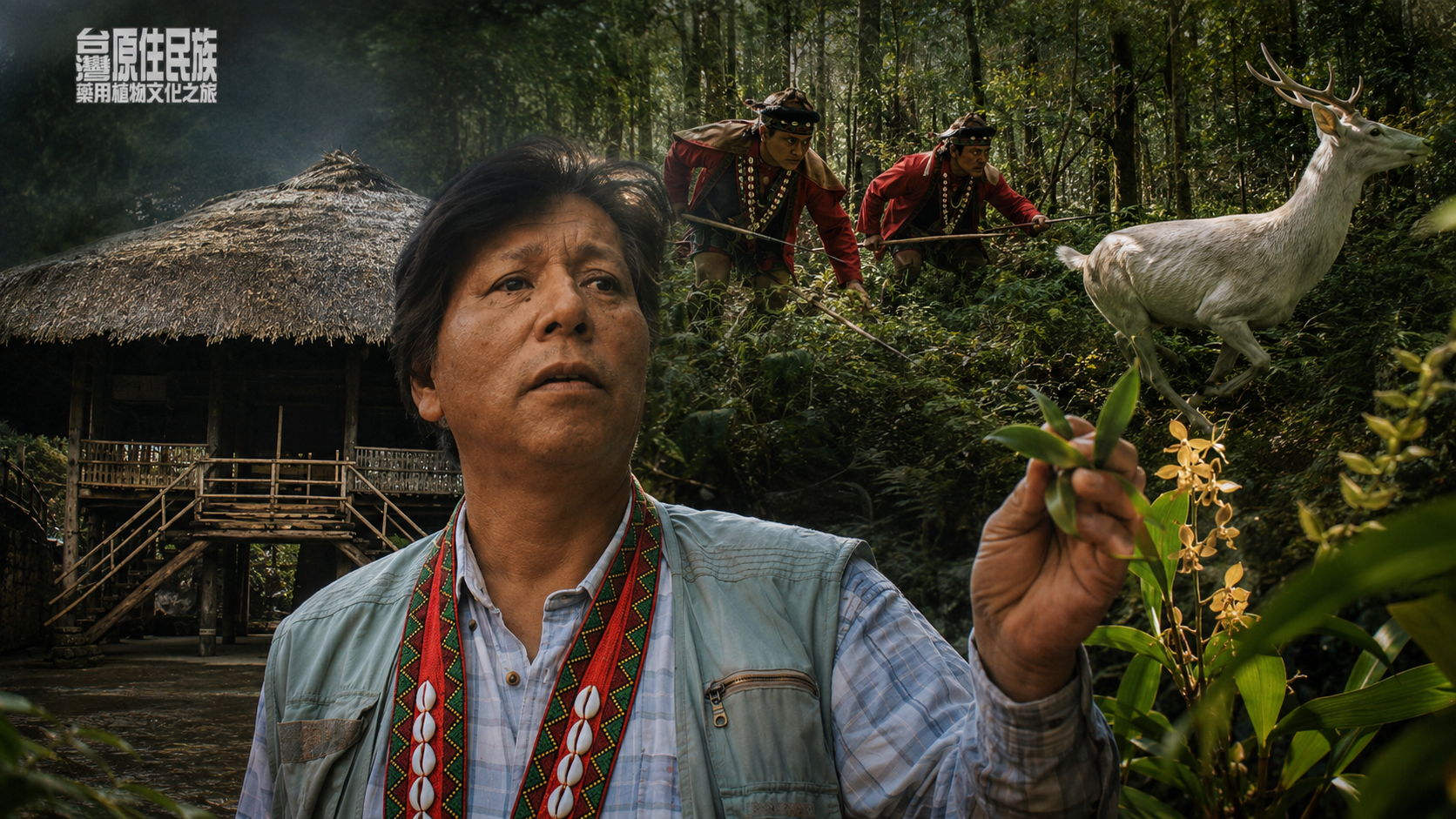
Some people talk about traditional medicine, and the first question they ask is: 'What can this herb cure?' When I hear such questions, I often feel sorry for the plants on the mountain. They have lived in the forest for hundreds of years, growing together with wind, soil, water, fire, animals, hunting trails, ancestors, taboos—yet once they enter a modern person's data table, they are immediately compressed into an 'efficacy column.' As if the sole purpose of a plant's existence is to wait for urban dwellers to ask whether it can stop bleeding, reduce fever, relieve pain, or fight inflammation. This is not knowledge organization; it resembles dragging an elder to fill out a resume.
What Teacher 高德生 taught me in the past was precisely not this 'herb supermarket' logic. When he talks about plants, he never talks only about plants; when he talks about animals, he does not treat them as illustrations in an ecology textbook; when he discusses rituals, he is not merely listing dates, steps, or songs. He speaks of how the entire Tsou mountain world operates: when one may enter the forest and when to stop; which plants are still young and which have matured enough to bear houses, torches, and ritual duties; which animal behaviors can be observed, and which ailments are not merely physical but signal a breakdown in relationships among body, family, land, and spirit.
What impressed me most was the five-section reed. To ordinary people, it is simply the five-section reed—perhaps with the addition of 'a common grass family plant'—and that's about all the knowledge one gets before the encyclopedia scroll passes over it. Yet Teacher Kao once mentioned that Tsou people have different names for the five-section reed at various growth stages: a smaller size has one name, a larger size another, and when fully grown and ready to be used for building houses, it enters yet another identity; after drying, it becomes wood or torch material, acquiring new names.
What is most precious here is not just a few Indigenous language terms, but a classification philosophy. Mainstream knowledge often asks: 'What species is it?' Tsou mountain forest knowledge also follows up with: 'At what life stage is it now? What can it do? Who is suitable to use it? In which occasions may it be used? If misused, will it offend the mountain order?' In other words, the five-section reed is not named once and done; its name evolves continuously with its life stages, uses, and social positions. Plants grow, and names also grow; as names grow, knowledge gains temporal depth.
This is where Tsou ritual ecology becomes most fascinating. It does not place rituals in a cultural showcase nor ecology on a scientific display board; it weaves them together. The war ritual Mayasvi is not merely song, dance, and costume; the Kuba is not just a background building in tourist photos; rather, it is an institutional system through which the tribal community confirms courage, order, male age responsibilities, ancestral relationships, and mountain boundaries. Millet festivals, planting rituals, hunting trails, rivers, plants, animals, mountain gods, and family memories are not scattered chapters but a fine-grained web. Outsiders who take only 'beautiful ceremonies' without understanding that web are like stealing spider silk while claiming to comprehend the forest.
Traditional medicine is similar. Tsou medical knowledge cannot be crudely judged with a binary effective/ineffective rubric. Of course, when the body goes wrong, modern medicine must be consulted—dental pain requires a dentist, infections require a physician; there is nothing romantic about this. Yet if one therefore dismisses all traditional medicine as superstition, that is another form of laziness. Modern medicine excels at bacteria, nerves, tissues, pharmacology, and pathology; traditional medicine often simultaneously attends to pain sensations, omens, taboos, spirit realms, family relationships, and land order. The two are not about one eliminating the other but whether either has humility enough to admit: the body is not merely organs; it also lives within a cultural cosmos.
Take 'catching tooth worms' as an example. If one mocks such statements solely with modern dental language, one easily gains cheap superiority. The problem is that cheap superiority rarely cures illness nor fosters knowledge. For traditional societies, toothache is not an isolated physiological event; it may be understood as some kind of intrusion, blockage, imbalance, or relational anomaly. 'Catching' is not just a motion but also a therapeutic narrative that concretizes invisible pain and invites the ailment out of the body. Modern people may disagree with its etiological explanation but should not rush to mock its worldview. Often what is mocked is not error but a classification system we have yet to comprehend.
Teacher Kao has also spoken about many plants' relationship with warding off evil spirits. If these contents are written as 'certain plants ward off evil, certain plants drive away spirits,' it becomes too shallow. What truly matters: why can some plants be placed on the body, hung in specific locations, or appear before rituals and actions? Their function is not merely 'efficacy' but boundary markers. They tell people: you are crossing a field; entering the forest is not shopping, hunting is not sport, ritual is not performance, illness is not only treatable with painkillers. Plants here act like a door, a pass, or a reminder: you are not the master of the world; you are merely someone temporarily permitted to pass through.
Animals too are teachers. Monkeys know certain plants, wild boars know certain trails, birds' appearances may alter human actions, snakes' movements may prompt people to reassess places. These are not fairy tales but ecological wisdom formed from long-term observation. Unfortunately, modern education often turns animals into vocabulary items on exams, plants into Latin names on specimens, and rituals into cultural week performances. Children thus know many answers yet do not necessarily know when to be quiet; they know many classifications yet do not necessarily understand the responsibilities behind them.
The Tsou macroscopic vision lies in its refusal to view nature as a material warehouse: mountains are not resources, streams are not water volumes, animals are not prey, plants are not medicines, rituals are not events. In the Tsou cosmos these things interconnect: millet drives annual cycles, war rituals drive communal spirit, Kuba drives politics and ethics, hunting trails drive animal behavior, plants drive medicine and warding off evil, taboos drive whether people know restraint. Mainstream society likes to slice knowledge into subjects; Tsou traditional knowledge reminds us that the world is not originally divided—it was chopped up for convenience. Chop long enough, and people mistake fragments for truth.
If today one wishes to discuss Teacher 高德生's contributions, I would not merely say how many herb medicines he preserved nor label him as a ritual executor, hunter school instructor, or cultural historian. All are correct but insufficient. More importantly, he demonstrated a kind of 'mountain reasoning': from the growth stage of a single grass, one sees time; from a plant's use, one sees taboos; from an animal's behavior, one sees teaching; from a war ritual, one sees how an entire tribe reconfirms its communal identity.
In the AI era, such knowledge is especially precious and especially dangerous. Precious because it can help us re-understand ecology, medicine, education, and cultural sovereignty; dangerous because without gatekeepers like Teacher Kao, AI will quickly organize Tsou knowledge into beautiful errors. Then models will fluently tell you that certain plants cure certain illnesses, taboos represent certain symbols, rituals have certain functions. Sentences flow smoothly, souls remain empty—like placing war rituals in presentation templates, turning Kuba into tourist filters, flattening the five-section reed's life stages into a single column. Technically efficient, culturally deeply disrespectful.
Thus this article is not an encyclopedia summary of Tsou traditional medicine but aims to remind: true Tsou ritual ecology does not lie in memorizing several herb names, ritual names, or taboo names; it lies in whether one understands that relational system. What Teacher 高德生 taught me was not merely 'what exists in the mountains,' but 'what kind of person one should become after entering the mountains.'
A mountain-savvy person does not rush to collect. A medicine-savvy person does not rush to prescribe. A ritual-savvy person does not rush to photograph. A Tsou-world-savvy person first learns to stop.
For the forest, what is most feared is not those who do not understand. What is most feared are half-understanding people: carrying notebooks, cameras, AI tools, and a face saying 'I will save your culture,' cutting up the cosmos as they walk.
True preservation is not taking knowledge away. True preservation is allowing someone like Teacher 高德生 to continue having the right to decide what may be said, how it may be said, who it may be told, and which matters should remain in the mountain wind.
AI use and content-safety disclosure
This article is based on interviews with Teacher 高德生, compiled by Aciang Iku-Silan; the main visual uses images specified by the client.