Deep Space Memory Project Part I: The Voyagers Are Running Out of Power—What Sounds Do Humans Want to Leave in the Universe?
Original Chinese title: 深空記憶計畫之一:旅行者號快沒電了,人類還想把什麼聲音留在宇宙?
Launched in 1977, Voyager 1 and 2 were originally missions to explore exoplanets beyond our solar system, but they have unexpectedly become humanity's most distant time capsule. Now, as the Voyagers' power wanes year by year, NASA must turn off some scientific instruments—like unplugging one lamp after another from an old warrior. This is not just a space news story; it is a question of civilization: when AI is generating vast amounts of sound, image and memory, what do humans truly want to leave for the universe? Data or soul?
Lawrence Lee
Technology journalist, science fiction critic, and space science educator.
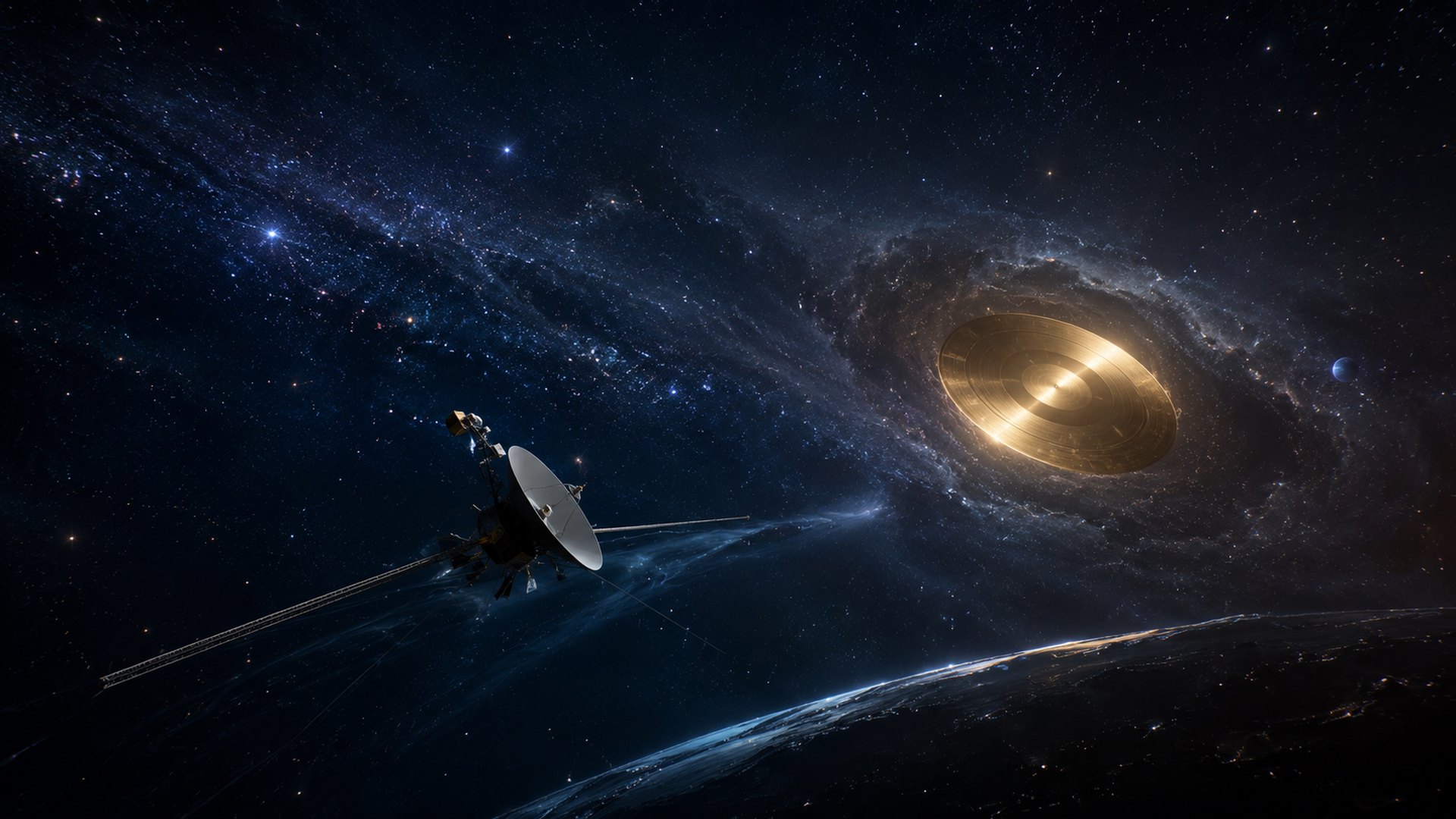
The Voyagers are running out of power.
That sentence sounds like a piece of technology news; in reality, it is more like the opening line of an obituary for civilization. Only this obituary is written very slowly—so slowly that it takes nearly half a century before its first word appears.
In 1977, Voyager 1 and 2 left Earth. There were no smartphones, no social media platforms, and no generative AI at the time. Humans still imagined the world through magnetic tapes, vinyl records, television news, and printed encyclopedias. As a result, a pair of machines designed to visit outer planets ended up becoming humanity's farthest postmen.
They carried the Golden Record. Not Spotify, not cloud storage, not short-video backups. It was a real record containing Earth sounds, music, greetings, image codes, and a kind of almost naive cosmic courtesy: Hello, we are from Earth. Here there are waves, heartbeats, baby cries, music, languages, mathematics, some science, and a lot of unselfconscious self-congratulation.
Looking back today, the Golden Record seems like a long letter humans wrote to themselves before internet addiction took hold. It contains no algorithmic recommendations, no traffic passwords, and no headlines designed to capture an alien's attention in three seconds. Its scale is measured in tens of thousands of years—fourty thousand, one hundred thousand, or even longer. Such a sense of time would be intolerably low conversion rate for modern platforms.
But the Voyagers are aging.
RTG nuclear batteries are not myths. They generate electricity from heat produced by radioactive isotopes decaying. They are stable and resilient, ideal for deep space, yet they inevitably degrade. With each loss of power, engineers must make a cruel choice: which instrument stays awake? Which one goes to sleep first? Science is not always a palace where lights stay on forever; sometimes it resembles an Indigenous community activity center during typhoon night—the generator runs out of fuel, and everyone begins discussing whether to turn off the air conditioning, corridor lights, or the last lamp illuminating the elders.
NASA's latest mission status page shows that both Voyager 1 and 2 have entered interstellar space; meanwhile, several instruments have been turned off for power saving or performance degradation. This is not failure; it is the most honest physics of deep-space missions: even the greatest civilizations must face battery percentages.
What makes the Voyagers most moving is not their high technology but their low-tech persistence over so long a time.
The contemporary AI world is just the opposite. We have massive data centers, real-time generation, billions of parameters, and file systems that resemble human memory more than actual memory. Yet our preservation times are short. Platforms collapse, formats change, accounts lock, APIs disappear—a digital city becomes like an exhibition on a beach, washed away by the next wave of commercial tides.
The Golden Record reminds us: civilization's real question is not whether we can generate, but whether it is worth leaving behind.
If we were to remake a Golden Record for the universe today, what would we include? Global hit songs? Millions of AI-generated human faces? High-resolution Earth images? Speeches by world leaders? Or simply an honest instruction manual: Dear unknown civilization, we are clever but not necessarily mature; we can send machines beyond our solar system and turn our oceans into chemical soups; we invented AI to preserve knowledge while also using it to produce junk content; we search for extraterrestrial life while letting Earth languages vanish rapidly.
This brings us to the question Yuan Media AI should most pursue: if one day we were to include Indigenous Peoples' sounds from Taiwan in deep space, would that be glory or another form of colonial display?
Many would excitedly say we should send Indigenous language, ancient songs, rituals, and myths into space so the universe knows humanity's diversity. That sounds beautiful but also dangerous. Not all sounds can be made public; not all stories can leave their land; not all ancestral memories are suitable to be packaged as 'shared human material.' The Golden Record's cosmic romance must hit the brakes when it meets Indigenous knowledge governance.
AI is the same. When we say we want to preserve languages, songs, dreams, and rituals, we cannot ask only whether technology can do it; we must also ask who consents, who controls, who benefits, and who has the right to refuse. Otherwise deep-space archives become just another form of advanced collection. Previously specimens were collected for museums; now sounds are collected for clouds; previously labels read 'Indigenous community artifacts'; now they say 'minority language dataset.' Colonialism changed its hard drive but kept the same face.
The Voyagers are running out of power, yet the questions they leave behind have just begun to shine.
Perhaps civilization's final proof is not in data volume but in restraint. Which sounds should not be taken? Which knowledge can only be spoken at certain seasons, among specific groups, on particular lands? Which silences themselves constitute a right? The universe is vast, but not everything needs to be sent there.
The Voyager continues flying through darkness. It does not understand traffic metrics, will not update, will not post tweets, and will not go live-streaming sales. It simply carries a Golden Record, slowly leaving the solar wind's boundary. This slowness seems almost sacred in our age that rushes to turn everything into content.
If Yuan Media AI undertakes a 'Deep Space Memory Project,' its first piece should not rush to praise technology but ask: when AI can preserve everything for humans, do we still have wisdom to know what cannot be preserved? What cannot be made public? What cannot be outsourced to machines?
The Voyager's power will run out. The Golden Record may never be played by any life. But it has accomplished one thing: it forces us to admit that humanity's most precious is not the signal itself, but the ethics of choosing which signals to send.
In darkness, that old machine still flies. On Earth, we are still learning how to speak.
Further Reading and Sources
NASA Voyager Mission; NASA's "Where Are Voyager 1 and Voyager 2 Now?" mission-status page; and the NASA Voyager Golden Record overview. This article is commentary and a public-science narrative; mission details should still be checked against the latest NASA/JPL information before publication.
AI use and content-safety disclosure
This article was compiled and edited through Yuan Media AI's editorial workflow.