Who Passes Through the Air? eDNA, Wildlife Monitoring and the Invisible List of Life
Original Chinese title: 空氣裡有誰經過?eDNA、野生動物監測與看不見的生命名單
Wildlife doesn't always show itself to people, but it leaves traces. Skin flakes, hair, excrement, pollen, mucus, even microscopic DNA in the air can become a biological list. Environmental DNA is changing ecological surveys: scientists no longer just go into forests looking for animals; they can also read life that has been present from water, soil, snow and air filters. This technology is fascinating, and it reminds us: when nature becomes detectable, who has the right to read these signals of life?
山海資料庫筆記
Notes from the Mountains, Seas and Ecosystems Data Repository of Yuan Media AI, focusing on translation between local knowledge, natural monitoring and public science.
Previously we thought that being seen meant existing.
Whether there are wild boars in the forest depends on footprints, scat, camera traps; whether fish swim in streams requires long-term observation; whether frogs exist at night relies on ears; whether migratory birds fly overhead needs telescopes and patience. Ecological surveying is a hard discipline: researchers get sunburned, bitten, slip, lose their way, and then return to face statistical software. The romance of ecologists most often smells like sweat, insect repellent and damp socks.
But now life begins leaving lists in places we cannot see.
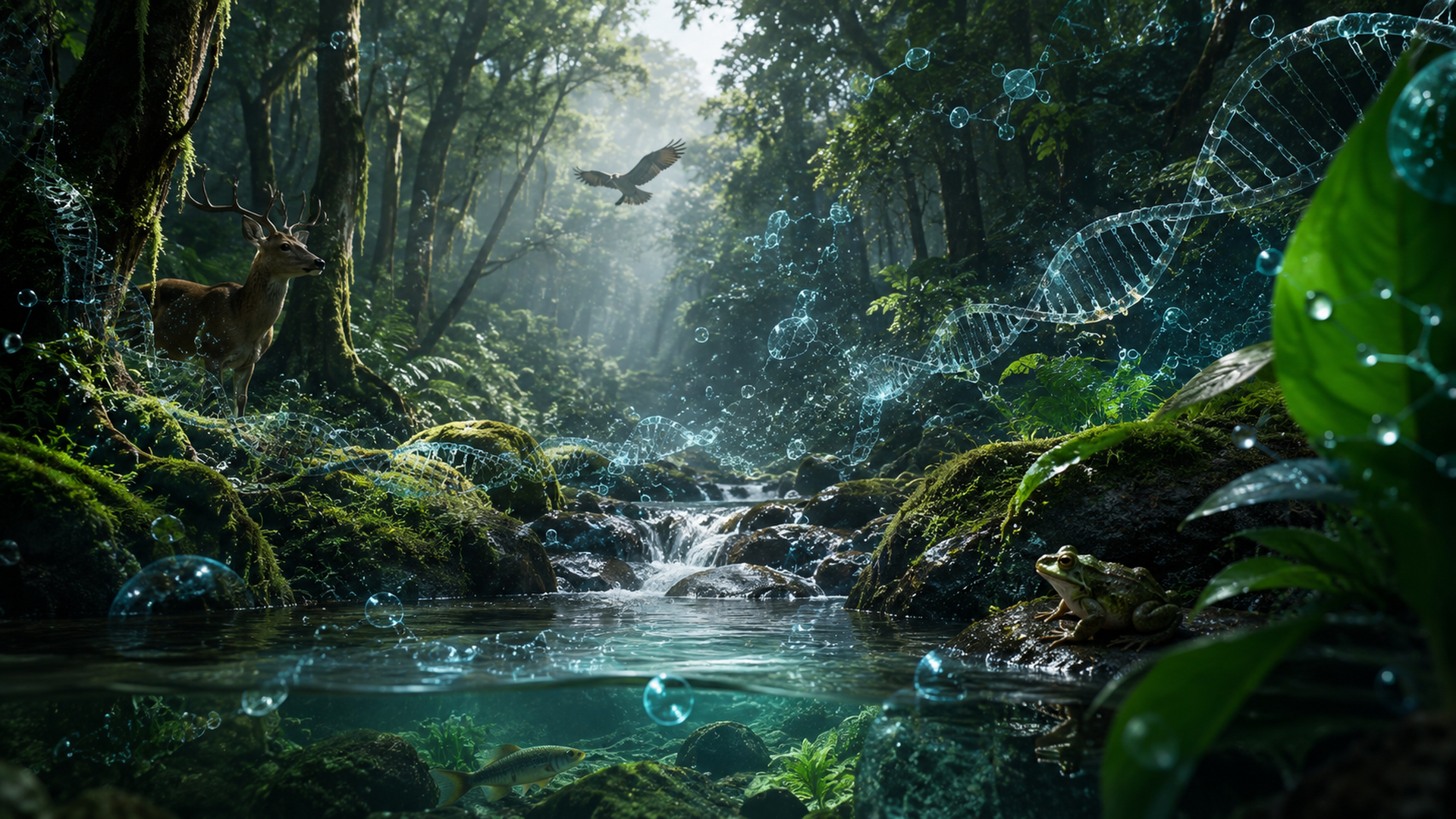
Environmental DNA, abbreviated eDNA, refers to genetic material left by organisms in the environment. Fish swimming through water leave skin cells and mucus; animals walking over soil leave hair, excrement, saliva; plants release pollen; insects, birds, mammals and microbes all leave tiny traces in the environment. Scientists collect water, soil, sediment, snow, even air, then analyze them with molecular techniques to determine which life forms have been present.
This sounds like natural surveillance. What is heard are not human meetings but those neighbours who usually do not wish to show their faces.
The most fascinating aspect of environmental DNA is that it makes "not being seen" no longer equal to "not existing." Many endangered, rare, nocturnal or hard-to-capture species cannot be fully understood through traditional surveys. Camera traps may miss them; researchers may miss the season; underwater visibility may be poor; forests have a thousand ways to make humans admit they are not the main actors. eDNA provides another entry point: one does not need to see the animal itself, only read its signals.
This matters greatly for conservation. Whether a certain fish still exists in a stream, whether a particular amphibian remains in a wetland, or whether an invasive species has quietly arrived — eDNA may provide early warning. It can also reduce disturbance to ecosystems; there is no need always to capture, mark and move organisms. For some fragile habitats, less human enthusiasm itself constitutes protection.
Recent research has turned attention toward air. Air quality monitoring filters originally used to track pollutants may also preserve tiny clues about surrounding life. In other words, a single filter might not only tell us whether the air is dirty but also which plants are flowering and which insects or animals have been nearby. Nature signs in quietly; the attendance book is so small it requires a laboratory to read.
But new technology always raises an old question: who will use it? For what purpose?
When life signals become collectible, nature enters the world of data governance. Which rare plants exist in a certain mountain forest? Are there special fish species in a particular stream? Do caves contain unique microbes? If this information is made public, it may help conservation but also attract tourism pressure and land stress. Data are not neutral. Especially ecological data, once linked to locations, can become temptations on maps.
For Indigenous Peoples' lands, this issue is even more sensitive.
The hunting grounds, gathering sites, streams, sacred places and ecological knowledge of Indigenous communities are often not simply "natural resources." They are part of history, kinship relations, taboos, seasons, responsibilities and the order of life. If external researchers enter tribal territories with sampling bottles, treating them merely as scientific samples without addressing consent, feedback, data control and community interests, then even advanced technology may reproduce very old patterns of extraction.
Collecting plant specimens in the past; now collecting DNA samples. Returning to museums before; uploading to databases now. Tools have become lighter, but ethics do not necessarily become heavier.
This is why Yuan Media AI should place eDNA within discussions of "Two-Eyed Seeing." On one hand, we need science. Facing climate change, habitat fragmentation, invasive species, disease and development pressure, traditional observation and modern molecular techniques can complement each other. Tribal elders know when certain birds no longer appear; hunters know how animal paths have changed; gatherers know seasonal anomalies in plants; eDNA provides another layer of evidence that makes policy harder to pretend it is asleep.
On the other hand, we also need governance. eDNA is not a magic wand and should not become a pass for external institutions to enter lands. Clear communication must precede sampling; data must be classified; sensitive locations cannot be freely disclosed; research results must return to communities; benefits and risks must be explained clearly. Otherwise "conservation" may again become pretty packaging containing the same power imbalances.
More interestingly, eDNA also changes our philosophical imagination of "existence."
An animal not in camera frames leaves traces in water; a plant unphotographed leaves pollen and DNA in air; an ecosystem surface quiet but at molecular level bustling like a market. This reminds us that human senses are too limited. Not being seen does not mean non-existence; not being heard does not mean silence; not being recorded in databases does not mean non-existence.
The same applies to culture.
Much Indigenous knowledge has also been regarded by mainstream society as "without evidence." No written records, so no history; no land deeds, so no territory; no academic papers, so no knowledge. Now eDNA tells the scientific community that the world is full of invisible yet real signals. Should mainstream knowledge systems then humbly acknowledge: not all truths will first grow into evidence formats familiar to you?
Of course, eDNA also has limitations. It may be contaminated; it may be difficult to determine organism abundance; it may not distinguish whether DNA was freshly deposited or brought by water flow. Scientific tools are not crystal balls. Treating eDNA results as absolute answers is like treating AI summaries as doctoral theses: convenient, but disasters are also convenient.
The best way to use them is to embed them in a multi-evidence system: traditional ecological knowledge, long-term field observation, camera traps, acoustic monitoring, satellite data, environmental DNA, and everyday experiences of local communities. This is true Two-Eyed Seeing — not treating tribal knowledge as an opening remark while the laboratory speaks throughout.
Who passes through the air? That is a scientific question. Who has the right to know, preserve and use this answer? That is a civilizational question.
Further Reading and Sources
Research on environmental DNA and biodiversity monitoring using air filters; public science reports from UCL/York; recent literature on DNA-based biodiversity monitoring. If tribal hunting grounds, gathering sites or sensitive ecological locations are involved, published data should avoid disclosing precise positions.
AI use and content-safety disclosure
This article has been compiled and edited through the Yuan Media AI editorial process.