Don't Treat the Seabed as the Next Open-Pit Mine: Deep-Sea Mining, Rare-Earth Anxiety, and the Invisible Ecological Costs
Original Chinese title: 不要把海底當成下一座露天礦場:深海採礦、稀土焦慮與看不見的生態代價
Energy transition needs batteries; AI needs chips; chips and batteries need minerals. So humanity quickly turned its gaze from mountains to the seabed, as if minerals lying on the ocean floor somehow posed fewer moral problems. Controversy over seabed mineral development is rising: proponents say it's critical mineral supply, opponents call it a high-stakes gamble with unknown ecosystems. The issue isn't just whether to extract—it's who has the right to turn 'the common heritage of mankind' into the next resource list.
原傳媒 AI 編輯室、李文驤
Yuan Media AI Editorial Desk; co-author: 李文驤 / Geography teacher at Catholic Daren High School.
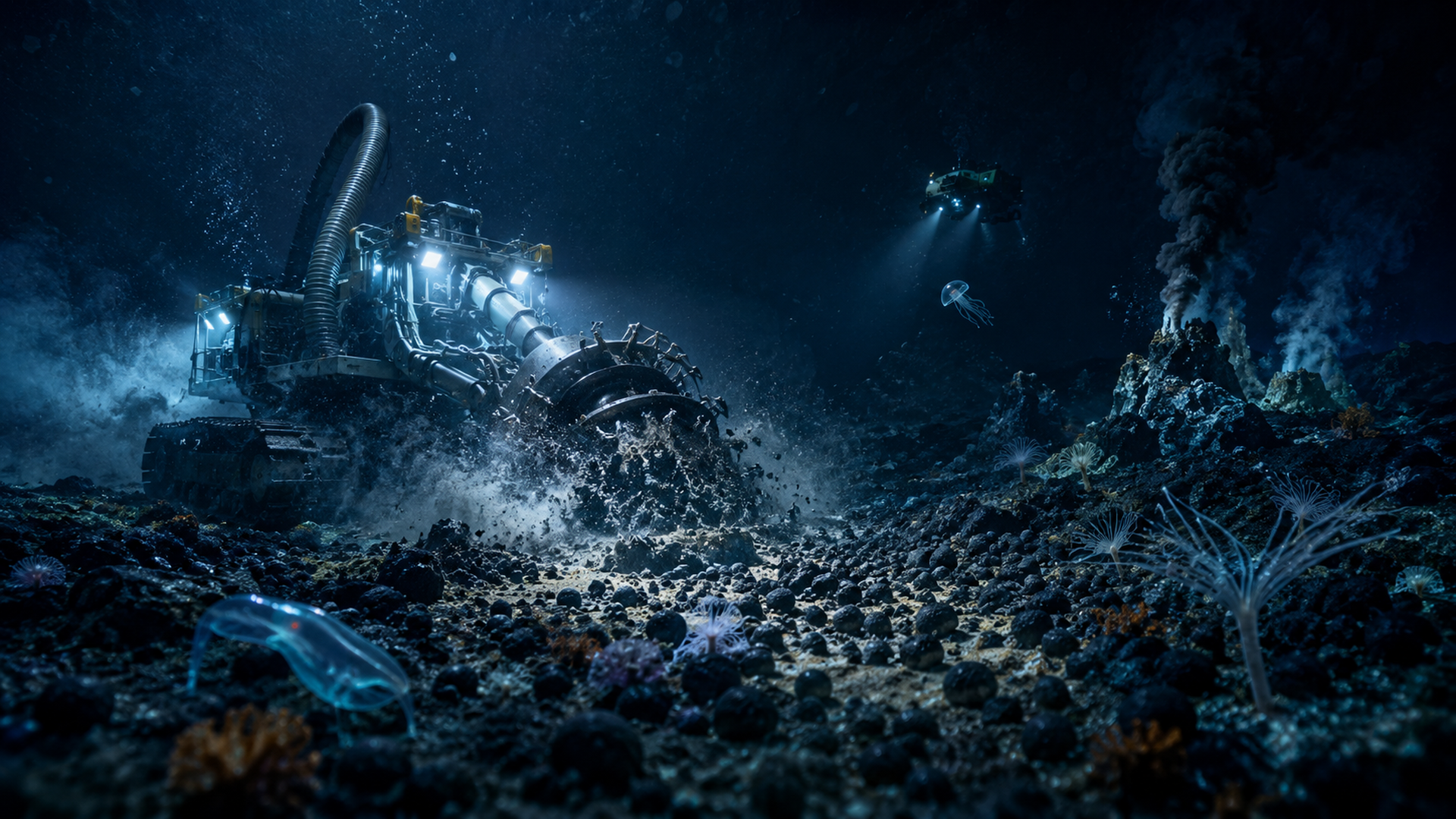
Deep-sea mining sounds like future technology, but it's more like an upgraded version of ancient human habits: when land resources run tight, we look at the seabed; when forests are in trouble, we say the ocean is vast; once shallow waters have been argued over, machines go down to several thousand meters because there are no voters, no cameras, and no protest banners—only organisms that don't know how to hold press conferences.
This is precisely where this controversy becomes most dangerous. It's not that there is no life; it's that the life doesn't know how to defend itself.
Polymetallic nodules are often described as "potatoes" lying on the seabed. The metaphor is cute and terrifying at once. As soon as humanity names something like an agricultural product, we forget more easily what ecosystem it belongs to. These nodules contain manganese, nickel, cobalt, copper, and other metals that happen to match the appetites of batteries, electronics, energy systems, and infrastructure. So the seabed transforms from a mysterious world into a supply-chain spreadsheet, from a living habitat into a mineral list.
Modern civilization is best at this trick: first turn the world into numbers, then claim we're merely managing those numbers.
Proponents have a complete argument. Energy transition needs batteries; batteries need metals. Electric vehicles must run, wind farms must be built, AI data centers must operate, and semiconductor supply chains must remain stable. Since land-based mining causes forest destruction, labor exploitation, and community conflict, seabed minerals seem to offer another path. This line of reasoning sounds rational, even morally superior: we're not doing this out of greed; we're doing it for a green future.
But the phrase "for the future" is often the most expensive fig leaf.
The seabed is not a warehouse. It's a high-pressure, low-temperature, dark, slowly forming life system. Many seabed species grow and reproduce at rhythms far slower than human industrial cycles. For capital markets, ten years is an investment payback period; for seabed life, ten years might be just a tiny change in sediment. When large machines operate on the sea floor, they don't merely take stones—they can stir up sediment clouds, destroy microhabitats, disrupt acoustic environments, and trigger chain reactions we haven't yet understood.
The horror isn't that we know how much damage it will cause; it's that we don't know what we don't know.
That sentence sounds philosophical but is actually the most basic humility in public policy. Ocean science is still developing, and human understanding of seabed biodiversity remains limited. Investing commercially before knowledge is adequate is like signing a contract first and then slowly filling out an ecology textbook. This sequence is familiar: build first, dig first, sell first, pollute first; later establish committees, write white papers, hold workshops. In the end everyone is busy, but only the scraped sea floor remains as quiet as an accident scene.
The bigger issue is governance.
Seabed beyond national jurisdiction is often called "the common heritage of mankind." That phrase was meant to remind us of shared responsibility; now it's easily swapped for shared resources. The common heritage isn't a joint ATM. If benefits are captured by a few corporations and powerful states while risks fall on marine ecosystems, future generations, and coastal communities, then it's not the common heritage—it's being collectively talked down.
Pacific island nations and ocean peoples face particular circumstances worth noting. Many potential development zones are highly correlated with Pacific politics, economies, and environmental fates. The outside world often views the ocean as a transit route, resource zone, or military buffer; for ocean peoples it is not empty but part of kinship, roads, memory, food, and cosmic order. When international conferences slice the seabed into contract blocks, that map language itself narrows the ocean.
Yuan Media AI can raise here the question of "Two-Eyed Seeing": seabed mineral governance should not be merely an engineering or economic issue but also a knowledge-institutional one. Scientific surveys provide data on species, sediments, noise, and toxicity; marine cultures provide ethical frameworks for human–sea relationships. The former asks whether we can extract; the latter asks why we think the seabed is just waiting to be extracted. Both questions matter, but the second is often pushed to after-tea conversations.
The black humor is that humanity might generate whale illustrations with AI while industrial noise alters real cetacean soundscapes; publish blue ocean covers in corporate sustainability reports while turning the seabed into the next open-pit development zone. The more polished the sustainability brief, the less voice the seabed has.
This doesn't mean all mineral demands can be cancelled immediately. Energy transition does need materials; modern medicine, communications, disaster preparedness, and public infrastructure cannot return to the Stone Age. The question is: are these truly needs, or are they amplified by waste, overconsumption, and short-lived product design? Have we pushed recycling, alternative materials, extended product lifespans, supply-chain transparency, and consumption reduction to their limits? If not, the seabed isn't a last resort—it's a lazy civilization finding a new excuse.
True civilization doesn't find deeper places to extract; it knows where not to touch.
The darkness of the seabed is not emptiness but another order of life. It does not exist for human anxiety. AI needs electricity, batteries need minerals, industries need growth—these are real pressures. But the seabed is also real. It just won't send a registered letter, appear on TV, or post on social media saying "do not disturb."
So let us speak its simplest truth: before we truly understand it, don't rush to turn it into the next resource zone.
Further Reading and Sources
International Seabed Authority related materials, background documents on the United Nations Convention on the Law of the Sea, and recent public reporting on seabed minerals and marine conservation. This article is a public commentary; commercial rules and international negotiation progress must still be verified against the latest ISA and UN documents before release.
AI use and content-safety disclosure
This article was compiled and edited through Yuan Media AI's editorial workflow.