Cultural Burning Is Not Arson: When AI Wildfire Alerts Meet Indigenous 'Good Fire' Knowledge
Original Chinese title: 文化燃燒不是放火:當 AI 野火預警遇見原住民的「好火」知識
AI can quickly detect fire points and predict wildfire risk, but it may not distinguish between disaster fires and cultural burning that cares for the land. True disaster preparedness wisdom requires satellite data and local knowledge to work together.
山海資料庫筆記
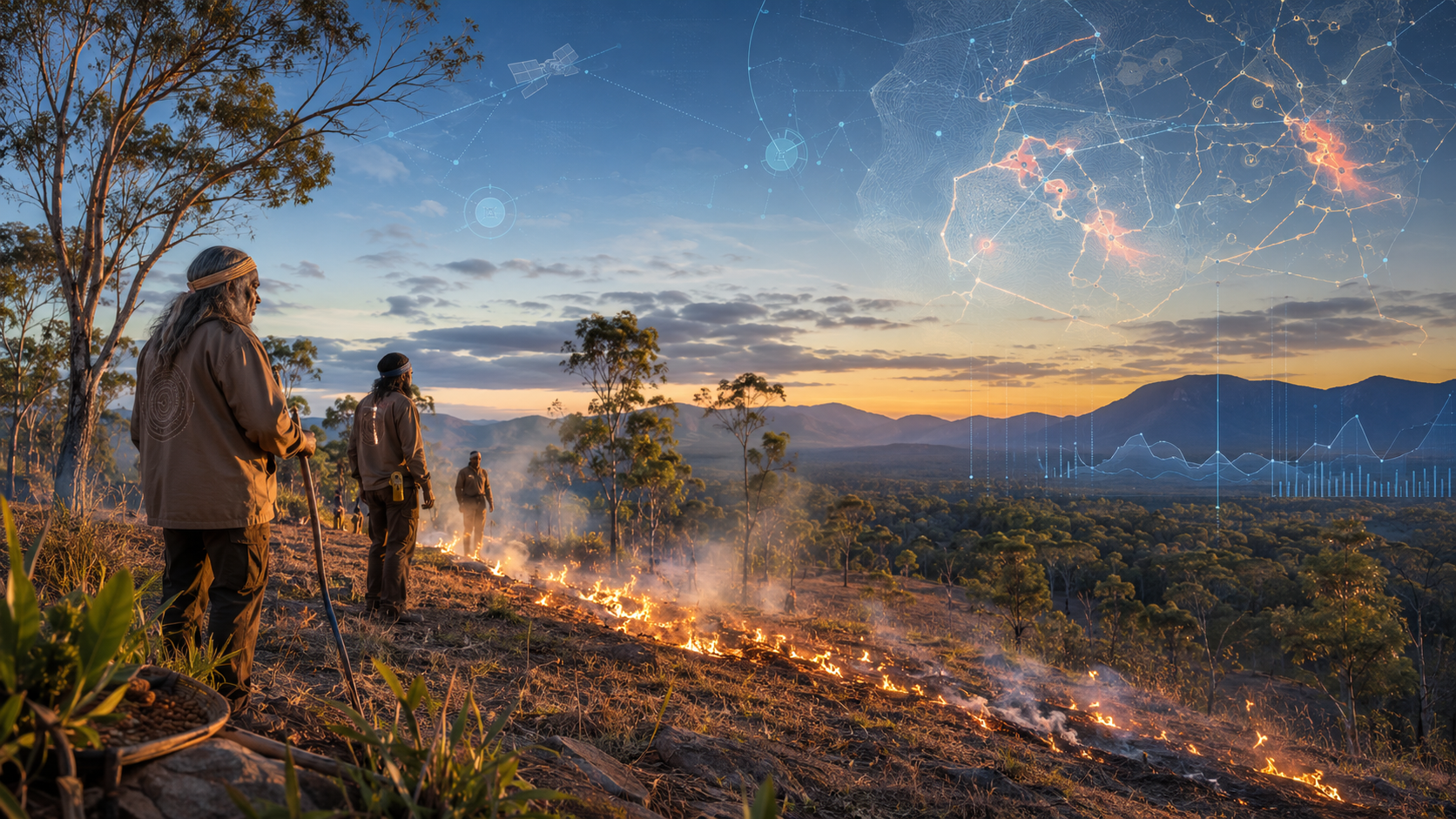
A satellite detects a hotspot in the night sky, and an AI system immediately marks it as a 'suspected wildfire.' But for cultural practitioners on the ground, that may be a low-intensity burn conducted through observation, agreement, and preparation: fire moving slowly along moist boundaries, clearing dead grass, and allowing certain plants to sprout again. Both sides see the same hotspot, but understand two completely different land relationships.
Wildfire AI Sees What
Extreme heat, drought, and strong winds are raising global wildfire risk. Recent disaster preparedness systems heavily use satellite imagery, infrared sensors, lightning data, terrain, wind speed, fuel moisture, and historical fire records. Machine learning can help identify smoke and thermal anomalies, predict fire spread direction, and prioritize limited firefighting resources to high-risk areas. For vast regions with difficult communications, detecting a fire just minutes earlier could change evacuation outcomes.
However, model classification often only distinguishes 'fire' from 'no fire,' or 'safe' from 'dangerous.' It can detect temperature but may not know why the fire started, who manages it, or what season the land needs it. If training data comes mainly from catastrophic wildfires, the system will naturally treat all burning as abnormal. This technical blind spot, once connected to law enforcement, insurance, or land regulation, could misclassify Indigenous care practices as violations.
'Good Fire' Is a Relational Knowledge System
Cultural burning is not random arson, nor is it simply modern disaster prevention's reduction of fuel. It may simultaneously serve food gathering, hunting, medicinal plants, weaving materials, animal habitats, ceremonies, and community education. Practitioners must judge soil moisture, wind direction, slope, plant life cycles, and neighboring landscapes, as well as know which places cannot be burned, which seasons are unsuitable, and who has responsibility to participate.
These details resist compression into a fixed operations table. The same fire can have different meanings at different elevations, vegetation types, seasons, and community purposes. Low-temperature, slow, ground-hugging fires may form discontinuous burn patches that preserve animal hiding spaces and promote plant regeneration; high-temperature, out-of-control wildfires may destroy tree crowns, soil, and settlements. Marking both as 'anthropogenic fire sources' erases the most important difference.
Colonial governance long promoted total fire suppression and also banned or punished Indigenous peoples for using fire. The result was not only interrupted cultural practice but also continued accumulation of shrubs, leaf litter, and dead wood in some regions, making later fires more intense. Recent research and policy discussions in Canada, Australia, and the western United States are re-examining Indigenous-led fire management; however, 're-adopting' must not become a new form where governments or corporations extract technology while excluding knowledge holders.
Making AI a Community-Correctable Tool
Truly advanced wildfire AI should not only improve detection accuracy but also express uncertainty and cultural context. Systems can incorporate culturally burning areas, times, and purposes agreed upon by communities, so authorized practices are not treated as unknown threats; they can also feed satellite observations back to ground teams for correction by people familiar with the land regarding fire behavior, fuel conditions, and ecological changes. Data should be governed jointly by communities, with sensitive locations and cultural information not fully public.
Two-Eyed Seeing here is not splitting science and tradition half-and-half but allowing both methods to check each other. Satellites excel at seeing broad-scale change; local observation can identify subtle seasonal and species relationships; AI can rapidly process risk, while cultural practice can alter land conditions before fires occur. Fire departments, researchers, and communities co-designing systems enable models to know when to alert and when to ask rather than uniformly deny fire.
Success cannot be measured only by 'area burned' or 'fuel reduced.' Whether cultural burning succeeded also includes recovery of edible and medicinal plants, improved animal habitats, youth relearning wind reading and landscape identification, and communities rebuilding land management responsibility. AI can help organize multi-year imagery and monitoring records, but indicators must be set jointly with knowledge holders. Otherwise, even if the system calculates disaster-reduction numbers, it may ignore whether burning damaged cultural relationships or made communities more dependent on external consultants.
This also involves accountability. Cultural burning cannot be romanticized as a panacea applicable everywhere, especially in regions where climate, land use, and vegetation have changed dramatically. Every burn requires community authorization, professional preparation, safety boundaries, and long-term monitoring. What governments should truly do is not borrow the name of 'good fire' but remove legal and resource barriers to support Indigenous peoples restoring their own fire governance capacity.
Future disaster preparedness cannot pursue a completely fire-free world. When all fires are suppressed, land may accumulate fuel for the next catastrophe; when all fires are handed to algorithms, governance loses context. AI can see a hotspot in seconds, but knowing whether that fire harms or cares for the land still requires people who have lived there long-term. Good fire is not a technical glitch but proof that the land is still breathing.
Sources and Further Reading
- Hoffman et al.: Institutional barriers and opportunities for Indigenous-led fire stewardship in Canada
- Science Advances: Historical cultural burning and wildfire-climate relationships in the southwestern United States
- International Journal of Wildland Fire: Comparative case studies on cultural burning and impacts of wildfires on vegetation and landscapes
- NASA FIRMS and Copernicus: Satellite hotspots, wildfire monitoring, and remote sensing data services
AI use and content-safety disclosure
This article was compiled and edited by the Yuan Media AI editorial process.