Thawing Permafrost: Ancient Microbes, AI Climate Models, and Indigenous Frontline Observations
Original Chinese title: 永凍土正在醒來:古老微生物、AI 氣候模型與北極原住民的前線觀察
Permafrost thaw is not just scientific news; it is reshaping the roads, homes, hunting trails, and seasonal rhythms of Arctic Indigenous peoples. Without local observations, AI climate models may see only data, missing lived worlds.
鄭淑禎
Full-time Assistant Professor, Shih Chien University
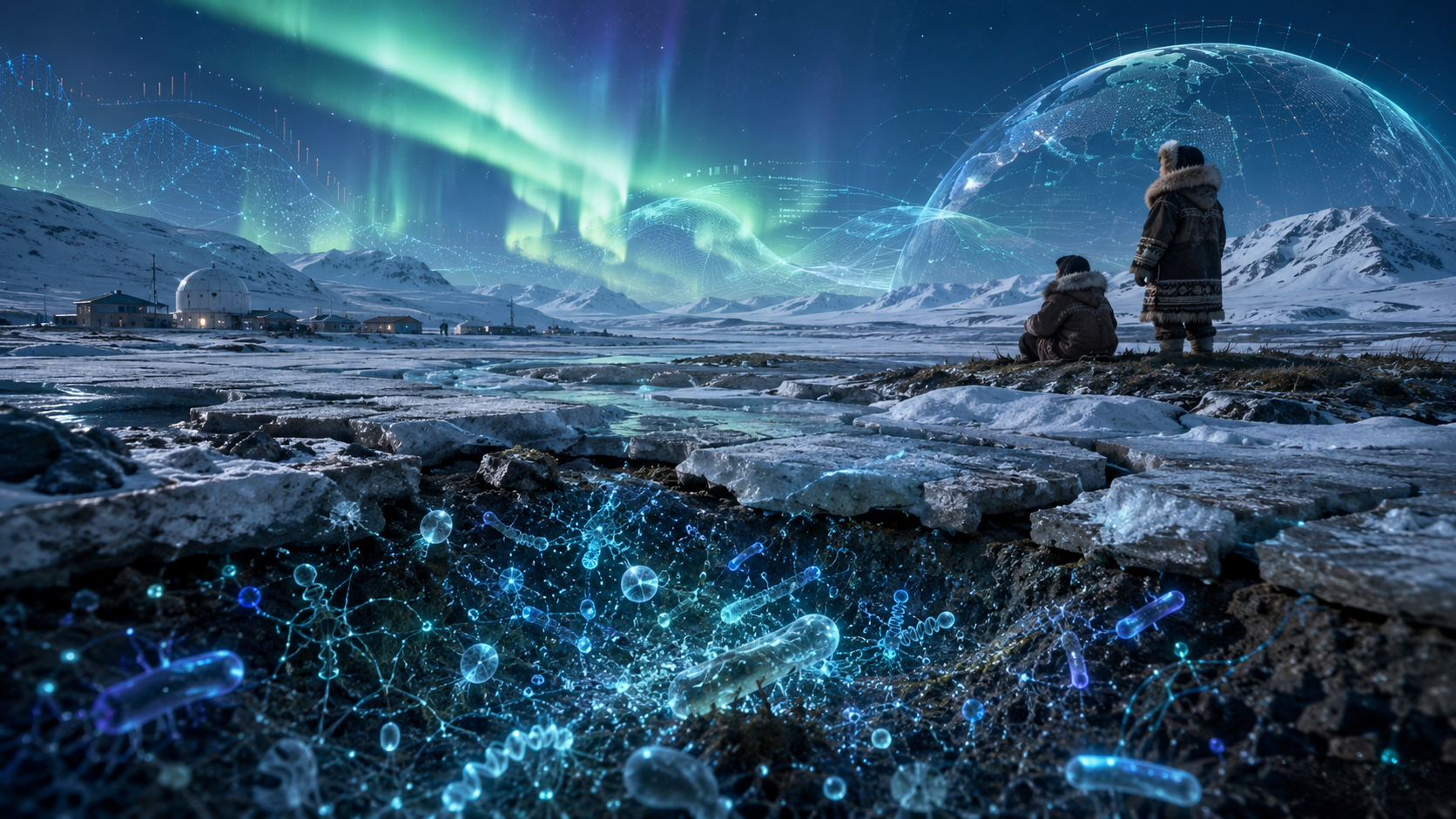
In some Arctic communities, houses are not toppled by storms but slowly pulled apart as the ground beneath them softens. Walls tilt, roads undulate, riverbanks collapse; hunting trails that once were reliable become uncertain. These changes may seem remote, yet they connect to global climate: permafrost preserves vast ancient carbon, and when it thaws, dormant organic matter can re-enter atmospheric cycles.
Thawing Permafrost Is Not a Static Warehouse
Permafrost is soil or rock that remains at or below 0°C for at least two consecutive years; in some regions it has been frozen for thousands of years. It holds plant remains, animal carcasses, microbes, and ancient DNA, as well as enormous organic carbon stores. As temperatures rise and the active layer deepens, microbes previously constrained by ice begin decomposing organic matter, releasing carbon dioxide; in waterlogged, oxygen-poor wetlands they may also produce methane, a more potent greenhouse gas.
Media often describe reactivated ancient microbes as “zombie viruses,” but the real risk—already occurring and far larger—is alteration of the carbon cycle and landscape structure. Permafrost thaw can cause ground subsidence, lake expansion or drainage, forest falls, and coastal erosion. These changes feed back on vegetation, fire regimes, water quality, and infrastructure, forcing climate models to handle a complex feedback: warming causes thaw, which may release more greenhouse gases.
How AI Sees the Deforming Arctic
The Arctic is vast, with sparse ground monitoring stations and difficult access in many areas. Satellite radar, optical imagery, aerial surveys, and sensors thus become essential tools. GeoAI can identify surface subsidence, lake boundaries, vegetation, and moisture changes across years of imagery, integrating data at multiple scales into permafrost risk maps. The Woodwell Climate Research Center project, supported by Google.org, is also experimenting with AI and satellite data to build more timely, broadly updatable monitoring capabilities.
AI’s strengths are speed and scale. Models can detect changes in vast pixel arrays that human eyes struggle to track continuously, helping identify roads, pipelines, settlements, or carbon stores that are especially vulnerable. Yet prediction maps are not ground truth. Snow cover, cloud layers, vegetation, and sensor resolution can introduce errors; different models may define “thaw” differently. Without on-site sampling and long-term calibration, even elegant risk maps may hide uncertainty beneath their color palettes.
Arctic Residents Are Not Sensor Substitutes
For Arctic Indigenous peoples, permafrost is not a temperature curve but the foundation of homes, cemeteries, water sources, hunting trails, and seasonal life. Communities track when river ice thins, which roads flood early, how animal migration shifts, and whether past seasonal names still describe today. These observations span decades and generations, capturing daily change more closely than short-term research projects.
ELOKA (Exchange for Local Observations and Knowledge of the Arctic) represents a direction where local observation and scientific data work together under respect for knowledge rights. Communities are not free-labeling contractors; they should participate in framing research questions, data stewardship, scope of public release, and use of outcomes. Certain hunting trails, cemeteries, sacred landscapes, or biological resource locations carry sensitivity and must not be publicly mapped simply because a model might find them useful.
Two-Eyed Seeing requires models to accept local experience as calibration while also enabling communities to use scientific tools. Satellites can show broad subsidence; residents can point out why a particular road is dangerous. AI may estimate high-risk zones, but local decision-makers know which buildings, water sources, and seasonal travel periods are most urgent. Only by integrating these perspectives does monitoring become actionable climate adaptation.
From Data Collection to Co-Governance
Permafrost research also raises ethical questions about soil samples, ancient DNA, microbes, and carbon data. Who holds the samples once they leave the Arctic? Can research teams hand them over to corporations for model training? Should communities know where their data flows, request withdrawal, or share technology and outcomes? If AI monitoring ultimately serves only insurance, mining, and infrastructure investment without improving resident safety, it again treats the Arctic as a resource frontier rather than a lived world.
Thus, maturity of an AI permafrost system is measured not just by prediction accuracy but by transparency about uncertainty, community decision-making power, and retention of research resources locally. Technology can help humans see change earlier, yet it cannot decide for affected peoples what deserves protection.
Permafrost is waking up—not only ancient microbes, but also the carbon, memories, and responsibilities preserved in ice. As ground becomes unstable, we must ask not merely whether models calculate correctly, but whether we are willing to listen to those who walk daily on changing terrain. The Arctic is not a background for climate dashboards; it is a home with people, names, journeys, and memory.
Sources and Further Reading
- Research on reactivation of ancient permafrost microbes, decomposition of soil organic carbon, and release of carbon dioxide
- GeoAI, satellite imagery, and remote sensing techniques mapping Arctic permafrost thaw and surface change
- ELOKA (Exchange for Local Observations and Knowledge of the Arctic) local observation and Indigenous knowledge platform
- Woodwell Climate Research Center and Google.org AI permafrost monitoring collaboration project
AI use and content-safety disclosure
This article was compiled and edited through the Yuan Media AI editorial workflow.