Stone Does Not Speak, but AI Is Learning to Listen: Archaeology Re‑reading the Silence Left by Humans
Original Chinese title: 石頭不會說話,但 AI 開始聽得懂:考古學正在重新閱讀人類留下的沉默
From AI identification of pottery shards, satellite imagery to three‑dimensional reconstruction, this article discusses how archaeology is being re‑read with the aid of digital tools while avoiding the reduction of history into algorithmic output.
莊溪
Recognized for contributions to plant education and public knowledge promotion, with a focus on how technology can help ordinary people re‑understand the clues left by land, life and civilization.
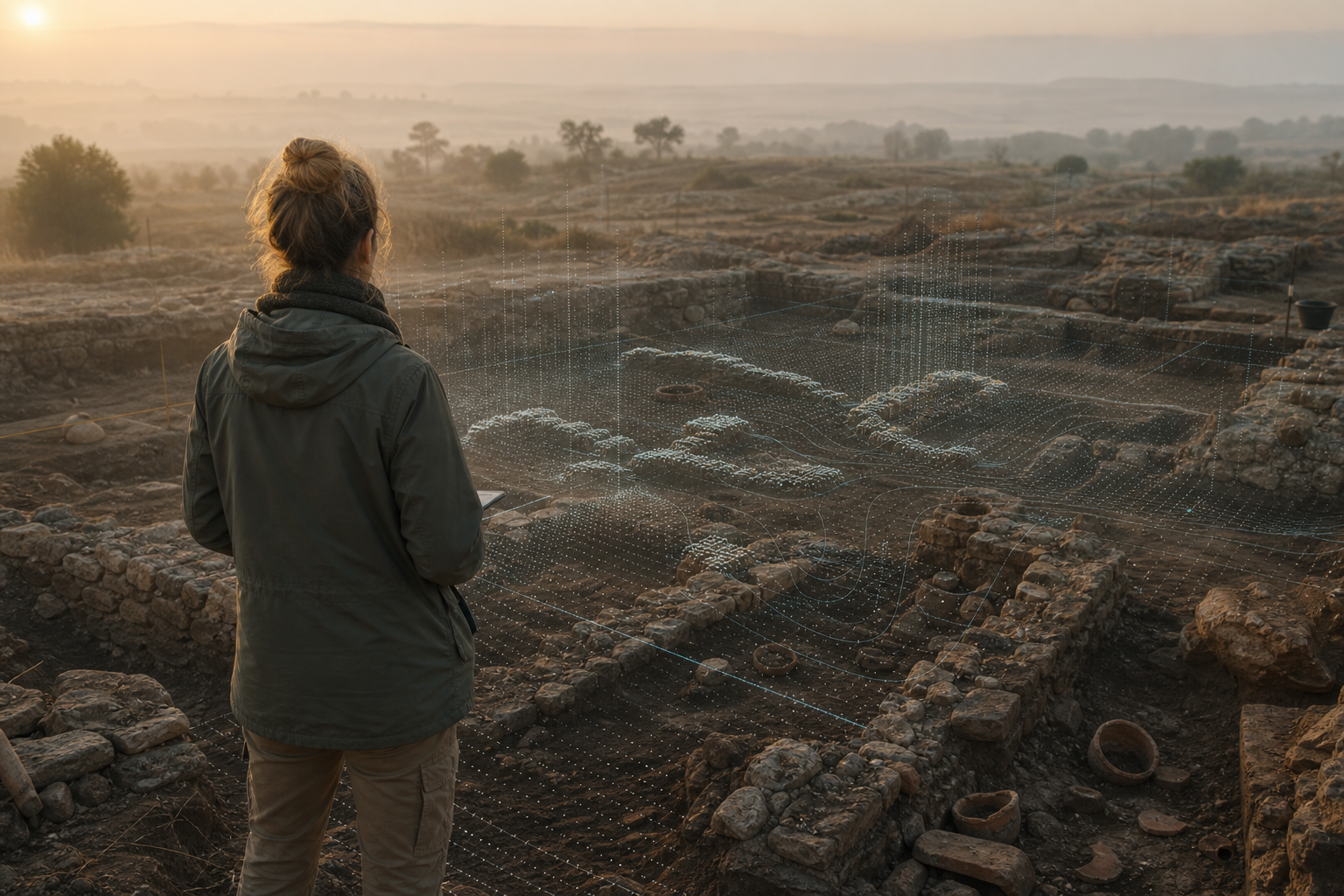
Archaeology is most easily misunderstood as "digging for treasure." A shovel goes down, a gold object emerges, the camera zooms in, and the narrator immediately announces in a low voice that a lost civilization has been brought back to light. This certainly makes for good television and suits audiences who want to believe they have suddenly understood human history during their late‑night snack time. The problem is that real archaeology is rarely so romantic. More often it involves slowly reconstructing how humans lived, exchanged, migrated, ate, died and imagined the world from soil layers, fragments, ash, bones, pollen, pottery shards and a pile of traces that are unlikely to trend on social media.
AI entering archaeology changes not "finally we don't have to work hard." If someone thinks that dumping a model into an archaeological site database will automatically spit out the truth about civilization, they probably mistake the field for an online shopping platform. AI's real value is its ability to find patterns in large datasets that are difficult for human eyes to sustain attention on: surface anomalies in satellite imagery, traces of ancient paths in aerial photographs, similarities in pottery shard textures, possible combinations of fragmented inscriptions, and changes in building structures after three‑dimensional scanning. It acts like a tireless assistant, but not as an oracle that can be directly appointed as the judge of history.
From Fragments to Patterns
Traditional archaeology relies on meticulous field records. The position of soil layers, depth of finds, relative relationships of artifacts, surrounding environment and dating all influence interpretation. AI can convert these data into comparable, visualizable and re‑searchable structures. A researcher who once had to examine thousands of photographs to identify a pattern can now get preliminary classification assistance from the model; broken objects that were previously difficult to assemble completely can have candidate combinations suggested based on shape, curvature and material clues.
But the most dangerous trap occurring here is that what models find is similarity, not meaning. Two pottery shards may look similar in shape but could represent either the same tradition or merely similar craft conditions; two sites with comparable spatial configurations might indicate cultural exchange or simply reflect human responses to water sources, wind direction and defensive needs. Algorithms are excellent at saying "looks like," while history must ask "why it looks like that, who says so, and how much similarity is meaningful."
This is why archaeology cannot be replaced by AI. Archaeology does not jump from data directly to answers; it moves back and forth between data, questions, methods and interpretations. An AI without a problem‑oriented mindset will only arrange fragments neatly, like preparing the body of a civilization for burial—clean, but not necessarily closer to the truth.
Digital Reconstruction Is Not Resurrection
Recent advances in three‑dimensional scanning and digital twins have opened new possibilities for site preservation. Earthquakes, wars, urban development, tourism pressure and climate change can all cause cultural heritage to deteriorate rapidly. Creating high‑precision 3D models of sites at least preserves the appearance at a given moment, providing reference for research, education and restoration. For the general public, digital reconstruction also turns "a confusing pile of stones" into an accessible spatial experience.
However, digital reconstruction easily produces a beautiful lie. The more polished the visuals, the easier it is for audiences to forget that they are inferences. How tall was a particular column originally? What did a roof cover look like? Were there painted decorations on walls? How were spaces used by people? Some of these details may be supported by evidence; others may simply reflect reasonable imagination by modelers and designers. Without clear indication of the level of evidence, digital archaeology can turn from a research tool into civilization cosplay. Such cosplay is beautiful and even sells tickets, but it risks making the public treat speculation as history itself.
Therefore, responsible AI‑driven archaeology should make uncertainty visible. Which parts come from direct measurement? From textual sources? From comparative inference? From illustration only? Truly mature digital humanities do not package history into flawless animation; they let audiences see how knowledge is constructed. In short, the most fascinating aspect of archaeology lies not in answers but in how evidence gradually approaches them.
Whose Civilizations Are Being Read
AI in archaeology raises a deeper question: where does the data come from? The sites that are extensively scanned, organized, studied and made public worldwide tend to concentrate in regions with abundant resources, well‑developed academic institutions and strong museum networks. Conversely, many local communities, Indigenous Peoples' settlements, migration routes, marginal landscapes and oral memories may be almost absent from databases. When AI learns only from accessible data, it treats the better‑preserved history as humanity's center and pushes the undigitized world to the margins again.
This is not about forcing every archaeological article into an Indigenous Peoples issue; rather, it reminds us of a basic fact: the silence of civilizations often stems not from natural absence but from power. Certain place names have been changed, some tombs moved, artifacts collected in distant museums, and languages never entered archival systems. If AI does not process these historical contexts, it will simply recalculate inequality with a more advanced interface.
What archaeology must ask of AI is not "can machines help us find more sites" but "what ethics are we prepared to use when re‑reading the traces left by humans." Stone does not speak, yet it is not voiceless. Its voice hides in location, wear marks, fire stains, sedimentation, paths and repeated human usage. AI can amplify these signals but cannot decide which silences deserve to be heard.
Finally, archaeology's greatest reminder for the AI era may be that what humans leave behind is usually more honest than how they introduce themselves. Palaces speak of power, garbage pits of diet, tombs of hierarchy, tools of labor and paths of exchange. When we re‑read these silences with AI, do not rush to proclaim a civilization's resurrection. First admit it: we have finally learned to ask better questions about a stone.
Sources and Further Reading
- UNESCO Digital Heritage and related materials on digital preservation of cultural heritage
- Nature, Science Advances and research applying digital archaeology, remote sensing archaeology and machine learning in archaeology
- Smithsonian and international museum digital collection cases
AI use and content-safety disclosure
This article was compiled and edited through Yuan Media AI editorial workflow for human review before publication.