The Forest Holds a Meeting Every Day; Humans Keep Treating It as Background Music
Original Chinese title: 森林每天都在開會,只是人類一直把它當背景音樂
From soundscape ecology, AI sound recognition and forest conservation: how recorders, acoustic data and citizen science reshape our understanding of forest biodiversity.
Yuan Media AI Editorial Desk
Yuan Media AI content team, focusing on AI, education, culture, public issues and cross-domain knowledge dissemination.
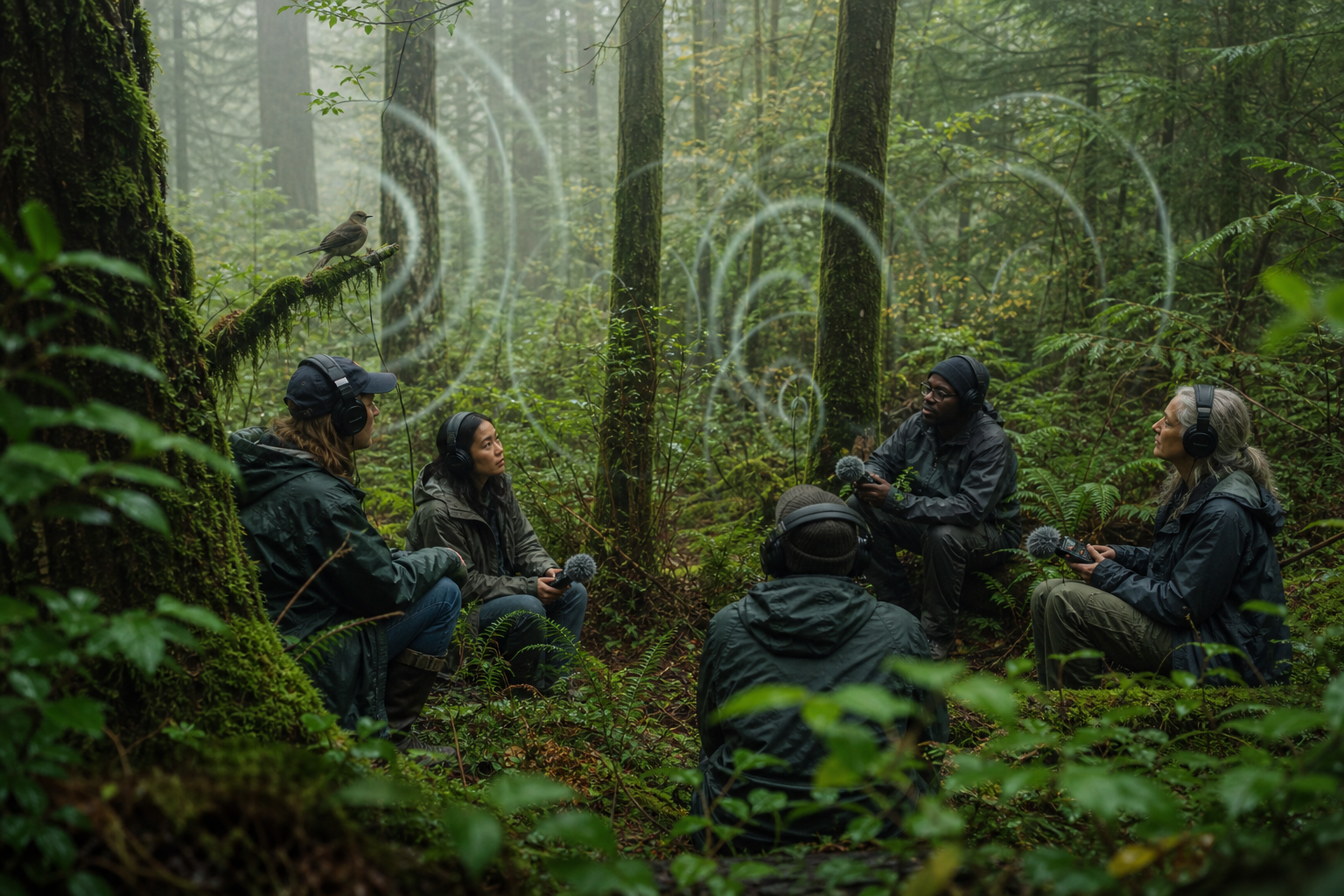
Humans have long known forests through sight. Tree height, leaf greenness, animal presence, trail beauty—forests become background in tourism brochures: oxygen for city dwellers, photo opportunities, spiritual cleansing, proof we didn't rot on the sofa this weekend. Yet the forest's most active information exchange often happens not where we see it but within sound.
Morning bird songs are not music; insect rustling is not noise; frog choruses are not rural white noise; water and wind through canopy are not free meditation apps. Together they form a dynamic soundscape recording species presence, breeding seasons, habitat change, climate stress and human disturbance. The forest holds a meeting every day; humans just treat it as background music, confidently claiming to love nature.
Sounds Is an Ecological Attendance Sheet
Soundscape ecology's core is simple: hear the ecosystem. Researchers place recorders in forests, wetlands, streams or farmland, collect environmental sound over long periods, then analyze changes across frequency bands, time and sound types. Certain birds sing only at specific times; some frogs correlate closely with rainy seasons and temperature; insect sounds may reflect season and habitat structure; even human car noise, machinery and aircraft become disturbance indicators. When recording duration extends, sound shifts from fragmentary impression to comparable data.
AI adds scale. Previously researchers might wear headphones for hundreds of hours until doubting their life choices; now models assist in identifying bird, frog, insect sounds and anthropogenic noise, quickly flagging possible species and anomalous periods. This does not mean AI understands forests better than field researchers—it handles repetitive tasks first, freeing human experts to interpret, verify and provide ecological explanations.
The most fascinating aspect of sound data is capturing the unseen. Many animals evade cameras or avoid humans yet still vocalize. For dense forest, night, mountainous areas or long-term monitoring sites, soundscape data fills visual survey blind spots. Whether a certain bird exists in the forest does not require it to pose before a lens; once it opens its mouth, the entire forest records attendance.
AI Is Not a Forest Translator
Of course we should not portray AI as possessing clairvoyance. Model sound recognition has error rates: background noise, distance, echo, rain and similar sounds across species cause misidentification. More troublingly, many regions lack sufficient sound databases; models are familiar with common, well-labeled, heavily studied species but may respond sluggishly to low-data-area species. If AI only heard European forests, it should not claim to understand tropical woodlands. This is like someone who has only seen Taipei MRT maps suddenly declaring mastery of all tribal roads—commendable courage, questionable judgment.
Thus the most important aspect of soundscape ecology is not filling mountains with recorders but establishing responsible data workflows. Where does sound come from? How long recorded? How labeled? Who may use it? Does it involve community life, private domains or culturally sensitive audio? To what extent should data be public? These questions are often treated as logistical details in natural sciences but in the AI era directly affect model bias and data ethics.
If recording sites lie near Indigenous communities or traditional territories, special attention is needed. Forest sounds may include not only nature but work, ceremonies, songs, hunting activities or community life noises. Not all recorded sounds should be public, uploaded, trained on or reused. Indigenous knowledge and local community experience are not decorative "local perspectives" here; they remind science that data is not ownerless air and sound does not belong to whoever records it.
From Conservation to Public Sensory Training
Soundscape monitoring has practical conservation value. When a forest faces road development, tourism pressure, logging, fire or extreme climate impacts, species composition and activity timing may shift. Long-term soundscape data can provide early warnings: certain species' sounds diminish, nighttime anthropogenic noise increases, breeding seasons show anomalies, or ecological corridor interruptions weaken bird communication. These signals do not immediately become news but may reveal forest health changes earlier than human eyes.
More importantly, soundscape ecology could transform public education. Many assume nature education means recognizing plants, animals and photos—important yet if we rely solely on sight we shrink the world into an encyclopedia. Sound teaches children that forests are temporal: dawn, noon, night and post-rain at the same location differ; a stream's sound changes between low water and flood; a mountain range swaps acoustic expressions across seasons. Hearing is not visual accessory but a primary route to understanding ecology.
Urban dwellers especially need this training. Modern life conditions us to be sensitive only to notification sounds: messages, calls, system prompts, elevator arrival tones. Bird songs become wallpaper, insect rustling noise, wind blocked by windows, stream water engineered into drainage facilities. We claim environmental concern yet cannot hear what the environment is saying. This civilization has progressed so completely that ears begin regressing into phone accessories.
Yuan Media AI cares about soundscape not because it's trendy but because it reminds us to reorganize sensory and knowledge relationships. AI can help process massive sound data, but true change lies in human arrogance: stop treating incomprehensible sounds as background; stop dismissing signals that cannot be immediately monetized as noise. The forest is not silent—it simply does not speak in the format humans love most.
Next time you enter a mountain forest, try speaking less. Listen where birds respond, how water turns, which canopy layers wind passes through, how insect sounds fill gaps. The forest holds a meeting every day; its agenda includes breeding, alerting, foraging, territory, season and survival. Humans may attend but should not start hosting upon entry.
Sources and Further Reading
- Cornell Lab of Ornithology and bird sound database, citizen science projects
- Soundscape ecology journals and long-term ecological monitoring studies
- International biodiversity monitoring and passive acoustic monitoring cases
AI use and content-safety disclosure
This article is compiled and edited by Yuan Media AI editorial process for human review before publication.