Quantum Communication Is Not Faster; It Changes Who Can Eavesdrop
Original Chinese title: 量子通訊不是比較快,它真正改變的是「誰偷聽得到」
Quantum communication is often misunderstood as faster networking. Its real importance lies in redefining eavesdropping, trust and information security.
阿克斯星門
Professor at the General Education Center, Chung Yuan Christian University. Long-term focus on technology civilization, public science, AI and future social imagination; skilled in deconstructing the public significance of new technologies from cross-domain perspectives.
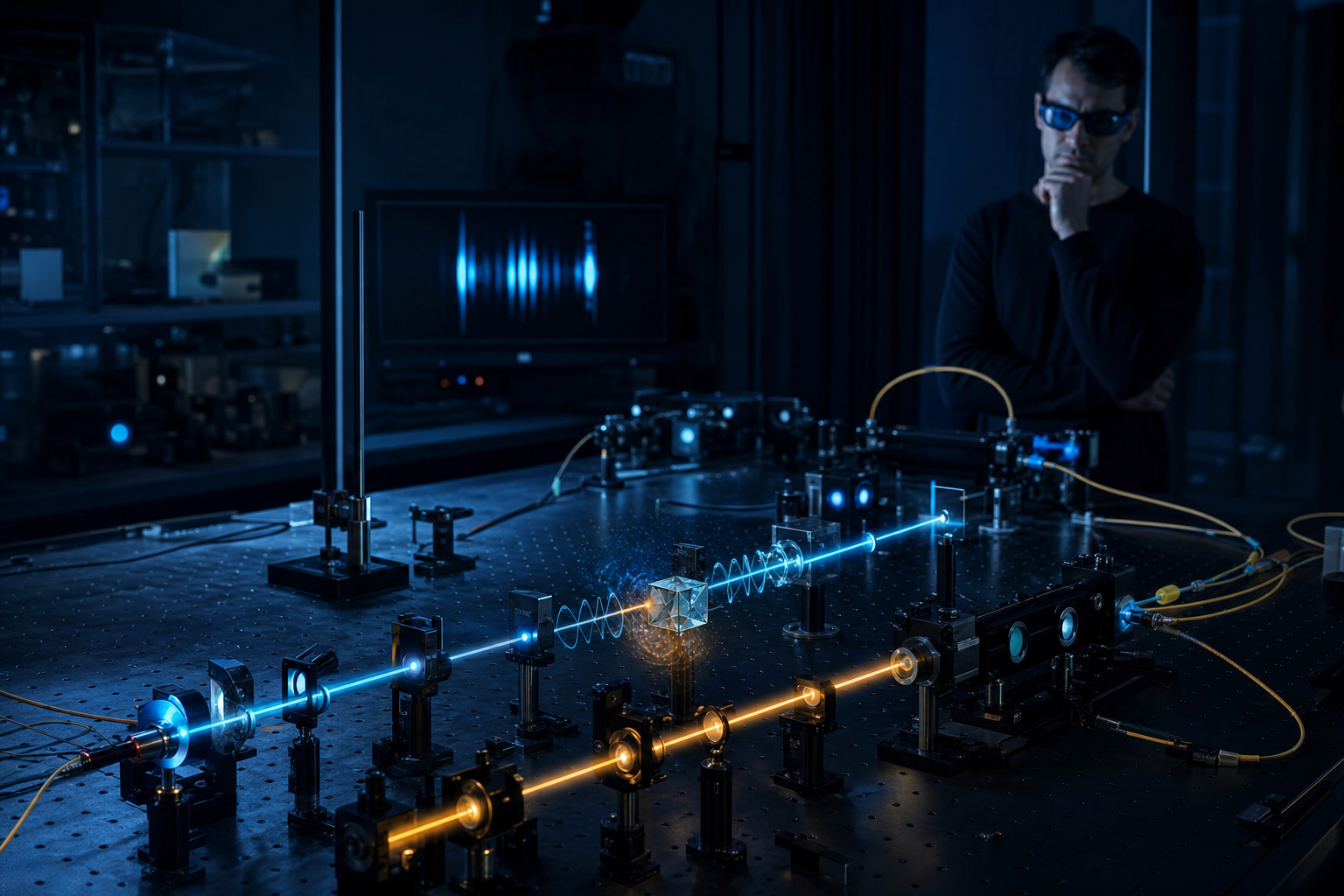
Every so often, a term appears in the tech world that turns presentation backgrounds deep blue. Quantum is one of the most durable.
Quantum computers, quantum communication, quantum encryption, quantum sensing — they all sound like humanity finally preparing to leave primitive civilization and head toward some future conference room where lasers are always on. The problem is that the public's most common misunderstanding of quantum communication is thinking it means 'the network will become faster.' That's roughly like hearing about a microscope and asking if you can fry an egg — not entirely unimaginable, but the focus clearly went off track.
What truly matters in quantum communication is not speed; it is trust. More precisely, it attempts to change who can eavesdrop and whether eavesdropping leaves traces. In a world where data flows faster than human moral growth, this is very important. After all, modern civilization's daily life resembles a large-scale naked run: banks, hospitals, schools, governments, clouds, social platforms, smart homes — all exchanging data. We are merely wearing the clothes of cryptography and praying there are no holes.
From Transmission to Trust
Traditional information security relies on cryptographic algorithms and computational difficulty. Simply put, data can be intercepted, but without a key it is theoretically hard to decrypt. However, 'hard' does not mean 'impossible,' especially when computing power improves, algorithms are broken, management lapses occur, or human password habits remain as fragile as birthday cake candles — security gaps appear. More troublingly, some data can be stolen first and decrypted later when technology advances. This strategy is sinister but fits humanity's consistent creativity: it doesn't matter if you don't understand today; just steal it home and freeze it.
The core idea of quantum key distribution uses the properties of quantum states to transmit keys. If someone attempts to measure or eavesdrop, the quantum state will be disturbed, and the communicating parties can theoretically detect anomalies. In other words, quantum communication does not guarantee that no one in the world wants to eavesdrop; it makes eavesdropping less quiet. This difference is crucial. Security is not about fantasizing away bad people; it is about designing a system where bad people leave footprints.
Of course, we must also immediately pour some cold water so the tech myth doesn't burn too hot. Quantum communication is not a magical talisman. Actual systems still have equipment vulnerabilities, distance limits, cost issues, node trust problems, integration difficulties and engineering maintenance challenges. As long as humans are involved, security systems can never rely solely on physical laws. You may use quantum methods to distribute keys, but if users stick passwords next to their screens, even the universal constants won't save you. This is not a quantum problem; it's a human one — and human problems are usually harder than quantum ones.
Why Nations Care
The reasons why nations pay attention to quantum communication are easy to understand. Financial transactions, defence communications, satellite networks, diplomatic information, medical data and critical infrastructure all require higher-grade security. When future quantum computers may threaten parts of the current public-key cryptography systems, the world is also promoting post-quantum cryptography and quantum-safe communication. This is not a single-track race; it is an entire information-security migration.
The public issue here is not just 'which country is more advanced.' More importantly, who can afford security and who must use cheap, fragile systems? If in the future high-grade quantum security belongs only to militaries, large financial institutions and super-enterprises, while ordinary schools, local governments, hospitals and social platforms still rely on patchwork cybersecurity, then technological progress may actually widen the security class divide. The rich use quantum locks; the poor forget to update routers — this future sounds sci-fi but is also real.
Public technology discussions must avoid two extremes. The first is sci-fi worship: once quantum appears, peace reigns. The second is cynicism: it's too expensive, too far away, ordinary people can't use it, so there's no need to understand. Both are convenient and both are irresponsible. Quantum communication won't change your home Wi-Fi tomorrow, but it is reshaping how nations, corporations and research institutions imagine future security architectures. The general public does not need to become quantum physics experts, but should understand that it involves data rights, infrastructure and public budgets.
History of Eavesdropping in Civilization
From a broader perspective, the history of communication is also the history of eavesdropping. Humanity invented messages and interception; invented cryptography and decryption; invented mail and letter opening; invented networks and phishing, surveillance and data leaks. Every communication revolution expands connections but also expands distrust. Quantum communication has civilizational significance because it reminds us: information society is not sustained by speed but by trust.
Today many platforms talk about trust like brand slogans. They want us to believe data will be used properly, that privacy policies are not hypnotic literature, that algorithms won't go wild, and that leaks are just occasional events. But trust cannot rely solely on statements; it must rest on verifiable technology, institutions and accountability. Quantum communication at least provides one direction: making eavesdropping no longer invisible, making security not just 'please believe us' but 'you can check'.
But verifiable technology does not mean governance automatically becomes transparent. If quantum communication is packaged as a national-security black box, the public will still only stand outside clapping; even asking questions feels unpatriotic. Truly mature technological governance should protect necessary secrets while allowing society to understand basic principles, application boundaries, budget logic and risk assessment. Otherwise quantum becomes yet another temple monopolized by experts, with ordinary people responsible for taxes and worship.
Not Faster, But Harder to Pretend Nothing Happened
The most memorable sentence about quantum communication is: it does not make things faster; it makes eavesdropping harder to pretend didn't happen. This is especially critical in the AI, cloud and data economy era. Because future power lies not only with those who own land, factories or armies, but also with those who can read, store, analyse and predict data. If data is new oil, information security is the fire extinguisher beside the oil tank that many ignore. Waiting until an explosion to find it usually leaves only press releases.
Quantum communication will not solve all human security problems, but it forces us to rethink one thing: a truly civilised form of communication is not just delivering messages far away; it is ensuring messages are not quietly altered, stolen or sold along the way. Speed shrinks the world; security lets the world still trust each other. The former suits advertising; the latter suits civilization.
So next time you hear about quantum communication, don't ask if network speed will improve. Ask: who communicates? Who needs secrecy? Who might eavesdrop? Who is responsible for verification? Who bears costs? Who is excluded from security? These questions are more important than blue laser light. The true mark of technological maturity is not how much it looks like the future, but whether it reduces the awkwardness of being eavesdropped on and pretending nothing happened.
Sources and Further Reading
- Nature Quantum Information: research on quantum communication and quantum key distribution
- IBM Quantum: public education materials on quantum information
- ESA, NASA: open data on satellite quantum communication and deep-space communication
- NIST: post-quantum cryptography standardisation and information security transition data
AI use and content-safety disclosure
This article was compiled and edited by the Yuan Media AI editorial process for human review before publication.