Bumblebees Use Tools: Humans Lose Another Self-Satisfied Reason for Superiority
Original Chinese title: 蜜蜂會用工具:人類又少了一個自以為高級的理由
Bumblebees using tools doesn't mean they'll apply to doctoral programs tomorrow, but it does give humans another self-satisfied reason to lose. Wisdom doesn't have to look human to be worthy of being seen.
Yuan Media AI Editorial Desk
Yuan Media AI content team, focusing on AI, education, culture, public issues and cross-domain knowledge dissemination.
# Bumblebees Use Tools: Humans Lose Another Self-Satisfied Reason for Superiority
Small Brains, Slap Big Arrogance
Bumblebees use tools. The moment this phrase appears, human civilization loses another self-satisfied reason to feel superior. In the past we said humans are special because they make tools; then chimpanzees, crows, sea otters and octopuses raised their hands in apology, saying we would too. So humans had to change our story: at least we have language, culture, financial statements. Now even bumblebees start solving problems, so human civilizational self-esteem can only retreat to the last defensive line: at least bumblebees won't hold meetings. That part is true; they might be luckier.
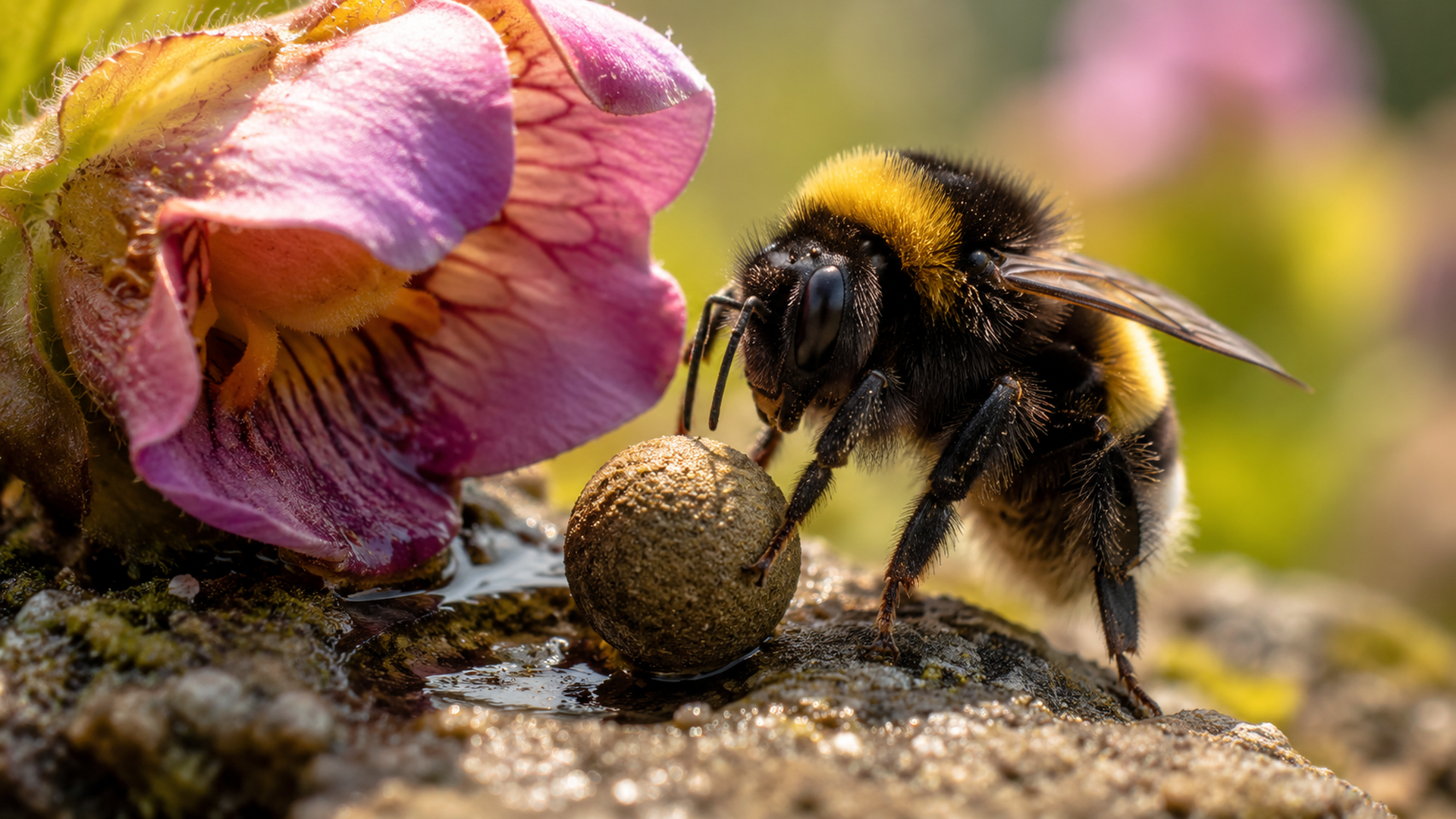
Recent studies on bumblebee and bee cognitive abilities keep reminding us: insects are not flying micro-machines. They can learn, remember, navigate, identify flower sources, adjust strategies, and form astonishing collaboration within the group. The latest eye-catching research design puts bees in front of a problem that requires "manipulating objects" to obtain a reward. They must move a ball so they can approach a sweet reward they couldn't reach before. This is not just luck; it involves goal understanding, spatial judgment, action adjustment and memory.
Wisdom Doesn't Have to Look Human
Of course, saying bumblebees use tools doesn't mean they're writing engineering papers, nor does it mean we should award them miniature safety helmets. Science fears two kinds of exaggeration: one is looking down on animals as if they are just instinct-driven machines; the other is anthropomorphizing them to the point where they seem like gifted students next door, only lacking tax filing skills. A more mature attitude is to acknowledge that different lives have different forms of wisdom, and human measurement methods are often too narrow.
We habitually imagine wisdom as language, mathematics, plans, exam scores and abstract reasoning. But natural-world wisdom is often embodied, contextualized and relational. Bumblebee wisdom isn't just in that tiny brain; it's also in their relationships with flowers, light, scent, paths, peer signals and seasonal changes. The bee colony isn't a single big brain, yet it can complete complex division of labor; they have no central government, yet often outperform many meeting systems. This is an affront to human administrative culture, but a healthy one.
"Instinct" Sometimes Is Just an Excuse for Not Understanding
Humans frequently use the word "instinct" to handle non-human life. Bumblebees collecting nectar is instinct; bird migration is instinct; fish schools turning is instinct; ants building nests is instinct. This term sometimes acts like a lazy label: once we stick it on, we don't have to ask how they actually perceive, learn, judge and correct. Of course, instincts do exist; but dumping all complex behaviors into the instinct box is like writing "omitted" for every exam question you can't answer.
The value of bee research isn't just making us exclaim "Wow, they're so smart," but forcing us to re-examine our arrogance. We've too easily divided life into high and low, placing those who speak human language at the top and the silent ones below. But nature has no obligation to sort itself according to human self-esteem. Small brains do not equal small worlds; silence does not equal ignorance; inability to write a resume does not equal lack of ability.
AI Era Needs More Insect Reminders
This is also interesting for the AI era. Today many people judge artificial intelligence using "how much it resembles humans" as the standard: can it chat, can it write poetry, can it comfort, can it pretend to understand you well. But bumblebees remind us that wisdom doesn't have to take human language as its appearance. AI is the same. It may appear smart on certain tasks but lacks a body, habitat, hunger, wind direction, flowering periods and death risks. Bumblebee wisdom is embedded in the world; AI wisdom is often locked inside data. Neither should be reduced to a single word "smart" or "not smart."
This also makes us re-examine ecological ethics. Pollinators are not agricultural service outsourcing firms, garden decorations, nor mascots for honey brands. They are living actors in the ecosystem. When habitats fragment, pesticides increase, climate anomalies occur and monoculture agriculture continues to squeeze their lives, what we lose is not just yield but an entire set of non-human wisdom and ways of interacting with the environment. If humans only realize bumblebees' importance when they're about to disappear, that's not environmental awareness; it's supply-chain panic.
The World Is Smarter Than We Imagine
Bumblebees using tools shouldn't ultimately be written off as mere trivia. It is a small mirror reflecting human big self-satisfaction. We are not responsible because we are superior to all life, but because our destructive capacity is too strong, so we must take responsibility. Bumblebees don't need us to award them wisdom certificates; they need flowers, habitats, less poison and a world that doesn't convert all life into productivity values.
Next time you see a bumblebee perched on a flower, perhaps you can have a little less arrogance of "it's just an insect" and a bit more curiosity of "it is processing a world we may not fully understand." The world is smarter than we imagine; many forms of wisdom simply won't report to us in human language. The black humor is that bumblebees try hard to push the ball to the right position, while humans often push the entire Earth in the wrong direction. If we compare problem-solving abilities, we probably still need to be a bit more humble.
Further Reading and Sources
- Scientific American, bumblebee problem-solving and tool-use coverage
- Smithsonian Magazine, bumblebee cognitive abilities coverage
- Nature, studies on bumblebee social learning and complex behavior
AI use and content-safety disclosure
This article is organized and proofread by Yuan Media AI editorial process, for manual review before publication.