Community Building Is Not a Painted Wall: If a Place Only Has Photo Spots, It's Just Wallpapering Loneliness
Original Chinese title: 社區營造不是彩繪牆:地方如果只剩打卡點,就只是在替寂寞貼壁紙
Community building often gets mistaken for painting walls, holding events, or taking photos of results. Once the walls are painted, the event ends, and the official group photo is sent out, the place suddenly seems to have a 'story.' But when residents go home, they still face the same problems: who opens the community center? Who cares about the elderly? Where do children go after school? Why is the market so quiet? For three months, the streetlight at the corner has been broken—someone needs to fix it. If community building only results in painted walls, it's not called 'building' anymore; it's called 'place makeup.' Makeup isn't wrong; what's wrong is treating makeup as therapy. Painting a broken wall with color, placing a few installations on an empty lot, hanging string lights at the corner—when the photographer arrives, the place becomes 'warm.' The problem is that warmth can only exist in photos. If a place lacks real relationships to support it, even the most beautiful walls are just wallpapering loneliness: cute from afar, but still peeling when you get close.
李雪華
# Community Building Is Not a Painted Wall: If a Place Only Has Photo Spots, It's Just Wallpapering Loneliness
Results Photos Are Bright, But Places Don't Necessarily Have Light
Community building is most often misunderstood as three things: painting walls, holding events, and taking results photos. Once the wall is painted, the event ends, the official group photo is sent out, and the place suddenly seems to have a "story." But when residents go home, they still face the same problems: who opens the community center? Who cares about the elderly? Where do children go after school? Why is the market so quiet? For three months, the streetlight at the corner has been broken—someone needs to fix it.
If community building only results in painted walls, it's not called "building" anymore; it's called "place makeup." Makeup isn't wrong; what's wrong is treating makeup as therapy. Painting a broken wall with color, placing a few installations on an empty lot, hanging string lights at the corner—when the photographer arrives, the place becomes "warm." The problem is that warmth can only exist in photos. If a place lacks real relationships to support it, even the most beautiful walls are just wallpapering loneliness: cute from afar, but still peeling when you get close.
Places Are Not Backdrops; Residents Are Not Extras
True community building isn't about making a place look pretty; it's about making a place more livable. This is a simple statement, yet the hardest to achieve. Because life involves arguing, uneven division of labor, people who are always late to meetings, those who only show up for ribbon-cutting ceremonies, and those who do the most but get seen the least. A community isn't the smiling faces on a poster; it's a place where people have to tolerate each other day after day, coordinate with one another, occasionally roll their eyes at each other, yet still choose to keep living together.
Many external teams entering a place make the easiest mistake: treating residents as material. The project plan writes "co-participation," but in reality it's co-notification; it writes "local co-creation," but that means the local area cooperates with photography; it writes "resident empowerment," but that means residents are arranged to sit in the audience and applaud. After performing this kind of theater for too long, residents learn a very mature silence: since you'll finish and leave anyway, we just need to smile.
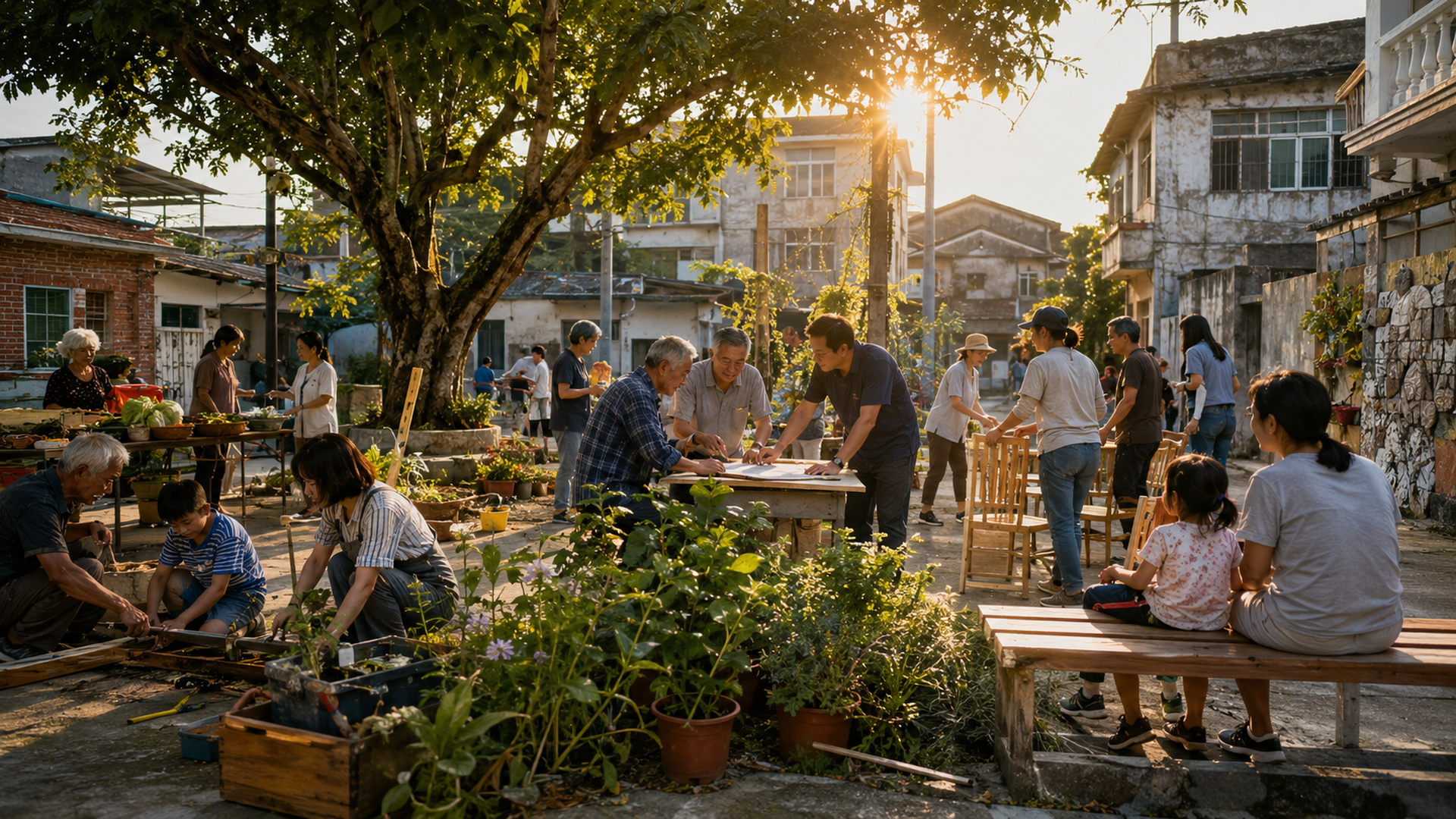
Good community building must reverse this. Outsiders can assist with inventorying, recording, designing, applying for funds, and matching resources, but they cannot treat the place as their own portfolio. The true protagonists are not designers, not funding agencies, nor hosts; it's those who remain after events end to collect chairs. Whoever collects chairs knows the place best.
Public Space Is Not Empty Land; It's Where Relationships Happen
The core of a community is often not some building, but places where people are willing to meet. Temple squares, in front of churches, community centers, parks, under old trees, corners of markets, riverside walkways, outside school walls—these places may seem ordinary, yet they form the skeleton of public life. Without public space, residents only have their homes, workplaces, and smartphone screens. If people only meet on social media platforms, they quickly mistake liking for participation and insulting others for public discussion.
The quality of a public space isn't about how new it is; it's about whether people can use it. Can the elderly sit? Can children stop here? Will teenagers be chased away? Can vendors survive? Can wheelchairs enter? Is it safe to walk at night? These questions matter far more than installation art. Many places truly need not another Instagram wall, but a chair that won't wobble, a streetlight that actually turns on, a clean restroom, and a place where people can chat even when it rains. These things are too plain for the news, yet local life is sustained by these humble elements.
Local Memory Cannot Only Be Wrapped in Nostalgic Candy
Community building also cannot rely solely on nostalgia. Old photos, old flavors, and old stories are certainly important, but a place cannot be forever trapped in the sentiment that "the past was better." The past also had poverty, factions, gender inequality, silence, and wounds. Gilding all of history is another form of laziness. Mature local memory should preserve both beauty and pain at once: it shouldn't turn history into tourism candy nor lock wounds away in a warehouse forever.
In multi-ethnic or Indigenous areas, this point matters even more. Culture isn't filler on an event program; clothing, dance, food, crafts, language, and rituals aren't there merely to make outsiders feel "unique." If community building turns culture into consumable experiences, the place becomes someone else's stage again. Those who truly respect a local area will first ask: what can be made public? What is suitable only for internal use? Which require family, elders, or community consent? Which should not be rewritten for tourism? Without these questions, cultural revitalization easily turns into cultural outsourcing.
Community Building Must Leave Behind Capacity
A good community building project should leave behind capacity after it ends, not just photos. Are residents better at holding meetings? Can they divide labor more effectively? Do they know where resources are located? Are they braver in discussing conflicts? Can they record stories themselves, run a community media outlet, and maintain public space? If the answer is no, then even lively events are only short-lived fireworks.
Places are not objects forever waiting to be saved. What places need is respect, companionship, and renewed belief that they have the capacity to improve slowly. Community building isn't about making outsiders think a place is beautiful; it's about making insiders feel a place is worth staying in. Photo spots can bring crowds, but relationships keep people. Walls can be painted, but loneliness cannot be solved with paint alone.
Further Reading and Sources
- Project for Public Spaces, "What is Placemaking?"
- UN-Habitat, Public Space and Global Public Space Programme
- Taiwan community building and local revitalization related public policy materials
AI use and content-safety disclosure
This article was compiled and edited by the Yuan Media AI editorial process, for publication after human review.