The Deep Space Memory Project III: The Voyager Golden Record 2.0 — As the Voyagers Run Out of Power, Earth Still Fights Over Who Is More Civilized
Original Chinese title: 《深空記憶計畫之三》金唱片 2.0:旅行者號快沒電了,地球還在吵誰比較文明
The Voyagers are running out of power, but humanity is still arguing over its sense of civilizational superiority. The Golden Record 2.0 is not just space romance; it asks in the AI age: who has the right to leave Earth’s final voice?
Lawrence Lee | Technology Journalist, Science Fiction Critic, and Space Science Educator
# The Deep Space Memory Project III: The Voyager Golden Record 2.0 — As the Voyagers Run Out of Power, Earth Still Fights Over Who Is More Civilized
A Single Record, More Honest Than Many Civilization Manifestos
The Voyagers are running out of power. That phrase sounds like a line from the last ten minutes of a sci-fi movie, but the real universe is not so considerate. There is no countdown, no soundtrack, no protagonist shouting in a control room that “we still have one chance.” Just an old probe launched in 1977, getting farther and farther from Earth, using ever less electricity to maintain a signal line that is almost absurd.
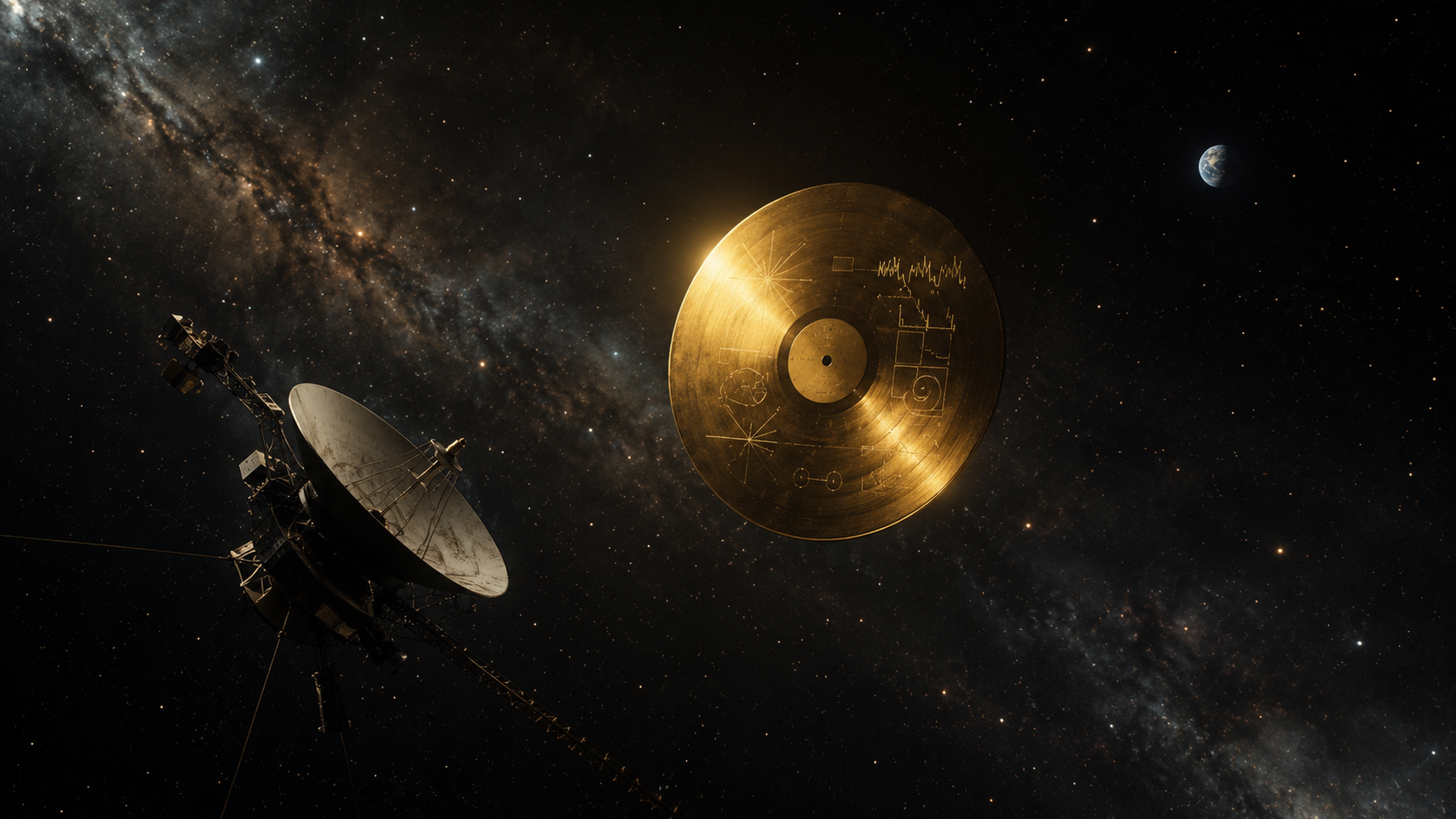
It carries the Golden Record. That gold-plated copper disc contains sounds, images, greetings, music and scientific symbols from Earth, intended to hand over “who we are” to some receiver who may never exist. The gesture is beautifully suspect, and suspiciously beautiful. Any civilization introducing itself will instinctively retouch its photo. The record includes babies crying, waves crashing, birdsong, heartbeats, music and greetings in many languages; it does not include war conferences, colonial treaties, concentration camp gates closing, or the laughter of corporate boards squeezing attention into advertising revenue. What humanity sent into deep space is not the full truth but a version hoping to be understood.
The Golden Record 2.0 Might Be an AI Data Center
If we were to remake the Golden Record today, the question would no longer just be “which songs go in.” In the AI age, humans would immediately think of databases, language models, multimodal images, audio files, knowledge graphs, cultural archives and automatic summaries. Technically, we could stuff Earth into a record far fuller than 1977; ethically, we might be far more chaotic.
Who has the right to represent Earth? Whose languages are preserved, whose languages become merely endangered corpora? Whose images are called cultural diversity, whose wounds are cut up into pretty material? Whose religions, ancestral spirits, taboos and family memories can be made public, and who is simply tagged by data engineers as “folklore content”? When AI becomes the new Golden Record editor, what humanity needs most is not bigger hard drives but better consent, authorization and accountability.
This is also the Voyager’s cold joke for the AI age: a probe running out of power understands restraint far better than many data centers that loudly proclaim sustainability. Every watt on Voyager counts; Earth’s AI industry often packages energy consumption as “the next wave of civilizational infrastructure.” The old machine in deep space saves power; the new machines on Earth heat up. Humanity claims to leave civilization for the universe while burning it into server cooling water. This is not science fiction; it is the page an accounting department would rather not include in a brand film.
Deep Space Networks Are Actually a Form of Civilizational Patience
Voyager can still reply, not by miracle but through Earth’s huge, expensive and quiet deep-space communication system. It does not chase instant reactions like social platforms nor use vibrations to remind you the world has broken again like news push notifications. The scale of deep-space communication is very slow: signals take time to go out and come back; engineers must think ahead when issuing commands because corrections are not a simple refresh. This slowness actually trains civilization.
We have grown too accustomed to equating “fast” with progress, “instant” with reality, and “generation” with creation. Yet Voyager reminds us that many truly important messages must withstand waiting. The Golden Record is not meant to be seen today but to possibly be understood by some uncertain future. If AI becomes the Golden Record 2.0, it cannot only pursue rapid generation; it must learn to preserve context, mark sources, respect silence and acknowledge that some data should not be eaten by models.
Civilization Is Not About Who Is More Advanced, But Who Is Willing to Be Understood
The most moving thing about the Golden Record is not its confidence but its humility. It does not guarantee that extraterrestrial life will hear it nor that they will understand it. It simply says: if you meet us, here are some sounds; please try to understand them. This polite stance toward the unknown is rare on today’s Earth. Human social media constantly argues over who is more civilized, who is more advanced, who is more correct, as if civilization were an endless awards ceremony. Yet our most cosmic business card turns out not to be a winning speech but a record willing to be slowly decoded by strangers.
What we call civilization is not how well we can present ourselves as superior, but whether we can admit our incompleteness. If the Golden Record 2.0 only includes victories, efficiency, technology, GDP, moon landings and AI breakthroughs, it would be an interstellar résumé; if it also leaves behind failures, mourning, migration, disappearing languages, wounded lands and people forced into silence, it comes closer to truth. The universe does not need us to pretend perfection. If the universe has patience, perhaps it wants to know: did this noisy species ever learn to reflect?
Voyager will eventually fall silent. It will not explode heroically nor dissolve into light on a screen; one day it simply stops sending signals. At that moment humanity loses a thin thread connecting to 20th-century idealism. Yet the Golden Record will still drift in deep space, like an offline backup and like a letter without proof of delivery.
So the real question behind the Golden Record 2.0 is not whether aliens will reply but whether we are still worthy of sending letters. As AI begins to organize humanity’s next generation of memory, we must first decide: shall Earth become a press release or an honest archive? The Voyagers are running out of power, yet they remind us that the most precious messages are never the loudest ones; they are those willing to cross long darkness and still not give up on being understood.
Further Reading and Sources
- NASA Voyager Golden Record Overview
- NASA Voyager mission pages and instrument notes
- NASA/JPL Voyager public mission updates
AI use and content-safety disclosure
This article was compiled and edited by Yuan Media AI editorial workflow for human review before publication.