Goats Follow Voice Cues, Bees Roll Tiny Balls: Human Superiority Shrinks Again
Original Chinese title: 山羊聽懂方向,蜜蜂會搬凳子:人類優越感今天又少一點
Goats can locate food based on the direction of human voices, and bees can move small balls to obtain rewards. These studies remind us once more that intelligence never takes only the form humans like.
全明正
Focuses on educational technology, digital learning, public knowledge, and how technology changes teaching environments.
# Goats Follow Voice Cues, Bees Roll Tiny Balls: Human Superiority Shrinks Again
Intelligence Is Often Defined by Humans in a Biased Way
Human definitions of "intelligence" have always carried strong self-worship. We tend to define intelligence as the form we are best at: language, arithmetic, planning, tool-making, writing papers, and then proudly declare that indeed we are the smartest. This criterion is like penguins organizing a swimming competition and concluding that giraffes aren't very good. It's not that giraffes can't swim; it's that the judges are too much like penguins.
Recent animal cognition research resembles an ongoing civilizational self-deconstruction show. Every so often, new studies remind humans: sorry, you thought only you could do this, but others seem to know a little bit too. This time, it's goats and bees.
Goats Are Not Just Grazing; They Understand Spatial Cues
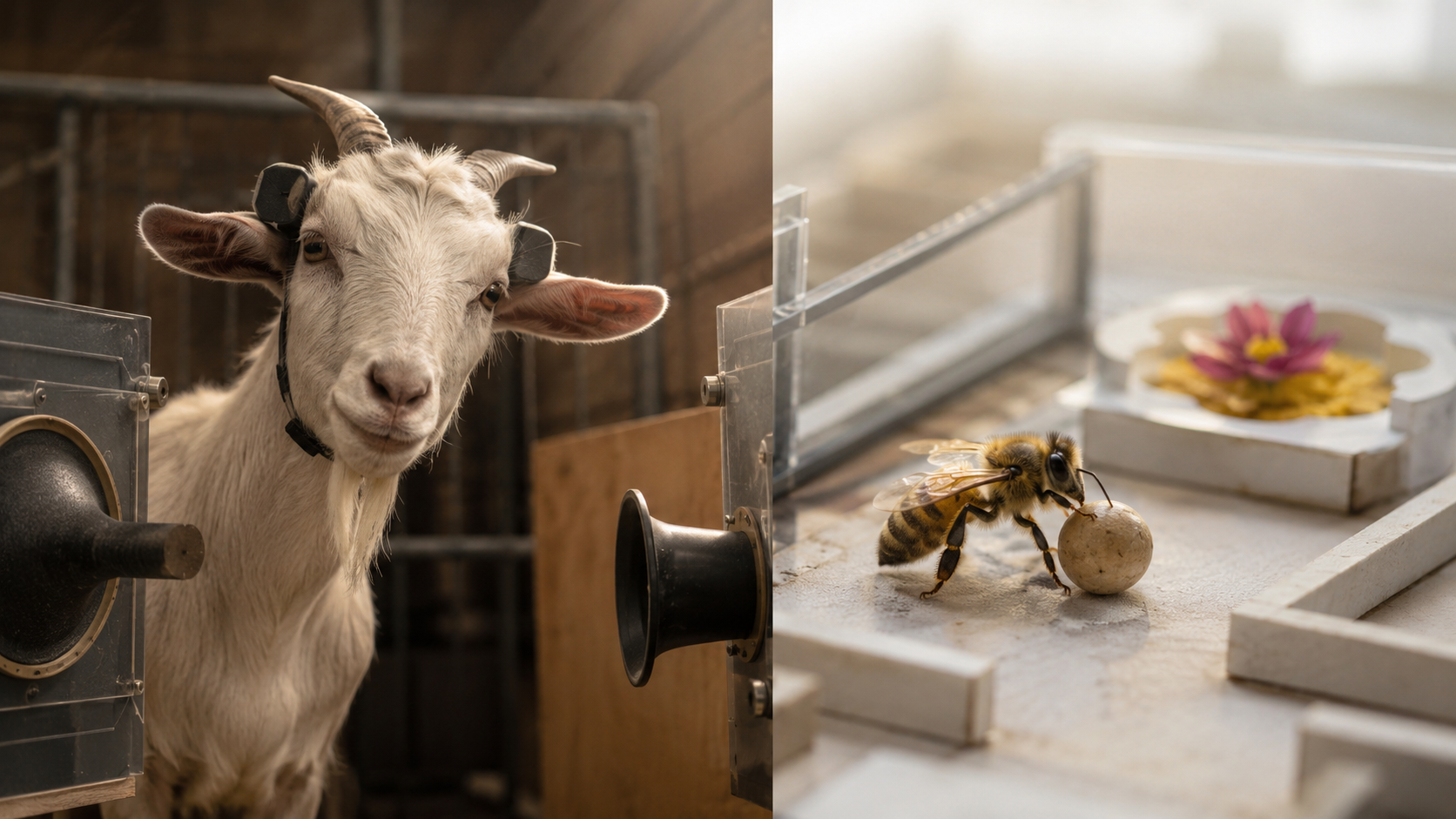
New research on goats shows they can locate food based on the direction of human voices. This seems simple but is actually not simple. The study concerns not just whether goats hear sound, but whether they can convert auditory cues into spatial judgments and make effective choices. This suggests that goats are not merely passive receivers of stimuli; they may possess a contextual understanding ability we have long underestimated.
This really slaps human stereotypes in the face. We often think domestic animals as functional beings: cows for plowing, sheep for grazing, chickens for laying eggs. As long as they reliably supply their purpose, we don't bother asking how they perceive the world. But once research shows goats can make spatial judgments based on voice direction, the whole question changes: do we truly understand these animals that live with humans every day, or have we simply been too lazy to understand?
Bees Moving Small Balls Does Not Mean They Want to Take a PhD Program
The bee study is equally fascinating. In the experimental design, bees can move small balls to appropriate positions to approach artificial flower rewards and then use them to get closer to the target. This does not mean bees will go work at IKEA tomorrow; it means that an organism with an extremely tiny brain may also demonstrate some flexible problem-solving ability.
The key is not anthropomorphizing bees, but acknowledging that "intelligence" can take many forms. Humans easily swing between two extremes when they see animals exhibiting skillful behavior: either belittle it as mere reflex or exaggerate to say the animal is just as smart as humans. Both are lazy. A truly mature scientific attitude is to recognize that other species have their own forms of cognitive ability, and such abilities deserve respect even if they don't look human.
These Studies Really Strike at Human Centrism
Animal cognition research is fascinating not only because it's cute but because each time it loosens the position humans place themselves at the center of all things. This is especially important in the AI era, as we also measure machines by our own standards: will they speak? Can they reason? Will they write? These questions are not wrong, but they imply one thing: humans are accustomed to using themselves as a ruler.
The problem is that if we judge the intelligence of real beings like goats, bees, crows, and octopuses so slowly and so biasedly, how can we be too confident in judging "what counts as intelligence"? Often it's not that we don't understand enough; it's that we've been self-centered for too long.
Education Should Also Relearn What Ability Means
These studies belong not only to zoology but also to education. School systems have long favored certain abilities: standard answers, linguistic expression, mathematical derivation, quick reaction, sitting still, writing things down. Yet there are many abilities in the world that may not score high on exams: observing environments, understanding subtle cues, finding paths in complex fields, coexisting with others, making stable judgments toward unfamiliar stimuli. Animal research reminds us that ability can be very concrete and also non-human.
If education only treats "winning like a human exam taker" as the sole standard, we are actually using the same method to belittle each other. Today you think goats aren't smart enough; tomorrow you might think some child isn't smart enough. The problem with this logic is never that it's too strict; it's that it's too narrow.
Less Superiority, Civilization Might Be Safer
Human superiority shrinking again today is actually good news. Because when superiority shrinks a bit, our desire to control other beings may also shrink a bit. We are more likely to treat them as co-inhabitants of this world rather than objects with only utility and value.
Goats don't need to write poetry to deserve respect; bees don't need to make presentations to be called capable. Within their own bodies and environments, they have long developed cognitive ways suited for themselves. What humans should truly learn is not to announce again "look, they're just like us," but to admit: there are many kinds of intelligence in the world that aren't ours.
This kind of cognition benefits science, education, and even AI ethics. A civilization willing to acknowledge others' abilities is usually less likely to compress all differences into a single set of standard answers.
Further Reading and Sources
- Royal Society Open Science Animal Behavior Research
- Science / Bee Problem-Solving Research
- Public Science and Animal Cognition Related Reports
AI use and content-safety disclosure
This article was compiled and edited by the Yuan Media AI editorial process, then reviewed by a human editor before publication.