The Deep Sea Is Not Silent, It Just Has No Microphone: When AI Starts Eavesdropping on the Underwater Civilization
Original Chinese title: 深海不是沉默,它只是沒裝麥克風:當 AI 開始偷聽海底文明
The deep sea is not silent; it is simply that humans have long failed to listen properly. As AI begins to assist in interpreting underwater soundscapes, technology simultaneously expands both conservation and development capabilities.
Yuan Media AI Editorial Desk
A cross-disciplinary knowledge and media narrative team focused on AI, environment, education, cultural data, and social innovation.
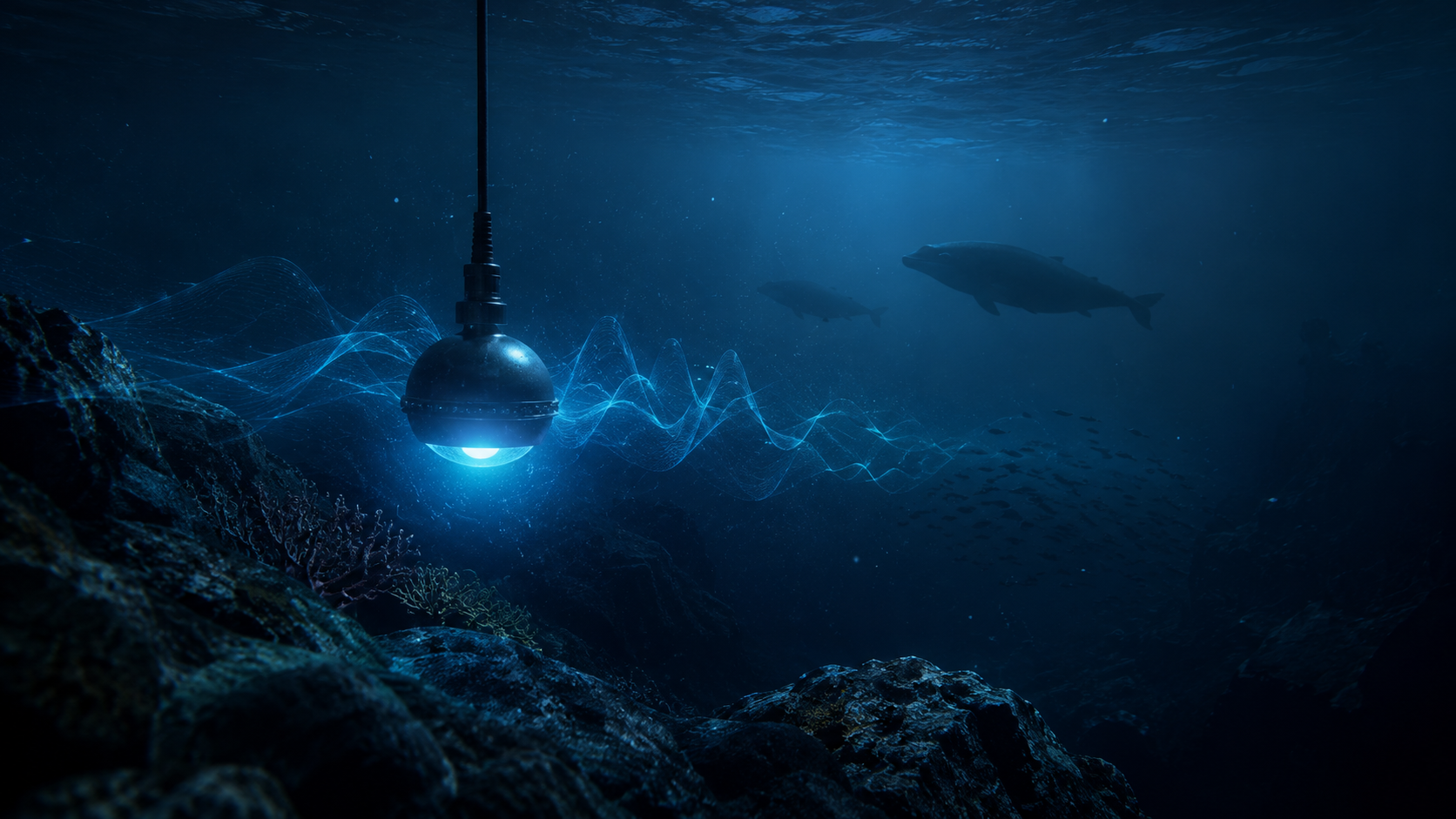
# The Deep Sea Is Not Silent, It Just Has No Microphone: When AI Starts Eavesdropping on the Underwater Civilization
We Have Long Been Too Dependent on Eyes
Human habits of understanding the world are largely visually biased. What we can see, we tend to believe; what we cannot see, we often classify as background. The deep sea has therefore long been misunderstood as silent, empty, and uneventful. It is not actually so. There it is simply too dark—dark enough that we lack patience to listen.
Sound travels more efficiently in water than light does. Whales and dolphins communicating at low frequencies, fish schools rubbing together, tectonic activity, submarine volcanoes, ice shelf calving, ocean currents flowing, ship engines, and industrial construction—all constitute a vast marine soundscape. The deep sea has never been quiet; it is our species' instruments and imagination that have historically not been quiet enough.
AI Makes the Deep Sea Readable
Passive acoustic monitoring and environmental DNA are the two most noteworthy lines of development in recent years. One listens with ears, the other reads traces left by life from seawater and sediments. The former is like installing microphones underwater; the latter is like fingerprinting underwater. The problem is that sound and molecular data are astonishingly abundant; without AI involvement, much of this data simply cannot be processed in time. Thus AI begins to serve as the ocean's shorthand writer: identifying sound sources, classifying events, detecting anomalies, comparing temporal sequences.
This sounds very progressive. Tech companies love telling such stories: using better models to guard the planet, using faster algorithms to give voice to the ocean. But this narrative has a standard blind spot—it always portrays monitoring as a natural extension of conservation, yet refuses to honestly face that monitoring technology can also serve development. When we know more about where life is abundant on the sea floor, where terrain is special, and where noise is fragile, we simultaneously gain greater capacity to mark, calculate, manage, and even plan how to enter at minimal political cost.
Hearing Does Not Mean Respecting
This is the sharpest point of the deep-sea issue. Technology itself carries no morality; it merely amplifies human capabilities. AI can help conservationists discover whale migrations and noise stress more quickly, and it can enable engineering systems to avoid high-risk zones more efficiently and construct with precision. Microphones are not angels; they are simply microphones.
Therefore the real question has never been whether we can hear the deep sea, but what we will do after hearing it. If the answer is merely that development becomes smarter, then so-called marine technology revolutions amount to nothing more than an advanced version of plunder. The greatest vice of human civilization toward the unknown is that while claiming exploration, we simultaneously begin drawing maps, calculating costs, and discussing efficiency. The deep sea is no exception.
Deep-Sea Life Is Stranger and More Fragile Than We Imagine
Deep-sea research repeatedly reminds us that it is not a wasteland but another rhythm of life systems. Recent studies near the deepest ocean trenches have discovered chemosynthetic ecosystems, meaning life does not need sunlight to build communities; it can rely on Earth's internal energy. Such discoveries are easily written into news headlines as "alien-like," but what truly deserves reflection is that we remain so unfamiliar with our own planet.
Strangeness itself need not be bad; the problem lies in humanity's excessive impulse to act toward strangeness. The less we understand, the more urgently we intervene; the more unexpected life forms are, the easier they become treated as incidental side effects. This resembles certain urban renewal projects: before truly understanding how old neighborhoods operate, discussions of demolition efficiency begin. Tragedies in the deep sea often extend this land-based governance mindset.
Deep-Sea Conservation Needs Not More Romance but More Constraints
Many people romanticize the ocean too easily, as if showing a few magnificent whale and dolphin images, deep-blue lighting, and unmanned submersible footage would automatically make the public develop marine ethics. Reality is not that simple. What is truly needed are institutional constraints: which sounds can be accepted? Which constructions must be delayed? Which areas should be regarded as high-protection sensitive zones? How transparently will soundscape monitoring data be made public? How will AI models avoid becoming black boxes serving only industry?
Without such governance design, even the most beautiful deep-sea images are merely moral decoration. Like many corporations that forever prefer to place landscape photos in sustainability reports: the bluer the photo, the harder it is to see the problems.
When the Sea Floor Has a Microphone, Humans Must Learn to Shut Up
AI can certainly help us get closer to the deep sea, but it should not become a moral exemption certificate. Hearing does not equal having the right to disturb; classifying does not equal dominating. Truly mature deep-sea technology should enable humans not only to know more but also to do less.
The deep sea has never been silent. What is silent are our own constraints on ourselves. Now that microphones have been deployed, the next step must be asked: Are we learning to listen, or merely swapping one higher-tech form of noise for another?
Further Reading and Sources
- NOAA Ocean Exploration
- NOAA PMEL Acoustics Program
- Nature / Reuters Deep-sea chemosynthetic ecosystem report
AI use and content-safety disclosure
This article was compiled and edited through Yuan Media AI's editorial workflow, with human review applied before publication.