Deep Space Memory Project No. 4 | As Voyager Begins to Conserve Power: Who Will Understand Humanity's Last Voice First?
Original Chinese title: 《深空記憶計畫之四》|當旅行者號開始省電:人類最後的聲音,會先被誰聽懂?
When Voyager starts saving power, humanity must also confront whether what we launch into space represents our full civilization or only a polished version of ourselves.
Lawrence Lee | Technology Journalist, Science Fiction Critic, and Space Science Educator
Long-term focus on space exploration, sci-fi narrative, technology culture, and public science education; skilled at translating cutting-edge science into civilizational writing.
# Deep Space Memory Project No. 4 | As Voyager Begins to Conserve Power: Who Will Understand Humanity's Last Voice First?
Power Conservation Is Not Just an Engineering Issue
What makes Voyager most moving is not how far it has flown, but how long it has been flying. Long enough that human technology products have gone through several generations; long enough that even the slang of social platforms has changed regimes, yet it remains beyond the heliosphere, reporting back to Earth in a stubbornly persistent way: I am still here.
But "still here" is now becoming expensive. To extend the mission, NASA must turn off instruments one by one, like reducing burdens for an elderly traveler. Voyager begins conserving power—not a romantic myth, but the most realistic side of space engineering: no civilization can remain fully powered forever. This is more honest than many tech myths because Earth's industries often pretend infinite expansion; data centers, platforms, models, and energy demands seem to have no tomorrow. Yet Voyager reminds us that technologies capable of lasting truly understand restraint.
The Golden Record Is Civilization's Self-Introduction, Also a Curation
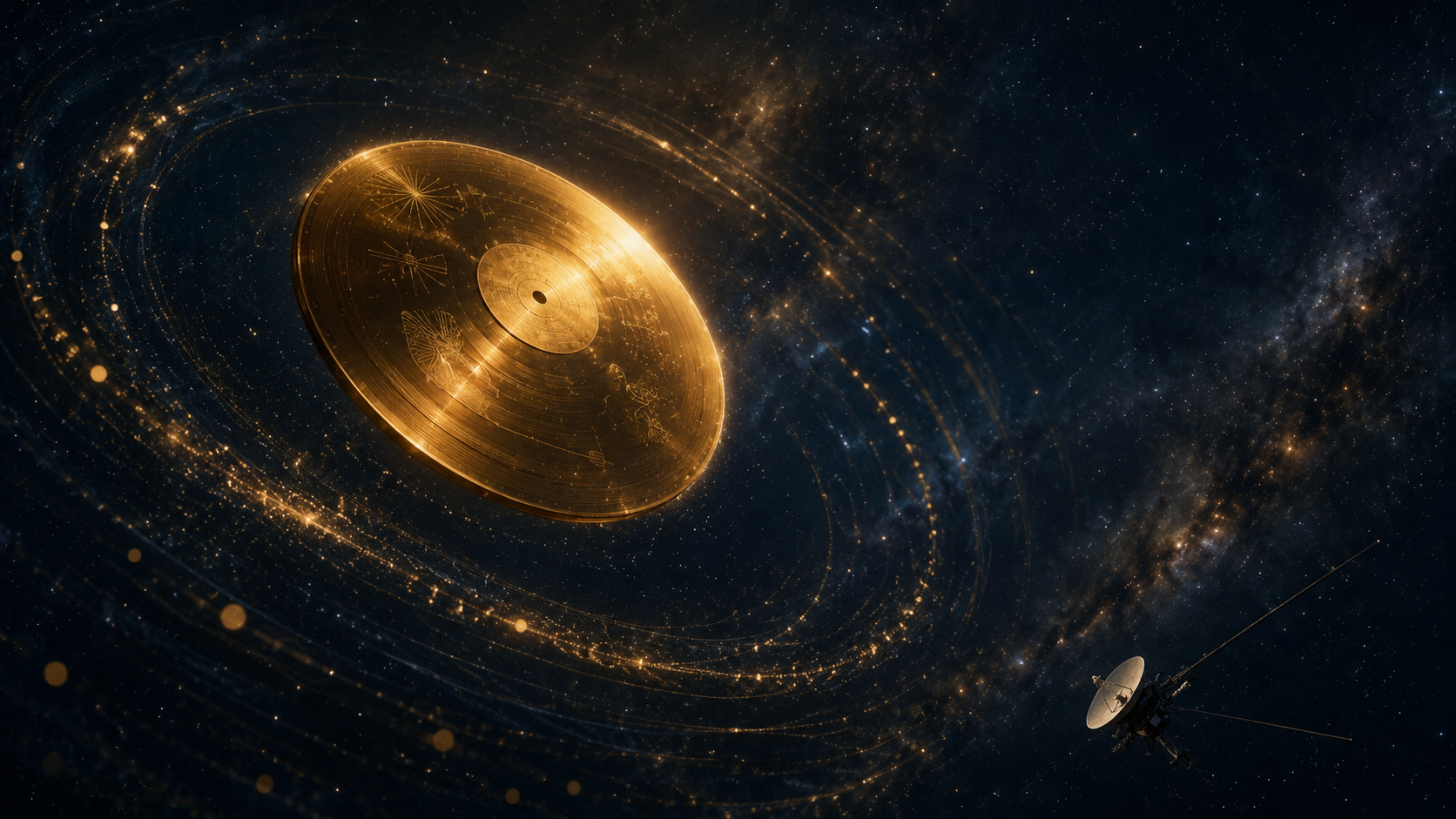
When discussing Voyager, the hardest thing to avoid is the Golden Record. That gold-plated copper disc holds Earth's sounds, music, images, and greetings—like a letter written to the cosmos. It compresses what humanity most wants to display into a portable civilization sample: waves, bird calls, infant cries, music, mathematics, greetings, and bodies. This looks beautiful yet suspicious.
Because every self-introduction is curated. No record can hold truly complete Earth. Whose voices are included? Whose are left out? If this is a civilizational résumé, it will naturally select the most attractive fields, skipping the awkward chapters. War, plunder, colonization, racial oppression, and ecological destruction are unlikely to be featured tracks. What humanity sends into deep space is not full truth but a version hoping to be understood. This is not strange; what truly matters is: in the AI era, are we repeating the same act—only with larger, faster tools that better disguise themselves as neutral?
AI May Become the Next Memory Editor
If we were to remake a "Golden Record 2.0" today, AI would almost certainly be absent. It could help us organize languages, select sounds, compress images, translate symbols, and even simulate an information structure most likely to be understood by alien intelligence. This sounds highly efficient yet dangerously so. Because what AI excels at is not preserving differences but flattening complex reality into computable averages.
Averages always look good. They have no rough edges, no contradictions, no cultural taboos, no silences and reservations that platforms struggle to understand. But civilization is not made of averages. True civilization comes precisely from processes where translations fail, negotiations occur, misunderstandings arise, and corrections are continuously applied. If we hand human memory over to AI management, we must confront a question: will it clear away all difficult things, leaving only an apparently complete empty shell?
This is especially sensitive in cultural data governance. Some memories do not belong to everyone; some voices should not represent the whole; some knowledge is unsuitable for flattening and public release. If AI merely says "I can organize" without asking "Do I have the right to organize," it risks becoming an efficient forgetting machine.
Deep Space Forces Humanity to Reconsider What Long-Term Means
Voyager's importance also lies in forcing us to re-understand time. Contemporary society is accustomed to short-term logic: quarterly reports, instant traffic, thirty-second short videos, public opinion surges every few days. Deep space does not eat this up. Signal round-trips alone require long waits; mission scales often span decades. This sense of time serves as education for today's civilization.
It teaches us that "leaving something for the future" is not about piling data as much as possible, but asking: will these things still have meaning in the future? Will they become unreadable digital ruins? If our languages, images, and sounds depend too heavily on platform formats, could future descendants—or even future machines—only see a black screen of format incompatibility?
Voyager and the Golden Record are moving not because they are advanced but because they are restrained and clear about what they leave behind. This contrasts sharply with certain AI industry practices: collect everything first, then claim it will be useful later. More data is better; larger memory is better, as if civilization's value equals hard drive capacity. This logic seems powerful yet hollow.
Who Will Understand Humanity's Last Voice First?
This question has no standard answer. Perhaps extraterrestrial life never appears; perhaps the Golden Record will never truly be understood. Or maybe the first to "reorganize humanity's civilizational voice" is not aliens but AI trained by humans themselves. At that point, machines may read not full humanity but a version selected, trimmed, and labeled by us.
Thus Voyager conserving power is more than a space news item. It acts as a distant mirror reflecting our civilizational anxiety: we fear disappearance, so we save frantically; we fear complexity, so we rush to organize; we fear misunderstanding, so we try to speak more clearly. Yet what the cosmos truly preserves may not be our proudest technologies but how we treat memory.
Voyager will age, quiet down, and one day stop responding. But that record will continue drifting. Like a letter with no guarantee of being opened, it is also civilization's self-test: when humanity attempts to speak to the unknown, will it simultaneously learn to be honest with itself?
Further Reading and Sources
- NASA Mission Voyager
- NASA Golden Record Overview
- NASA Voyager Instruments / RTG mission notes
AI use and content-safety disclosure
This article was compiled and edited through Yuan Media AI editorial workflow, then reviewed by human editors before publication.