Legislator 陳瑩: Atemoya Cannot Rely on a Single Market; Taitung Farmers Truly Need a More Stable Future
Original Chinese title: 立委陳瑩:鳳梨釋迦不能只靠單一市場,台東農民真正需要的是更穩定的未來
Legislator 陳瑩 addresses the Taitung atemoya issue, pointing out that farmers truly need orders, stable income, and diverse markets rather than being repeatedly consumed by political rhetoric.
Yuan Media AI Editorial Desk | AI-Driven Indigenous Township Economy and Policy News
Focusing on Indigenous township industries, local agriculture, public policy, and market transformation, organizing important signals from the Indigenous township economic frontlines and subsequent observations.
# Legislator 陳瑩: Atemoya Cannot Rely on a Single Market; Taitung Farmers Truly Need a More Stable Future
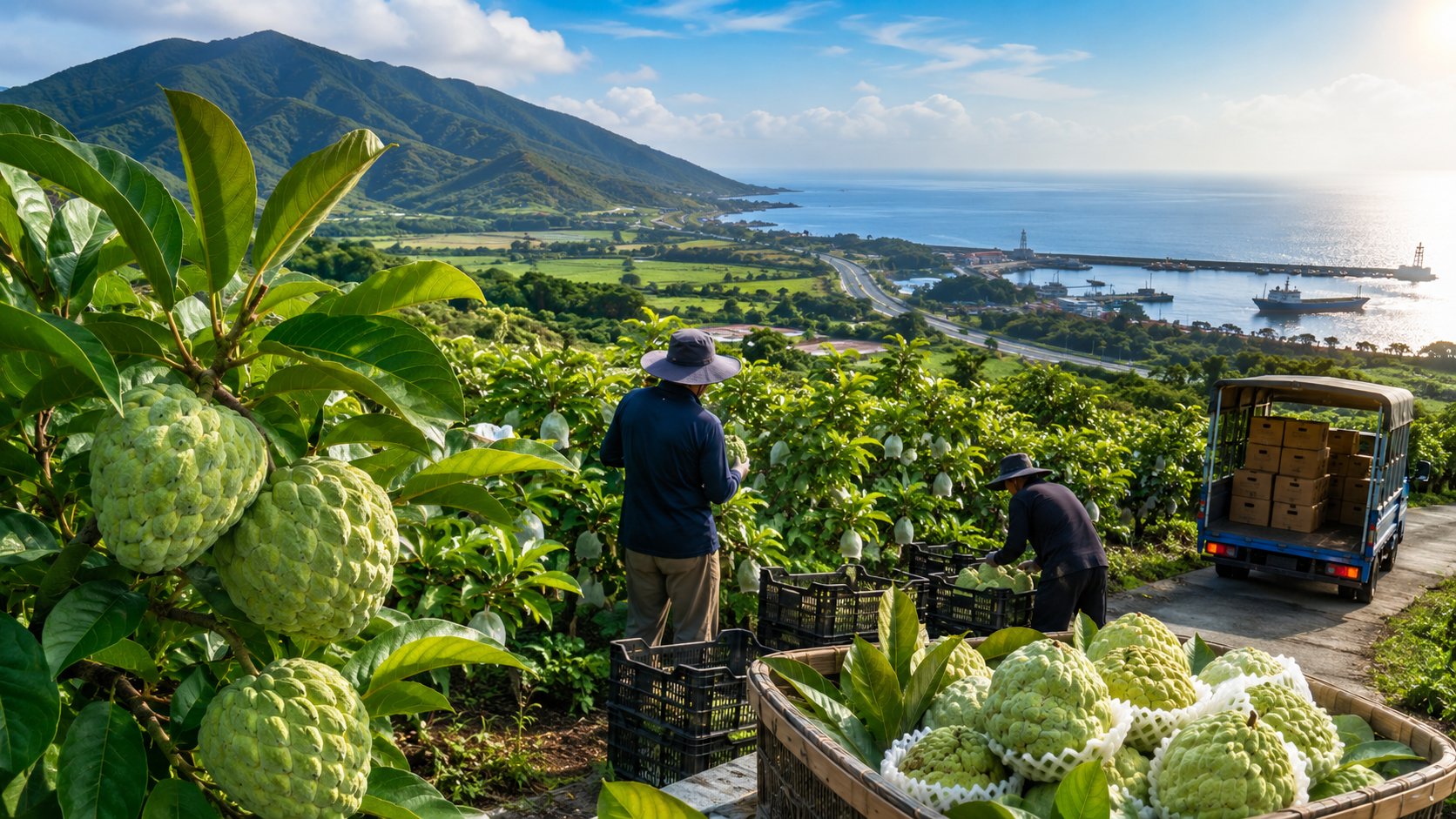
In discussions about Taitung agriculture, atemoya has never been just a fruit name; it simultaneously represents the labor of Indigenous farmers, the resilience of local economies, and an entire supply chain from production, packaging, logistics to markets. Legislator 陳瑩 recently spoke out again on related issues, with the focus not on verbal attacks but in clarifying problems for frontline farmers: what Taitung farmers truly need is not temporary political statements, but long-term stable orders, predictable income, and an industrial future not tied to a single market.
Legislator 陳瑩 points out that Taitung atemoya is an important industry accumulated by many farmers' years of hard work, with quality, sweetness, cultivation techniques, and market recognition already having quite a foundation. If outsiders view this industry using only one-sided impressions, ignoring farmers' year-round investment and risks, it's easy to marginalize the truly hardworking people again. Her core stance is clear: Indigenous agriculture should not be simplified into political symbols, nor seen as a fragile industry that can only rely on a single market.
This statement matters because it refocuses attention back onto industrial governance itself. The problem with atemoya has never been whether to endorse some political position, but how to reduce the risk of over-concentration in a single market. Legislator 陳瑩 believes that for Indigenous agriculture to truly go long-term, three things must be addressed simultaneously: first, expanding more diverse export and domestic markets; second, establishing mature production-sales early warning and total quantity management mechanisms; third, accompanying farmers in product upgrading and added value enhancement.
So-called diverse markets are not just slogans. For Taitung, beyond existing markets, future efforts should actively layout Japan, the United States, Singapore, Malaysia, and other Southeast Asian markets, so the industry does not bet its fate entirely on a single export direction. This thinking also better aligns with basic risk management when Indigenous industries face global market changes. In other words, truly protecting farmers is not letting everyone continue betting on a single path, but securing more selectable channels and stable trading conditions for farmers.
Legislator 陳瑩 also emphasizes that market diversification without production-sales early warning and total quantity management may still lead to old problems like overproduction glut and drastic price fluctuations. This point is especially important for Indigenous agriculture. Many tribal or local farm households are small in scale yet bear high costs and climate risks; once prices become imbalanced, the families most lacking buffer space suffer the impact. Therefore, from data collection, yield control, acquisition rhythm to market signal interpretation, more refined governance capabilities are needed, rather than rushing to put out fires annually after fruit emerges.
Another direction worth noting is product added value. Legislator 陳瑩 believes Taitung agriculture cannot just stop at "selling agricultural products out"; it should also consider how to enhance processing, branding, grading, packaging and channel integration capabilities. If atemoya can beyond fresh fruit layout towards graded premiumization, processing extension, local brand stories and farm tourism experiences, the industry's risk resistance capability will be higher. This is also the key of Indigenous economic upgrading: not just seeking sales volume, but striving for a more dignified and valuable industrial position.
From the perspective of Yuan Media AI Editorial Desk, what's worth noting about Legislator 陳瑩's statements this time lies in that it does not narrow problems to short-term debates, but returns to three more structural keywords: orders, stable income, diverse markets. If these three things can be gradually implemented, Taitung farmers facing market risks will not always be forced to bear the greatest cost in uncertainty.
For Indigenous Township Economy and Policy Watch news, this is also a typical reminder: what truly deserves tracking is not just who said what, but whether local agriculture can therefore be seen, understood, and even truly receive institutional and market support. The next step for atemoya cannot just be discussed; it must be properly managed. What Legislator 陳瑩 emphasizes is actually a principle that's not hard to understand yet often overlooked: farmers truly need standing markets and livable lives, and this is the attitude truly responsible to Taitung, Indigenous townships, and Taiwan agriculture.
AI use and content-safety disclosure
This article was compiled and edited by the Yuan Media AI editorial process, reviewed by human editors before publication.