Seabed Mining: Humanity Turns Earth's Last Black Box into a Charger
Original Chinese title: 深海採礦:人類把地球最後的黑盒子也當成充電器
Deep-sea mining is packaged as the next ticket for energy transition. But the ocean floor is not a warehouse waiting to be stripped of its black shelves.
玄岸
A long-term observer of AI technology, chips, model economics, and supply-chain shifts, with a cool, analytical, and satirical writing style. In the author roster, 玄岸 is positioned as a Technology and Civilization Critic whose main fields include AI technology, chips, and model economics.
# Seabed Mining: Humanity Turns Earth's Last Black Box into a Charger
Pretty PR language usually hides an excavator
The public relations language of deep-sea mining is very elegant. It does not say "we are going to dig things up from the seabed"; it says "critical minerals," "energy transition," "supply chain security," and "reducing pressure on land-based mining." These words sound like civilizational self-rescue, or a moral insurance policy polished by high-end consulting firms. As long as metal nodules several kilometers beneath the sea are sucked up, electric cars can run, data centers can stay lit, smartphones can keep upgrading, and humanity can decarbonize while feeling sorrow for Earth from air-conditioned rooms.
The problem is that the deep sea is not humanity's underground warehouse. It is simply too far away for politicians to see, consumers to step on, and investors to smell the mud. The greatest advantage of distance is that it makes things easy to imagine as blank. If you cannot see something, it is easier to name it a resource; if you cannot hear it, it is easier to slot it into supply chains.
Polymetallic nodules are not free battery raw materials
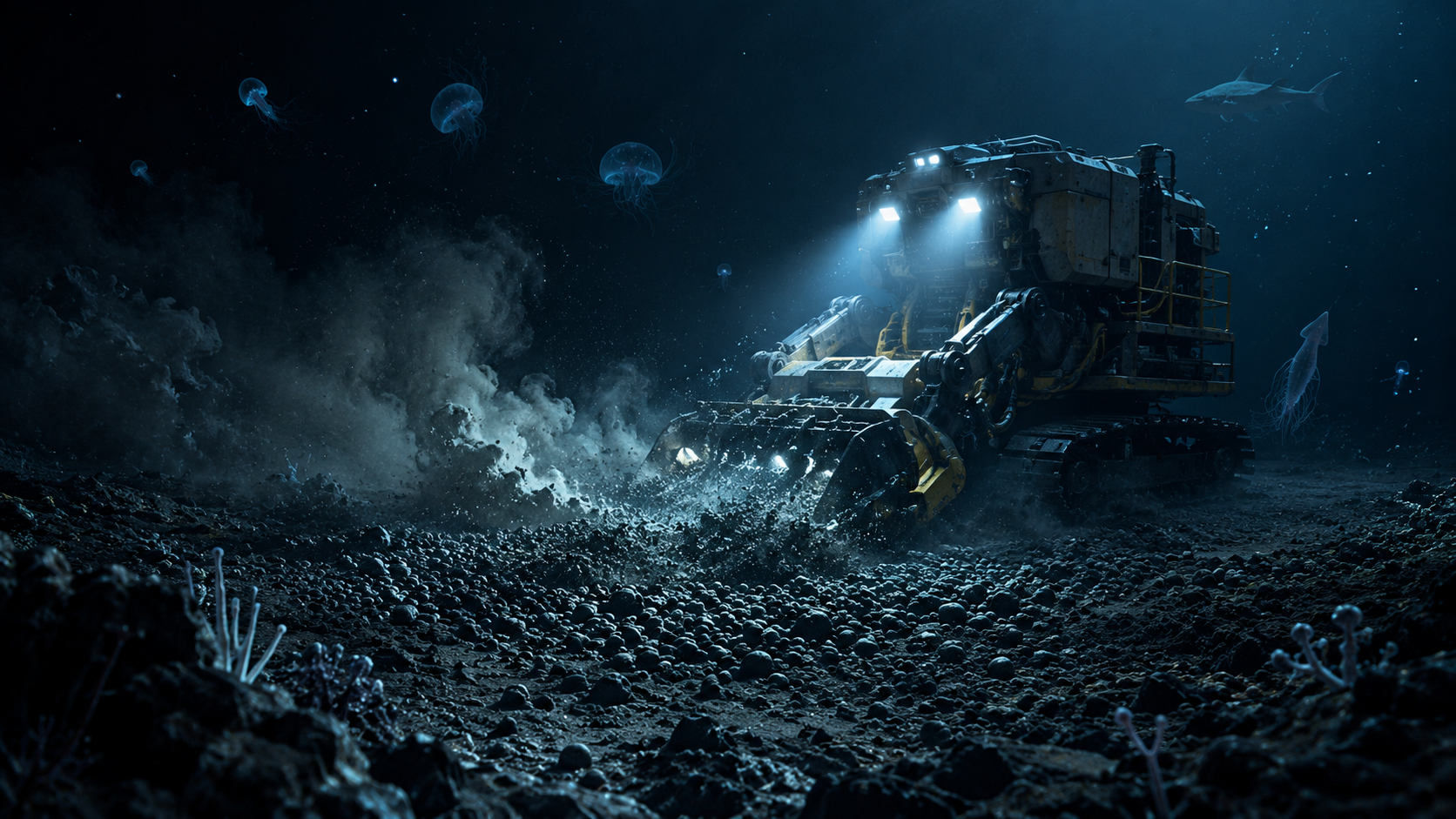
Polymetallic nodules scatter across the seabed like black potatoes, containing nickel, cobalt, manganese, copper and other metals, making them a new focal point for batteries, electronics, military industry, and infrastructure supply chains. Supporters say deep-sea mining might cut down fewer forests, displace fewer villages, and produce less surface pollution than land-based mining. These claims are not entirely without reason. Land-based mining does indeed carry heavy human rights, environmental, and social costs. But pitting one destruction against another to see which is less ugly cannot automatically become ethics.
Opponents worry that the recovery scale of deep-sea ecosystems is not an election cycle or a corporate quarterly report. Seabed disturbance, sediment plumes, noise, light pollution, habitat removal—all can affect a very slow, very dark, and extremely hard-to-study life system. Deep-sea organisms do not behave like social media users who immediately post complaints when disturbed; they simply disappear, migrate, or die, then become a number in parentheses within an environmental impact assessment report.
We still don't understand how the deep sea breathes
More troubling is that deep-sea science itself has many unknowns. For example, research disputes between polymetallic nodules and "dark oxygen" remind us that even seabed chemistry and life interactions are not fully understood. This should not be simplified to "scientists disagree, so industry can proceed." On the contrary, when knowledge is uncertain, governance should be more cautious, not more eager to approve.
Deep-sea mining is also a data governance issue. Who owns deep-sea data? Who sets environmental baselines? Are corporate monitoring reports public? Can international regimes handle conflicts between company interests, national interests, and the common interest of the ocean? If data are opaque, so-called risk assessments easily become high-level prayers. Reports can be very thick, but the seabed will not therefore be safer.
Energy transition should not become a new colonial submarine version
There is also a larger black comedy here: we say we mine for energy transition, yet rarely discuss demand management seriously. Must all electric vehicles keep getting bigger? Must all AI systems expand without limit? Should all consumer electronics be replaced annually? If civilization refuses to curb demand and merely extends supply chains deeper, it is not transitioning; it is dressing old greed in new batteries.
Deep-sea mining should neither be simply demonized nor easily sanctified. It requires scientific baselines, long-term monitoring, transparent data, international regimes, stop mechanisms, and public review. Most importantly, it needs a civilizational patience that does not rush to turn the unknown into assets on balance sheets. Such patience is uncommercial but necessary.
The last black box should not be used for charging first
Humans often say they want to explore the unknown. But when we explore the unknown, one hand holds measuring instruments while the other already holds contracts. The deep sea is not a charger, not a trash can, and not a black box waiting for humanity to save its battery industry. It is Earth's most unfamiliar and fragile memory layer. When we finally have the ability to reach in, the first action should not be grabbing; it should be pausing.
If the cost of energy transition is dragging another world that has yet to be understood into industrial logic, then this transition deserves re-examination. The deep sea does not exist for the sake of making surface civilization continue to shine. It owes us no batteries and no future.
Further Reading and Sources
- International Seabed Authority
- Reuters: The Metals Company and seabed mining application
- Nature Geoscience: dark oxygen debate and editor notes
AI use and content-safety disclosure
This article was compiled and edited through Yuan Media AI's editorial workflow, then reviewed by human editors before publication.