Deep Space Memory Project #5: Voyager Still Speaks, Earth Almost Forgets How to Listen
Original Chinese title: 深空記憶計畫之五:旅行者號還在說話,地球卻快忘記怎麼聽
Voyager still speaks from the dark. While Earth manufactures countless messages daily—short videos, AI summaries, and algorithmic noise—the old probe maintains a nearly impossible signal line across deep space with dwindling power.
Lawrence Lee | Technology Journalist, Science Fiction Critic, and Space Science Educator
Long-term focus on space exploration, sci-fi narratives, technology culture, and public science education.
# Deep Space Memory Project #5: Voyager Still Speaks, Earth Almost Forgets How to Listen
The Echo from Deep Space Carries More Weight Than the Noise on Earth
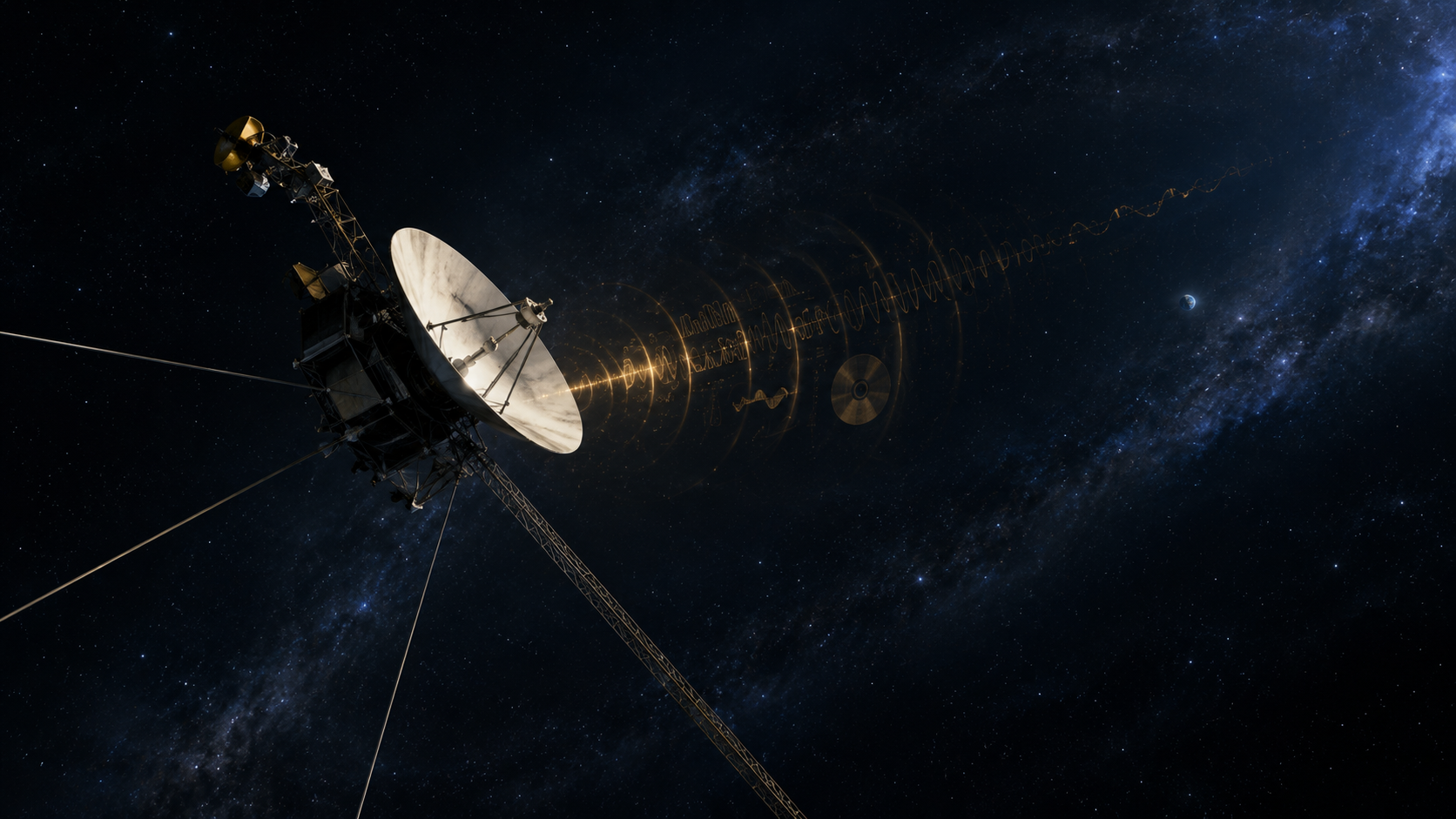
Voyager still speaks. That statement itself is somewhat astonishing. The old probe launched in 1977 has passed Jupiter and Saturn, left the planetary theater, crossed the boundary between solar wind and interstellar medium, and now continues to send weak signals back to Earth from the darkness of space. It has no pretty interface, no social media account, no subscription alerts, and certainly won't announce every three days that it's changing the world like some AI products do. It simply flies silently, occasionally speaking.
This kind of echo is extremely precious because it is not real-time communication but deep-time communication. The signal takes a long time to travel; engineers must wait a long time for replies. Deep space does not respond instantly; the universe has no read receipts and won't kindly inform you that "the other party is typing." In an era where three-second short videos are already considered too long, Voyager acts like an extremely old-fashioned elder: it speaks little, but every word is true.
The Golden Record Is Not a Database, It's Civilization's Self-Introduction
What fascinates people about Voyager is not just how far it has flown, but that it brought humanity's anxiety about "being remembered" to the edge of the universe. The Golden Record is the most beautiful packaging of this anxiety. That gold-plated copper disc contains natural sounds, music, images, and greetings in multiple languages—like a bottle message Earth writes for unknown recipients. It is not a database, not an encyclopedia, nor a Ministry of Culture year-end report. It resembles more like a bottle message: if anyone picks it up, please know we were here.
But every self-introduction involves editing. The Golden Record presents the Earth as seen by curators from a particular era and group. It has poetry and selection; sincerity and omissions. War, colonization, language loss, poverty, environmental destruction—these certainly do not become featured tracks. This is not to blame the Golden Record, but to remind us: all civilizational memories are selected. The issue is not whether we can select, but who selects, for whom, and by what standards.
AI Organizes Memory, It Can Also Wash Away Memory
The AI era makes this question sharper. Today, if we were to produce an "Earth Memory 2.0," AI would certainly be invited into the meeting room. It can assist in organizing corpora, translating languages, repairing audio, classifying images, generating summaries, and even simulating symbol formats that extraterrestrial intelligence might understand. This sounds powerful but also dangerous. Because AI is very good at organizing yet not necessarily at restraint; it fills gaps well but may not respect silence; it generates answers readily but may not know which questions should remain unanswered.
Voyager's signal grows weaker, paradoxically reminding Earth that more sound does not mean better communication. Earth now brims with sounds—news, commentary, videos, ads, model outputs, social media arguments, platform notifications—but often doesn't know what it truly wants to say. Voyager counters our information flood with a weak signal: the voices worth preserving do not need to be loud.
Deep Space Memory Is Also a Cultural Data Governance Issue
This is also the core of why this is the fifth installment of the Deep Space Memory Project. The last sounds humanity leaves behind may not be the loudest, but the most responsible. For Yuan Media AI, this matters deeply regarding Indigenous languages, oral histories, local memories, and cultural data sovereignty. Not all sounds should be uploaded; not all stories should be learned by models; not all knowledge can be summarized into pretty paragraphs. A truly mature memory system must know how to preserve boundaries.
The Golden Record's value lies not only in carrying Earth's sounds away but also in making humanity seriously imagine: if we could leave only one letter, what would go inside? Today's AI world is the opposite—we want to put everything in, as if more data means a safer civilization. But data is not memory; accumulation does not equal understanding. Often, more data makes it easier to forget who was deleted, misread, or forced into public view.
Earth Almost Forgets How to Listen
Voyager will eventually fall silent. Its power will decay, instruments will shut down, and one day Earth may no longer receive its signals. But that does not mean the story ends. It continues flying like an archive without viewers, a witness that no longer replies. It tells us civilization is not proven by being always online but by what we willingly hand to the future.
Earth almost forgets how to listen. This is not a scientific problem but a civilizational one. When we turn everything into data, all memories into cloud storage, and all sounds into trainable material, what we most need to learn may not be how to speak more but how to listen deeper. Voyager still speaks. What is truly unsettling is that what it says may not be the universe's secret, but human patience we are almost forgetting.
Further Reading and Sources
- NASA Voyager Mission
- NASA Golden Record Overview
- NASA Voyager Instruments and RTG mission notes
AI use and content-safety disclosure
This article was compiled and edited through Yuan Media AI's editorial workflow, reviewed by human editors before publication.