Urban Animals Are Not Failures of the Wild: Crows, Coyotes, and Raccoons Are Autopsying Civilization
Original Chinese title: 城市裡的動物不是失敗的野生:烏鴉、郊狼與浣熊正在替文明驗屍
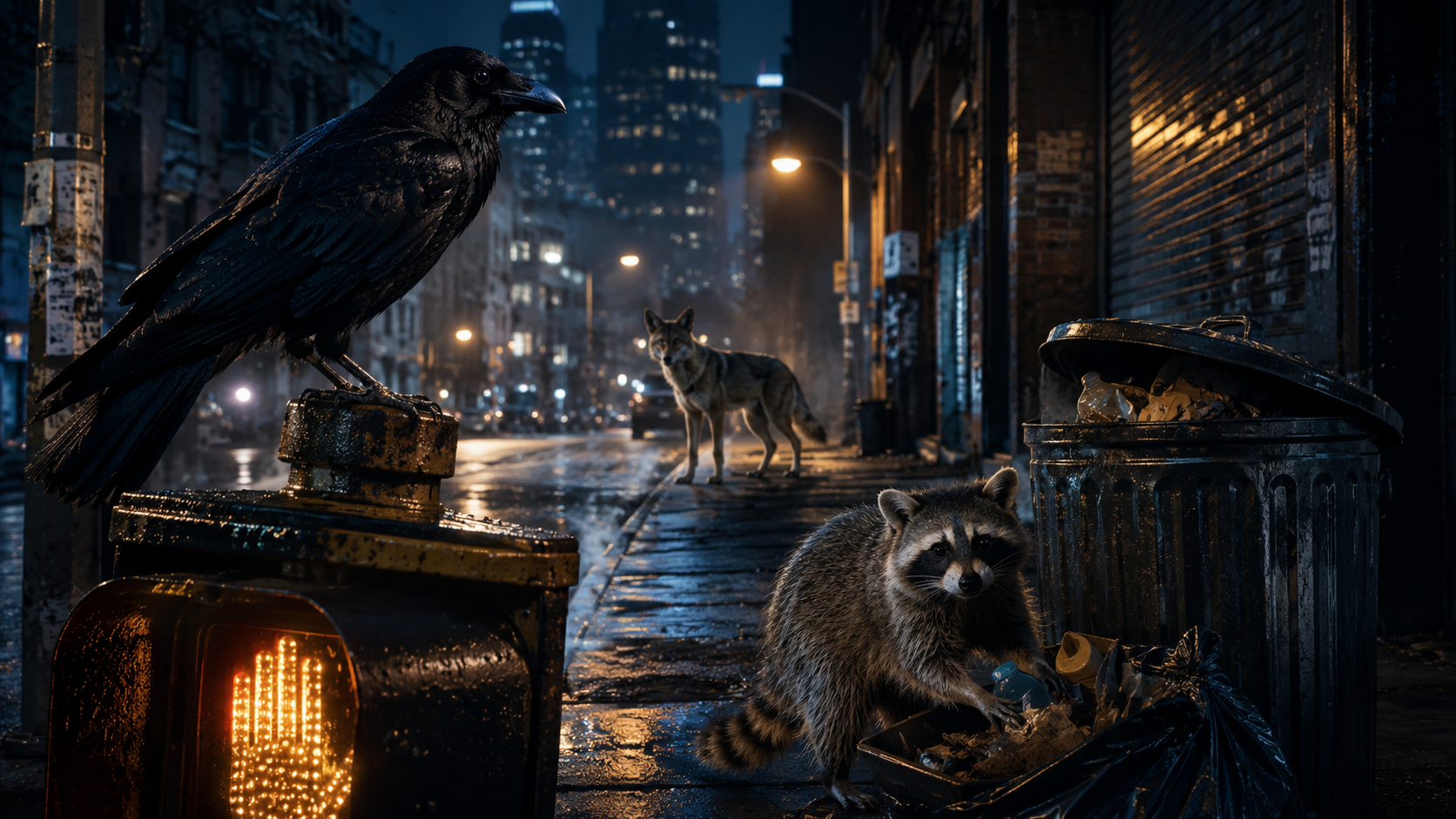
Urban wildlife are not natural failures but adaptors under urban stress. When animals learn to exploit trash, noise, building gaps, and human carelessness, they are actually pressure-testing civilization.
Yuan Media AI Editorial Desk
Consultant: 高德生
Focuses on public issues, technology governance, environmental ethics, cultural data, and social observation; handles cross-domain topics in a commentary tone.
# Urban Animals Are Not Failures of the Wild: Crows, Coyotes, and Raccoons Are Autopsying Civilization
Urban Cities Are Not Just for Humans; It's Only That Humans Have Always Thought So
Urbanites have a very cute narcissism: anything not arranged by humans is called an invasion. Tree roots breaking through sidewalks are trees being too wild; birds nesting on air conditioners are birds not understanding building regulations; coyotes appearing in communities are wildlife crossing boundaries; raccoons flipping trash cans are furry moral criminals.
But from the animals' perspective, the city is the most absurd forest. Here there is a non-seasonal food source called trash cans; artificial canyons called skyscrapers; night suns called streetlights; large primates that don't hunt well but scream loudly called citizens. For some animals, humans are not city masters but noisy backgrounds creating resources.
Coyotes Are Not Crossing Boundaries; Humans Have Built the Boundaries Badly
Recent urban ecology research increasingly clearly points out that animals are not just "intruding" into cities but adapting to them. Urban coyotes in many US locations show greater willingness to approach and linger around novel objects compared to rural coyotes; researchers warn this does not mean they are more aggressive, but rather less afraid of unfamiliar stimuli. This difference matters because human media loves to write "not afraid of humans" as "preparing to attack humans," as if animals that don't immediately flee have already started planning crimes.
Often we misread animal adaptation as threats and our own carelessness as natural loss of control. Garbage not collected well, blame raccoons being smart; pets let roam, blame wildlife approaching; city expansion to habitat boundaries, blame animals not understanding cadastral maps. Civilization's favorite black humor is first building others' homes into parking lots, then accusing them of trespassing on the parking lot.
Raccoons and Crows Are Actually Urban Stress Testers
Raccoons provide another more absurd case. Urban raccoons exploit trash, pet feed, yards, and human schedules to become one of the most skilled resource managers in night cities. They are not failed wild but successful readers of human loopholes. This ability is not worth romanticizing nor should it be demonized. It simply reminds us: cities have never been closed human works but multi-species laboratories. Only this laboratory's ethics review committee usually has only humans, and they often arrive late to meetings.
Crows, pigeons, squirrels, foxes, coyotes, raccoons all learn in their respective urban versions. They memorize routes, identify dangers, exploit human schedules, avoid traffic, steal food, even alter breeding and activity rhythms. Cities are no longer just concrete and crowds but a new habitat composed of noise, heat islands, light pollution, food waste, building gaps, and transport networks.
Media Turns Animals into Cute or Terrifying; Cities Don't Need to Reflect
Media likes to portray urban animals in two roles: cute or terrifying. Raccoons are trash pandas, coyotes potential threats, crows ominous omens, monkeys tourist chaos. This classification is convenient for traffic but not for understanding. Animals are not short video material; they are living indicators of city governance failure, food waste, habitat fragmentation, and human imagination poverty.
A truly mature city does not clear all non-human life but learns to manage boundaries. Waste management, pet responsibility, habitat connectivity, night lighting, road crossing design, public education are more effective than panic-driven culling. If humans only use "expulsion" for urban animals, our urban planning level is probably just a bit higher than brooms.
Looking at Animals Through Hunter Knowledge Is Not Turning Them into Symbols
Here we can also form a cautious dialogue with traditional animal knowledge. Many Indigenous Peoples' hunters and cultural historians do not treat animals as merely "resources" or "pests" but understand them within seasons, terrain, tracks, habits, taboos, and relationships. This does not mean directly applying urban ecology to traditional knowledge nor using any ethnic knowledge for pretty decoration. It reminds us: looking at animals cannot only see where they appear but also how humans have changed that place.
Consultant 高德生 has long focused on Tsou ritual ecology, hunter schools, and flora/fauna cultural history; this knowledge background reminds us: animals are not "abnormal events" in city problem lists but results of habitat, season, food, paths, and human behavior jointly acting. When we see animals only as invaders, we actually hide our responsibility for habitat change.
Urban Wildlife Is Autopsying Civilization
Urban animals are not failed wild. They are successful lives that have read human loopholes. They remind us civilization has never truly left nature but temporarily pressed it under asphalt roads. When a crow stands on streetlights watching us, it may not be predicting death. It is just thinking: these humans built such complex cities yet still cannot close trash cans properly.
If cities are honest enough, they should treat these animals as diagnostic tools. Where they appear often indicates problems in waste management, habitat fragmentation, night lighting, pet responsibility, and urban planning. They are not the opposite of city civilization but its autopsy report.
Further Reading and Sources
- Scientific Reports urban coyote behavior research
- Urban wildlife and rapid evolution studies
- Public ecology research on city animal adaptation
AI use and content-safety disclosure
This article was compiled and edited by Yuan Media AI editorial process, reviewed by human editors before publication.