Solar Storms Are Not Sci-Fi: When the Sky Sneezes, Earth's Power Grid Breaks a Sweat
Original Chinese title: 太陽風暴不是科幻:當天空打噴嚏,地球的電網就開始冒冷汗
From solar flares to geomagnetic storms, space weather is no longer just an astronomical curiosity—it’s a public infrastructure issue affecting our daily lives.
玄岸
Long-term observer of AI technology, chips, model economics, and supply chain shifts. Writing is cool, analytical, and satirical.
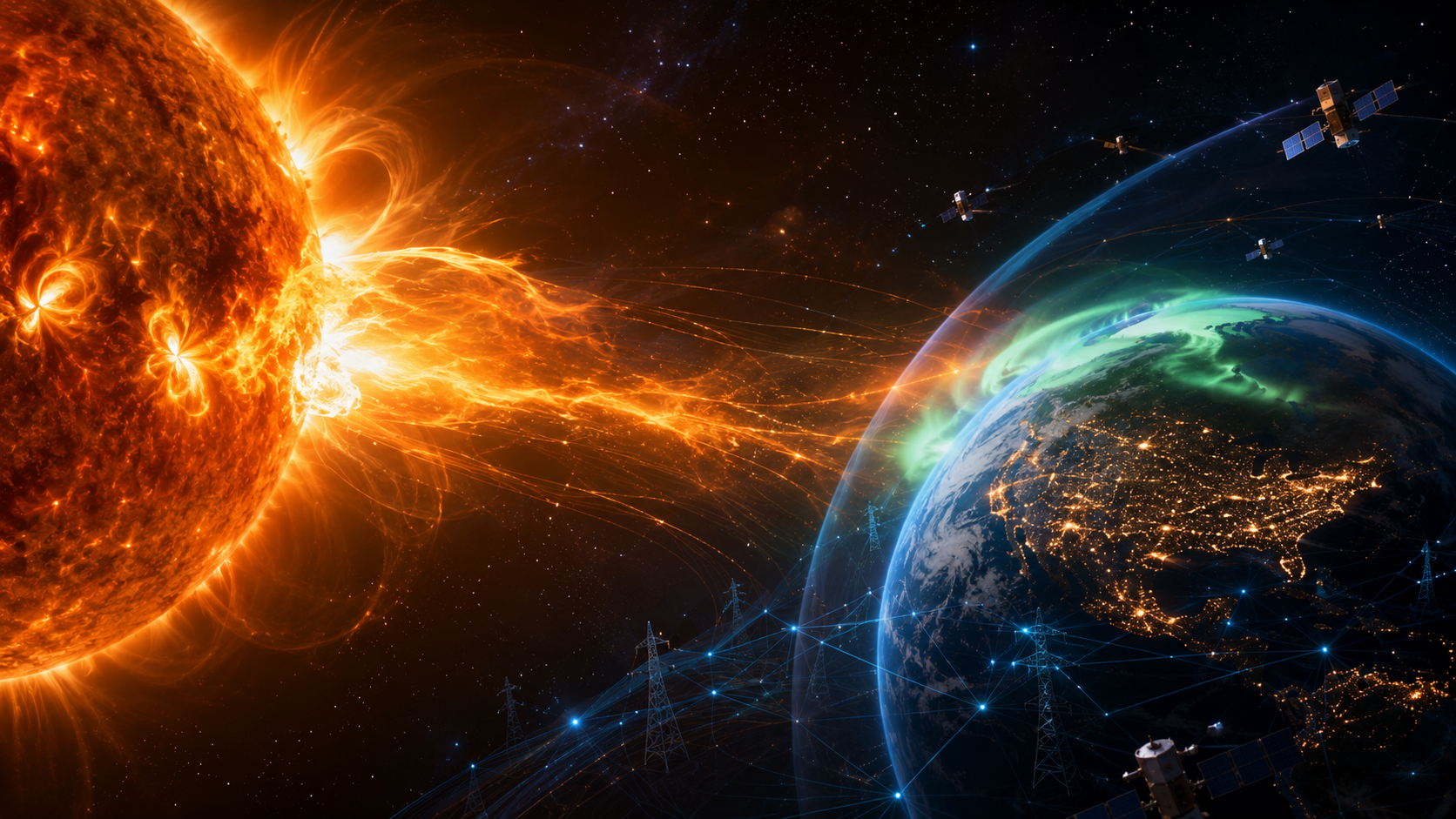
# Solar Storms Are Not Sci-Fi: When the Sky Sneezes, Earth's Power Grid Breaks a Sweat
Beautiful Auroras Behind Is Actually A Stress Test For Civilization
Solar storms are most easily photographed as beautiful auroras. As soon as it gets dark, the sky is like being painted with green and purple by someone, social media platforms quickly become tourism promotion pages. But for power grid engineers, satellite operators, air traffic controllers, and communications industries, solar storms are not romance; they are stress tests. Because we live today in a signal society, a synchronized society, an electrified society. As long as the sun sneezes slightly, many invisible systems on Earth will start coughing first.
Space weather sounds like a meteorologist suddenly going to work in outer space, but it is actually a reality problem that modern infrastructure must face. Solar flares, coronal mass ejections, high-energy particle streams disturb Earth's magnetic field and may affect satellites, power grids, navigation, and high-latitude aviation. In the past, humans mainly feared typhoons, floods, and earthquakes; today we also have to learn to guard against a star that is 100 million kilometers away from us and usually looks very quiet.
Not An Astronomical Issue, But An Infrastructure Issue
Modern society's dependence on satellites and electricity has turned space weather from "cold knowledge" into a public issue. Once navigation systems become unstable, aviation, shipping, logistics, financial timing, disaster preparedness scheduling may be affected; if large geomagnetic storms cause partial power grid anomalies, the problem is not just blackouts, but the entire highly interdependent social machine may experience chain tension. Humans have spent decades plugging life into the cloud, into power grids, into positioning and communications systems, which also means hanging civilization on a more fragile line.
The dark humor is that we often talk about technological civilization like an all-purpose toolbox, as if with enough computing power, enough data, enough chips, all uncertainties can be minimized. But the sun does not sign SLA, nor will it converge activity intensity because you have data centers. It doesn't care whether we are opening markets today, going to the cloud, or having video conferences. The universe has no customer service phone; this is worth modern civilization reviewing again and again.
Taiwan Should Not Treat This As Someone Else's News
Space weather is not far from Taiwan. Taiwan highly depends on power grids, submarine cables, satellite positioning, and high-tech manufacturing; any risks related to power stability, communication accuracy, navigation reliability are not just international news supporting roles. Especially when we talk about digital transformation, resilience cities, high-tech supply chains, AI and cloud infrastructure at the same time, we cannot pretend the sky is just background.
This also shows that public science should not only appear "when it's beautiful." Auroras can be a good entry point, but good popular science cannot stop at photo check-ins. What society needs to know is: what is space weather? How is it monitored? Which industries and systems are most vulnerable? How should governments and enterprises prepare? Once alerts rise, how do backup and response start? These questions are not glamorous, but far more important than filters.
Truly Mature Civilization Is Not Just Awe-Inspired
Facing space weather, what humans truly need to do is not render panic, but improve resilience: better monitoring, clearer warnings, sturdier power grid protection, complete satellite and communications backup, mature cross-departmental coordination. To put it directly, a mature civilization does not just awe at auroras; it knows there is engineering behind the beauty.
Solar storms are not sci-fi; they simply remind us: even advanced societies still hang on natural conditions. When the sky sneezes, the first to break a sweat may not be astronomers, but the entire modern civilization that has turned itself into a circuit diagram. Auroras are certainly beautiful, but more important than beauty is whether we finally admit: humans did not conquer the universe; they just temporarily live next to a star with a relatively good temper, plugging life too full.
AI use and content-safety disclosure
This article was compiled and edited by Yuan Media AI editorial workflow, reviewed by human editors before publication.