The Goblin Shark in the Deep: A Rare Image Reminds Us How to Watch the Unknown
Original Chinese title: 深海鏡頭裡的尖吻鮫:一段珍稀影像提醒我們如何觀看未知
From rare images of the goblin shark reported by Live Science and Journal of Fish Biology, this piece discusses deep-sea observation, scientific storytelling, and avoiding the demonization of unknown species.
Lawrence Lee
Author for Yuan Media AI on science and nature observation, focusing on the deep sea, space, and how humans record worlds that are hard to reach.
# The Goblin Shark in the Deep: A Rare Image Reminds Us How to Watch the Unknown
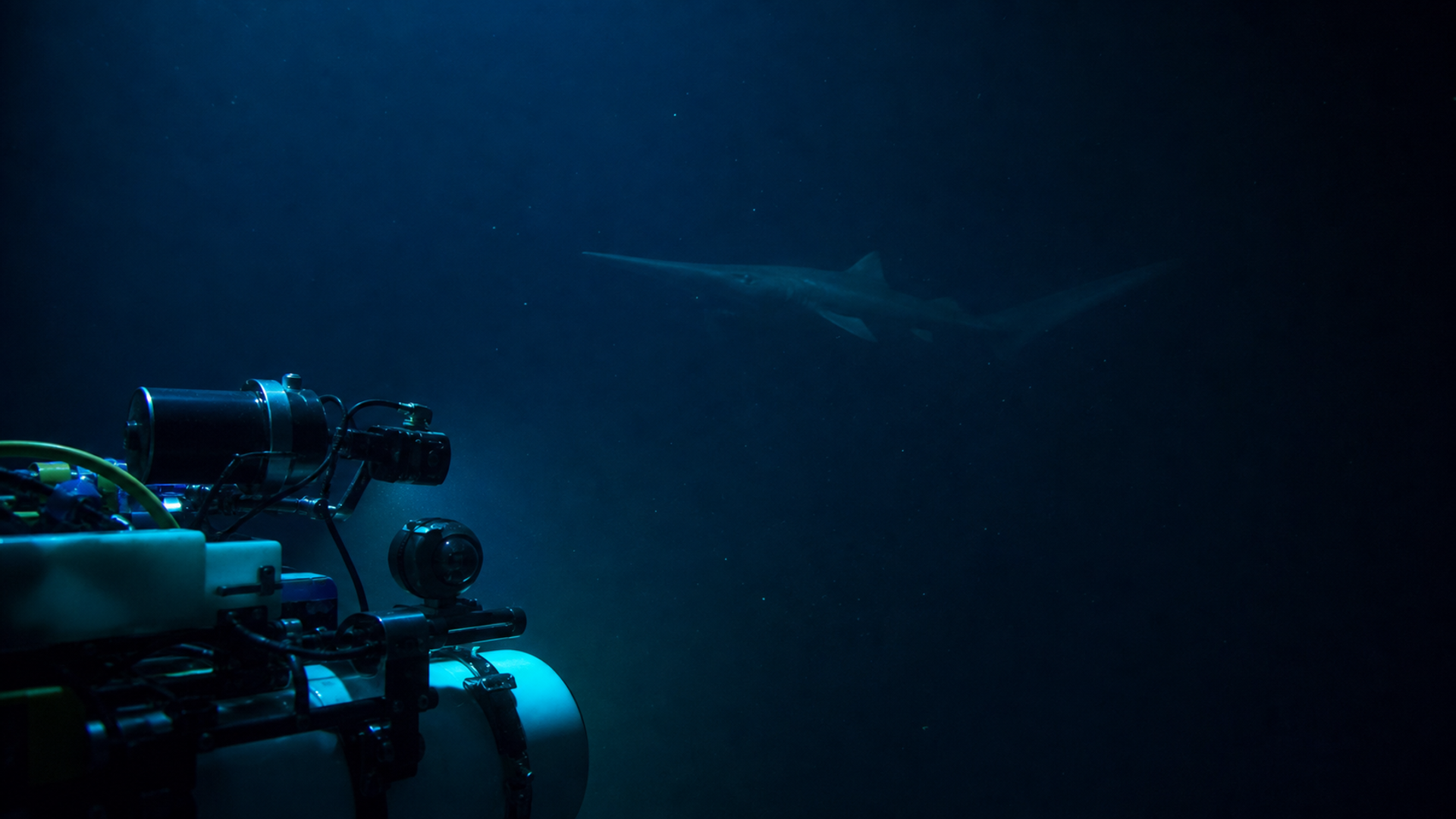
Deep-sea news is often forced into an ill-fitting costume: monster, alien, horror, never-before-seen. The goblin shark, also commonly called the goblin shark, is precisely the kind of narrative that most easily gets draped over it. It has a protruding long snout and jaws that can extend forward, making its appearance quite different from the sharks most people are familiar with. But when remote deep-sea cameras capture a rare figure, what science truly values is not whether it looks like a ghost story, but how the image itself fills in a missing piece of an ecological puzzle.
Rareness Is Not Permission to Mystify
Deep-sea species may be rare not because they are so scarce that they are nearly gone, but because human observation capacity is too limited. The deep sea is vast, high-pressure, low-light, and expensive; scientific vessels and remotely operated vehicles can only stay for short periods. Most of our knowledge about deep-sea life comes from accidental captures, specimens, acoustic signals, or brief images. Each clear or unclear record lights up a small coordinate in the great darkness.
Images of the goblin shark are therefore especially valuable. They mostly live in deeper waters and are not easily observed directly. If an image provides depth, location, posture, surrounding environment, and time of capture, researchers can cross-reference it with existing specimen records, catch data, ocean currents, and bathymetry. These seemingly calm details come closer to science than any sensational headline.
Deep-sea photography changes our sense of time
In the past, human understanding of the deep sea relied on objects "brought back": specimens hauled up by trawls or sediments retrieved by samplers in laboratories. Now, remote cameras, baited cameras, ROVs, and long-term observation stations allow scientists to wait without immediate intervention. This waiting is slow; sometimes hundreds of hours yield only a few seconds of footage, but it changes our relationship with the unknown.
The deep sea is not an empty backdrop but a rhythmic ecosystem. Some species may migrate upward at night, some individuals may feed along the seafloor topography, and certain behaviors may appear only under specific seasonal or water-mass conditions. If we rely solely on captures, we see life removed from its environment; with long-term imaging, we begin to see how life acts in place.
Not turning the unknown into horror entertainment
Public communication has a responsibility here. The goblin shark's appearance does attract attention, but calling it a monster makes people forget that it is simply an evolutionary adaptation to deep-sea conditions. Its long snout may be related to sensing prey; its extendable jaws are part of its feeding mechanism; its pale coloration relates to low-light conditions in the deep sea. In other words, features that seem strange to humans are not abnormalities for the animal but ways of life.
This is also the language needed for deep-sea conservation. As seabed mining, deep-sea fishing, cable laying, and climate change simultaneously alter the deep ocean environment, we cannot merely gasp briefly when a rare creature is photographed. The real question is: do we have enough data to know where they live? Do we understand how human activities will affect them? Can we exercise restraint in the deep sea before fully understanding it?
A single deep-sea image may look brief but could represent years of technology, voyages, and waiting. It reminds us that science does not instantly turn the unknown into the familiar; it acknowledges that the unknown has its own scale. When a goblin shark passes by from afar in the lens, it is not performing for humans nor coming for headlines; it simply swims through its own sea. Recognizing this may be the most basic courtesy we can offer when watching the deep.
Images also need to be properly preserved
The value of deep-sea images lies not only in a momentary view on social media. If they are properly archived with depth, temperature, coordinates, equipment, bait, exposure time, and interpretation limits, they can be re-analyzed years later. New image-recognition models might compare swimming postures; oceanographic data could explain the water-mass conditions at the time of appearance. A seemingly blurry segment today may become key evidence for understanding distribution ranges and behavioral patterns.
Therefore, scientific communication should not only ask whether this is the first, deepest, largest, or strangest. Better questions are: has this record entered a citable database? Can other researchers verify it? Does it avoid using location information in ways that could harm the species? Accumulating deep-sea knowledge depends on both surprise and discipline; without the latter, surprises quickly dissipate.
For general readers, this way of watching is also important. Seeing deep-sea life as neighbors on the same planet rather than monsters in a curiosity showcase makes us more willing to acknowledge the value of the unknown when discussing development, conservation, and research budgets.
Source verification
- Live Science's report on rare goblin shark deep-sea images, used to confirm the news context of the image.
- Journal of Fish Biology records, used to verify scientific publication and species information.
- This article is original commentary and synthesis; it does not copy long passages from source articles.
AI use and content-safety disclosure
This article was compiled from public sources by Yuan Media AI's editorial process, cross-checked and rewritten as original commentary; the cover image is AI-generated and does not use news photographs or identifiable people.