Organ-on-a-chip meets AI: Non-animal research is not a shortcut, but science closer to humans
Original Chinese title: 器官晶片遇上 AI:非動物研究不是捷徑,而是更接近人的科學
Organ chips, organoids and AI simulations are rewriting the front-end processes of biomedical research. They should not be understood as shortcuts to avoid animal experiments, but as tools that make drug safety, disease models and individual differences closer to human reality.
Yuan Media AI Editorial Desk
Tracking biomedical technology, AI research methods and research ethics, focusing on how new tools change public health decision-making.
# Organ-on-a-chip meets AI: Non-animal research is not a shortcut, but science closer to humans
Biomedical research is undergoing a methodological turn. The US NIH has established ORIVA to advance non-animal methods, and the FDA has proposed pathways to reduce reliance on animal testing in parts of drug development, placing organ chips, patient-derived organoids, 3D tissue models and AI simulations on the same policy map. This is not simply an animal welfare issue nor a slogan for regulatory loosening; it points to a long-standing scientific problem: many results that are effective or safe in animals do not necessarily hold in humans.
Models closer to humans
Traditional animal models have enabled major advances in modern medicine, especially in toxicology, safety and physiological mechanism studies. Yet species differences between animals and humans exist, and diseases are often simplified into controllable experimental settings. As drug development costs rise and clinical failure rates remain high, the scientific community naturally asks: can we use human cells, human tissues and human data earlier to build test environments closer to patients?
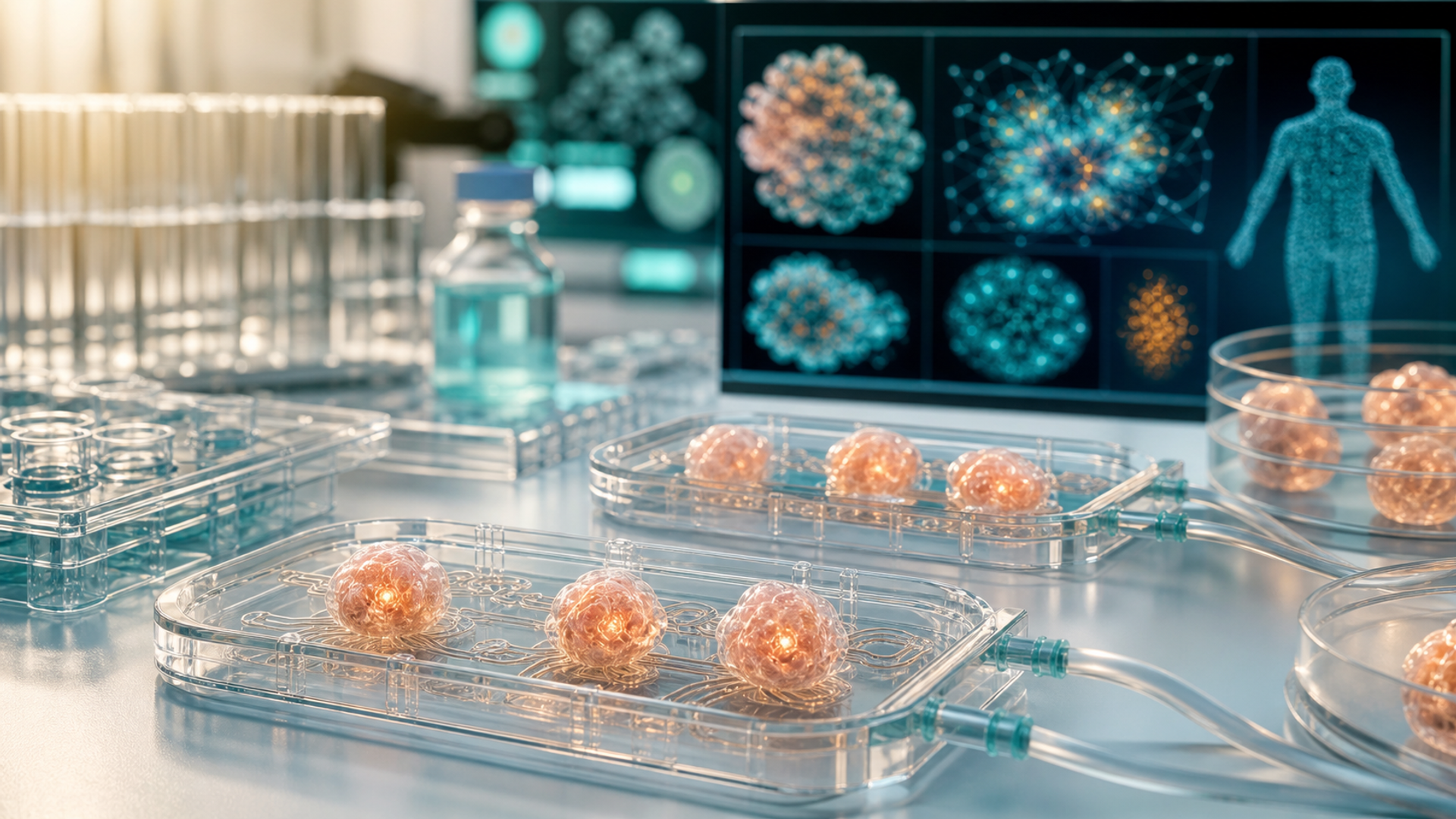
The value of organ chips lies in placing living cells into microfluidic systems that simulate blood flow, pressure, drug concentrations and tissue interactions; organoids allow researchers to culture miniature structures with partial organ characteristics from stem cells or patient cells. They are not whole humans nor universal substitutes, but they fill gaps past models could not see. For example, the chain reactions of a single drug on liver metabolism, gut absorption and cardiotoxicity may be detected earlier through multi-organ chips and AI simulations.
AI is not the judge, but the magnifying glass
AI’s role here should not be misunderstood as making final judgments for researchers. A better metaphor is a magnifying glass and navigation system. It can analyze vast amounts of microscopic images, gene expression, protein signals and drug response curves to find patterns difficult for human eyes to reliably identify; it can also build computer models to estimate distribution, metabolism and side-effect risk under different physiological conditions.
But for AI models to be trustworthy, they must still confront data sources, validation standards and bias issues. Do organoids represent diverse populations and ages? Are patient cells sufficiently diverse? Is the chip environment overly idealized? Can AI predictions be independently replicated by experiment? These questions determine whether non-animal methods become rigorous science or merely polished presentation language.
Regulatory shifts require patience
Policy signals from the FDA and NIH matter because regulatory bodies must recognize new methods before industry can incorporate them into formal R&D workflows. However, recognition does not equal immediate replacement. For non-animal methods to enter drug review, they must accumulate comparable, reproducible and interpretable evidence, and establish applicability boundaries across different disease and drug types. Some safety questions may still require animal data; other areas might soon be better served by human-relevant models.
What is truly worth anticipating is a shift in research culture. In the past, animal experiments were often seen as mandatory checkpoints; future mature questions should be: for this scientific problem, which model best answers human risk? If organ chips, organoids, clinical data and AI simulations can calibrate with each other, researchers are not merely reducing animal use but also improving understanding of humans.
Non-animal research is not a shortcut. It resembles a harder path that is closer to clinical reality. It demands joint work among engineering, cell biology, statistics, AI and regulatory science, and it asks society to place ethics and accuracy in the same question. When tiny organs in labs light up signals, we see not just technological progress but medicine finally asking seriously: can human disease be studied in ways more like humans?
For patients, accuracy is also ethical
When discussing non-animal methods, society often simplifies ethics to using fewer animals. But for patients, ethics also includes whether research is sufficiently accurate, whether it can earlier exclude ineffective or dangerous candidate drugs, and whether it avoids excluding minority groups and rare disease patients from models. If organoids come from diverse patient cells and AI analysis incorporates age, sex, genetic background and comorbidity differences, there is a chance to see problems that were only exposed in later clinical trials much earlier.
This also demands data governance keep pace with experimental technology. Patient-derived cells are not ordinary materials; they carry consent, withdrawal, de-identification, commercial use and feedback issues. For non-animal methods to become better science, they cannot pursue model refinement alone; they must ensure that people providing cells and data understand how their contributions are used. When human-relevant models truly respect humans, they deserve the name.
In coming years, what is most worth watching is not which method will be declared to replace all experiments, but whether regulators, academia and industry can establish shared validation standards. Only when failure cases are also publicly learned from will new methods accumulate genuine credibility.
Source verification
- Axios reporting on NIH ORIVA and non-animal research methods, used to confirm policy context.
- Reuters reporting on FDA promotion of non-animal methods with AI, organ chips and organoid applications, used to confirm regulatory direction.
- This article is original commentary and synthesis; no long passages from source articles are copied.
AI use and content-safety disclosure
This article was compiled, cross-checked and rewritten as original commentary by the Yuan Media AI editorial process based on public sources; cover image generated by AI, no news photos or identifiable people used.