Fish Schools Are Not Excel Spreadsheets: Who Speaks for the Sea in the Blue Transformation Era?
Original Chinese title: 魚群不是 Excel 表:藍色轉型時代,誰替海說話?
Global fisheries and aquaculture are entering a 'Blue Transformation' era: farmed production now exceeds wild catch for the first time, seafood demand keeps rising, yet overfishing and marine ecological stress persist. The issue is not simply whether to eat fish or not; it is that ocean governance cannot rely only on yield tables, satellite maps and market prices.
鄭淑禎
# Fish Schools Are Not Excel Spreadsheets: Who Speaks for the Sea in the Blue Transformation Era?
Ocean Is Not a Large Supply Table
When humans talk about the ocean, the most common mistake is to treat it as a large supply table.
Fish have yields, ships have tonnage, ports have prices, markets have demand; everything ends up neatly placed into annual reports. The tables look clean, like a freshly wiped conference table. The problem is that fish schools do not live inside Excel. They dwell among currents, temperature, sound, spawning grounds, fishing pressure, plastic debris, climate anomalies and human appetite. If ocean governance reduces to only numbers, it will ultimately become a kind of high-level deafness.
FAO global fisheries data remind us that the world is entering a critical turning point: aquaculture production has now surpassed traditional capture fisheries. This is major for food security and also major for marine ecosystems. Humans finally acknowledge that wild oceans are not infinite ATMs, so part of demand shifts to farming. But the black humor here is this: we did not suddenly become more restrained; we discovered the sea was being eaten by the ATM. When the curves in reports look beautiful, relationships inside the sea may already be deformed—that is precisely the crack most easily overlooked in blue governance.
Blue Transformation Cannot Simply Paint Old Words Sea-Blue
'Blue transformation' sounds beautiful. Blue economy, blue carbon sinks, blue food, blue finance—seemingly just painting old words sea-blue would automatically make them sustainable. But for coastal communities and small-scale fishers, the sea is not a policy term; it is the daily life site where judgments must be made. If today's wind direction is wrong, if wave sounds change, if fish schools do not come ashore, if port prices collapse, if fuel costs rise—these are not blue gradient backgrounds in presentations; they determine whether there will be one less dish on the family table.
Therefore, what ocean governance truly needs is not a choice between 'science or local knowledge', but Two-Eyed Seeing. Satellites can see large-scale sea surface temperatures, acoustic equipment can record whale and dolphin sounds and ship noise, environmental DNA can detect species traces in water; yet coastal communities know which seasonal winds bring which fish, which tide levels are unsuitable for going out to sea, which places must not be fished indiscriminately, which stories are actually memory versions of ecological rules. Science provides the ears of instruments; local knowledge provides the ears of relationships. Truly mature ocean governance should let these two pairs of ears correct each other, rather than letting one side subtitle the other.
Local Knowledge Is Not a Free Sensor
Here we must especially beware a new form of data colonialism: collecting fishers' experience into data without allowing them to participate in decision-making. Many research projects like to ask local communities: 'What do you know?' But the real question should be: 'Who will use what you know? To restrict whom? Where does benefit return?' If the data ultimately only helps large enterprises, distant fleets or platform companies fish more precisely, then local knowledge is not being respected but rather requisitioned.
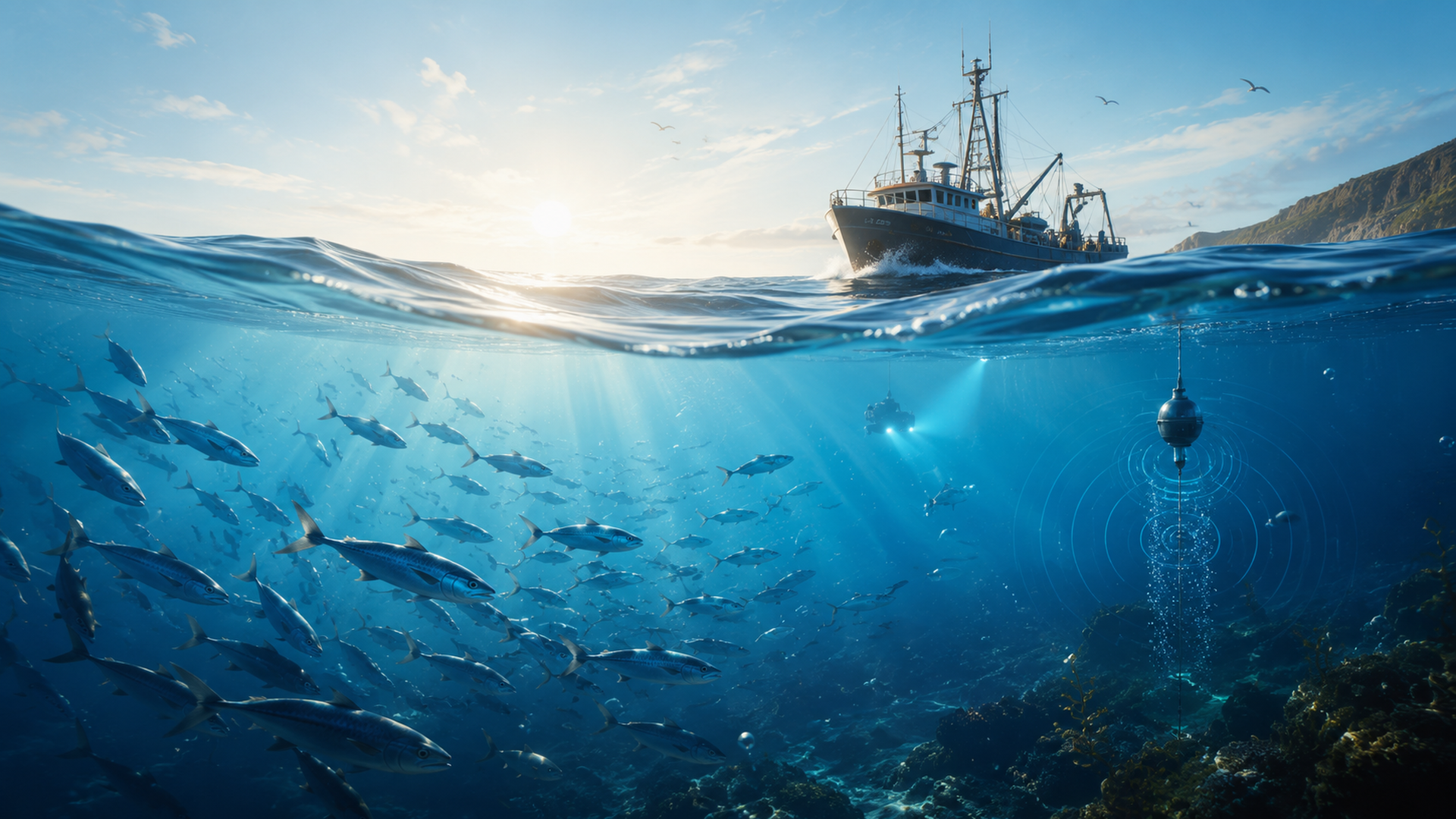
Ocean soundscape monitoring has recently gained attention and offers an interesting entry point. Humans have long assumed the sea is quiet—perhaps because our ears are designed unsuitably for it. In fact, the sea contains fish sounds, shrimp sounds, whale and dolphin sounds, coral reef sounds, as well as ship engines, detection sonar and construction noise. As the sea becomes increasingly noisy, some species cannot find each other, certain migration routes are disrupted, some reproductive behaviors are interrupted. The ocean is not a silent background; it is a city occupied by industrial noise. If we look only at yields and do not listen to sounds, we may wait until the ocean falls quiet before realizing that silence is not peace but life's departure.
Sea Is Not a Resource Warehouse, It Is a Network of Relations
If we place this matter within Indigenous Peoples and island community perspectives, the problem becomes more three-dimensional. Many coastal, estuarine, intertidal and island cultures have never treated the sea as a resource; they treat it as relations. Fish are not simply commodities, tides are not merely natural phenomena, taboos are not superstitions, seasons are not calendar decorations. Together they constitute a system managing human desires. Modern policy often translates these systems into 'cultural assets' and then holds separate meetings to discuss 'fisheries management'. This division is efficient but easily makes things worse.
We must acknowledge that the modern world cannot manage global seafood supplies solely through traditional experience, nor can it rely only on international institution reports to care for every local sea area. The truly difficult yet truly valuable work is connecting scales: from global yields to local fisheries, from satellite imagery to a captain's ears, from soundscape data to community taboos, from market demand to fish spawning. This is not romanticizing local knowledge; it is recognizing that ocean governance without local judgment will be like a beautiful map with no tides. Many small-scale fisheries' fragility comes not only from fewer fish but also from policy language being too distant and market risks being too close. When places can only be asked to conform to transformation yet cannot participate in defining transformation, blue governance becomes another kind of sea command written from the shore.
Fish schools are not Excel spreadsheets. The sea is not a supply chain waiting for human optimization. It is a vast network that reacts, goes silent, retaliates and also feeds people.
When we next see fish on our tables, let us ask less 'fresh or not' and more: from which ocean governance system does this fish come? If the answer remains only price, what we swallow may not be seafood but a whole set of failed policy proteins. True blue transformation is not making the sea better at earning money; it is finally teaching humans to be less presumptuous before the sea. If policies are willing to listen from the docks, they will discover many answers already embedded in wind, tide, fish signals and old captains' wrinkles; if technology slows down, it too will learn that data is not meant to replace human judgment but to help people renegotiate boundaries with the sea so future generations can still learn to recognize wind sounds and fish signals at the shore.
Further Reading and Sources
- FAO: The State of World Fisheries and Aquaculture 2024
- FAO: Blue Transformation overview
- NOAA and international ocean acoustic monitoring resources
AI use and content-safety disclosure
This article was compiled and edited through Yuan Media AI editorial workflow, reviewed by human editors before publication. The cover image was generated by AI and does not use news photographs or identifiable people.