Deep Space Memory Project No. 6: The Voyagers Are Running Out of Power, but Humanity Is Still Singing
Original Chinese title: 深空記憶計畫之六:旅行者號快沒電了,人類還在唱歌
Voyager 1 and 2 continue to work beyond the heliosphere, yet their power is waning. Humanity has etched sounds, images, greetings, and music onto the Golden Record, sending them into interstellar space; meanwhile, on Earth we let data platforms churn out short‑lived noise daily. The Voyagers remind us that true memory engineering is not about stuffing more data in, but deciding what deserves to be left behind before energy runs out.
Lawrence Lee | Technology Journalist, Science Fiction Critic, and Space Science Educator
# Deep Space Memory Project No. 6: The Voyagers Are Running Out of Power, but Humanity Is Still Singing
A nearly dead probe is more honest than a fully powered civilization
The Voyager probes most resemble human civilization not because they have flown far, but because they are running out of power yet keep talking.
This sounds like an old editor whose eyes are failing, whose keyboard is stuck, and who does not know who will pay the manuscript fee, yet still insists on finishing the last paragraph. Only Voyager has no fee; it has a nuclear battery that declines year by year and a faint stream of signals returning from deep space. To extend the mission, NASA must turn off instruments one by one, allowing this probe launched almost half a century ago to keep going. The universe shows no mercy; it will not grant extra voltage because you have historical significance.
This is why the Deep Space Memory Project deserves continued writing. While the AI world debates model size, data volume, and inference speed, Voyager reminds us of another matter: civilization's real problem is not whether we can generate, but whether we can leave something behind. It pulls technology out of victory narratives and reminds us that all great machines must eventually face material fatigue, energy decline, and signal loss. This is more honest than many sustainability‑themed briefings and more like true science.
The Golden Record is not a traffic commodity
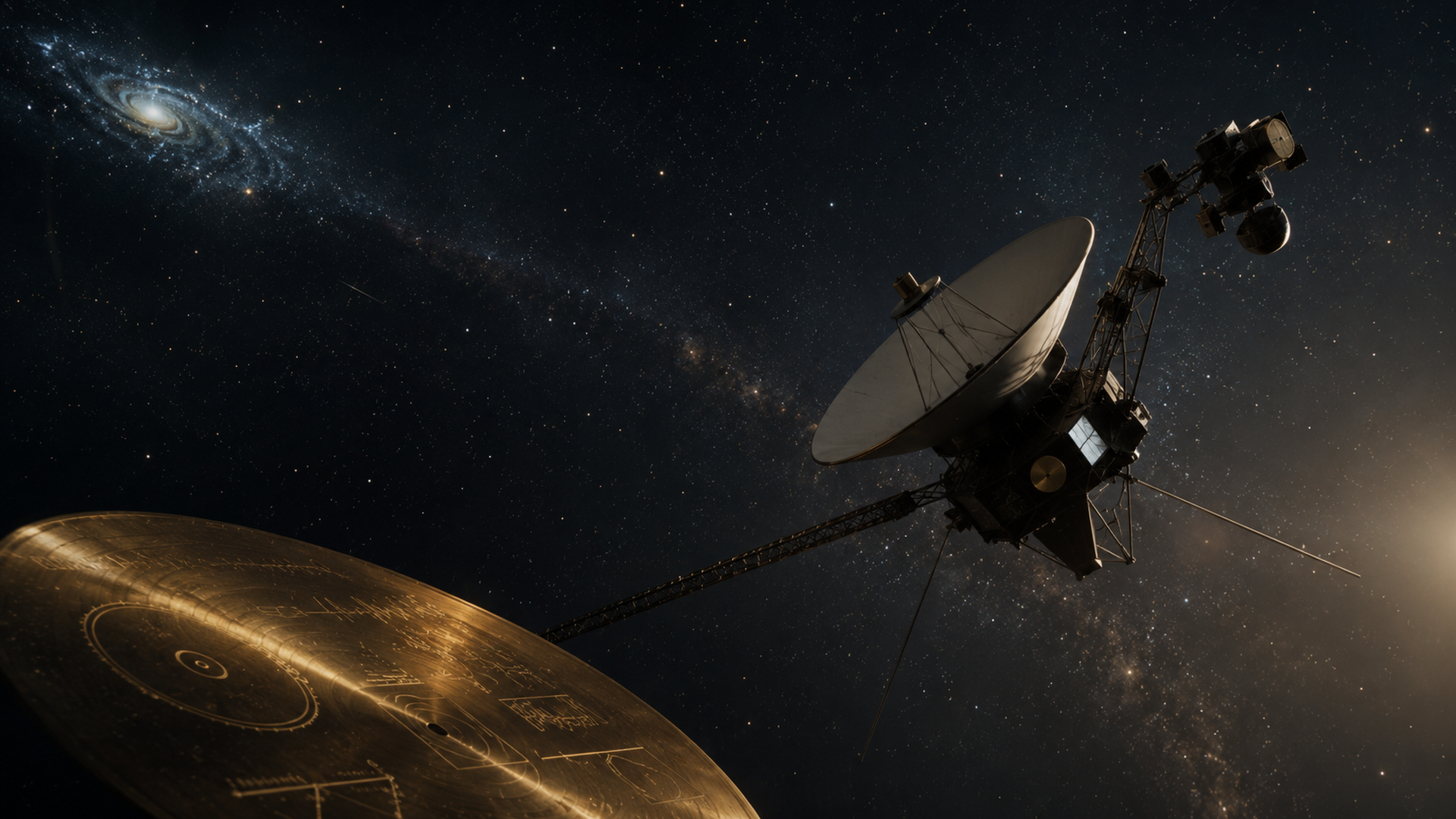
In 1977 humanity launched two Voyager probes. That year, many AI companies that exist today did not yet exist; smartphones were absent; social platforms had not been invented; even the modern ailment of turning breakfast into political manifestos was not fully widespread. Each Voyager carried a Golden Record. It was not an album release, it did not rely on charts, and there were no algorithmic recommendations. It was an extremely classical media form: Earth's sounds, images, natural noises, music, and greetings etched onto a physical object to be handed over to time.
The most cruel yet beautiful aspect of this record is that it may never have readers.
Modern media fears lack of traffic. Voyager is the opposite: it assumes it will not be liked, shared, or judged in comment sections. It simply tells the universe: here once lived a group of beings who were both cruel and gentle, capable of building rockets and waging wars, composing symphonies and writing trashy headlines; we may not deserve salvation, but at least we deserve to be recorded.
If AI remakes the Golden Record, the first version could be terrifying
Thus the question arises: if today an AI were to re‑compose an "Earth Golden Record," what would it include?
The first version might be terrifying. Models may pack in too many high‑resolution images, too many language samples, too many national propaganda films, too many corporate profiles, ultimately becoming a universe‑scale presentation. If extraterrestrial civilizations truly received it, they might politely remain silent for thirty thousand years. Humanity excels at turning important matters into databases and then turning those databases into disasters.
Voyager's lesson lies not in "data volume" but in "selection." The Golden Record is not a complete backup of Earth; it is an edited self‑portrait of civilization. It admits incompleteness, bias, and underrepresentation, yet still attempts to propose a narrative: Earth is not only war, borders, and industry; it also has thunder, bird calls, infant cries, music, greetings, and bodily scales. If AI participates in the next generation of deep‑space memory, it must first ask "which data should I not represent" rather than merely "how to compress more data."
Not every sound deserves to be sent away
This is especially important for Yuan Media AI. When we discuss Indigenous Peoples' languages, traditional knowledge, audio archives, and cultural databases, we cannot only ask "can it be stored," but must also ask "who selects, who may listen, and who has the right to remain silent." Some sounds suit public release; others belong solely to families, ceremonies, lands, and particular relationships. Sending every sound to the cloud is not memory preservation; sometimes it merely packages taboos as open data.
Voyager did not solve these issues; instead it made them clearer: when a dataset leaves its original Earth context and traverses interstellar space, can it retain ethics? If a song played by some intelligent life tens of thousands of years later is communication, misreading, or the echo of civilizational loneliness?
The AI era loves to proclaim "sustainable preservation." Yet we see the opposite reality daily: platforms collapse, formats vanish, accounts are banned, hard drives fail, cloud services change terms; yesterday's knowledge may become a 404 today. By contrast, Voyager's Golden Record is like an old, clumsy but honest person. It does not respond instantly, interact, or display intelligence; yet it knows where it is going and what it carries.
The last sounds may be the quietest ones
As Voyager instruments are turned off one by one, we are not watching a machine die; we are witnessing humanity's first interstellar media slowly entering silence. This silence is not failure. All truly long‑lived memories eventually become quiet. The point is whether, before becoming silent, it has spoken words worth speaking.
Thus the lesson of this Deep Space Memory Project episode is simple: do not treat the universe as a cloud backup and AI as an ancestral server. True civilizational memory requires power, material, language, selection, and humility. It also demands a less popular ability: acknowledging that the future may never understand us, yet we must still speak as clearly as possible. This is not pessimism; it is basic courtesy when facing deep time. It reminds us that public science education is not merely explaining how rockets fly farther but helping society grasp that all long‑range missions require trade‑offs, patience, and respect for the unknown.
Voyager is running out of power. Humanity is still singing. This is both absurd and solemn. The black humor lies in the possibility that when extraterrestrial civilizations finally hear the Golden Record, we on Earth may have already forgotten our server passwords. Even more humorous: what endures longest may not be the most computationally capable model, but a record that knows its incompleteness yet still wishes to remain polite toward the unknown.
Further Reading and Sources
- NASA Voyager Mission Status
- NASA Voyager Golden Record Overview
- NASA/JPL Voyager mission updates and instrument notes
AI use and content-safety disclosure
This article was compiled and edited through the Yuan Media AI editorial workflow, reviewed by human editors before publication; the cover image was generated by AI and contains no news photographs or identifiable people.