The Deep Sea Is Not a Battery Warehouse: The Rare-Metal Frenzy Dives Civilization's Greed Four Thousand Meters
Original Chinese title: 深海不是電池倉庫:稀有金屬熱潮把文明的貪婪下潛四千公尺
Global demand for batteries, electric vehicles, and energy transition drives the need for rare metals. Deep-sea mining is thus rebranded as a future resource solution. The problem is that the deep sea is not an undeveloped blank zone; it is an ecological world whose extent humans still understand very poorly.
Yuan Media AI Editorial Desk
# The Deep Sea Is Not a Battery Warehouse: The Rare-Metal Frenzy Dives Civilization's Greed Four Thousand Meters
Civilization's Best Skill Is Pushing the Cost to Where It Cannot Be Seen
The deep sea is not a battery warehouse; it just happens to be far enough from consumer markets that many people mistakenly think costs do not exist.
New-energy transition, electric vehicles, energy-storage equipment, upgrades of digital devices—these in recent years almost all carry a sense of moral legitimacy. Who does not want to reduce carbon? Who does not want to lower dependence on fossil fuels? The problem is that when a technological transition is spoken of as ever more righteous, society becomes easier to relax its vigilance about side effects. Thus demand for metals such as nickel, cobalt, manganese heats up quickly; deep-sea mining begins to be packaged as an inevitable future option. Language paves the way for mining first, as if adding words like green, sustainable, energy security would automatically make the seabed agree to become a supply-chain logistics base.
But the deep sea has never been a blank page. It is not empty land waiting for humans to fill with value, nor a place that can be sacrificed simply because it cannot be seen. The deep sea is one of Earth's slowest, most fragile, and also strangest ecological arenas. Many seabed organisms have long life cycles, specialized habitats, extremely slow recovery rates; our understanding of them still lingers at the stage of just beginning to name and describe them. In other words, humans may learn how to destroy first, then slowly rewrite what they actually destroyed.
The Green Transition May Also Grow an Old-Fashioned Face
Supporters of deep-sea mining often say that without new sources of metals, energy transition will encounter bottlenecks. This is not entirely baseless; the problem lies in how it designs options too narrowly: either mine seabed minerals or abandon the future. This binary is convenient because it focuses society on acquiring more resources rather than seriously discussing whether consumption can be reduced, recycling and design improved, which industrial demands are merely inert expansion. To put it directly, much that is called transition simply swaps old civilization's appetite for a new coat of paint.
Recent meetings and legal procedures of the International Seabed Authority have also made this debate increasingly concrete. Enterprises, governments, environmental groups, and scientists tug-of-war over regulations, permits, and environmental impact. Proponents emphasize supply chains and national competitiveness; opponents remind: if deep-sea ecological costs remain highly uncertain, early commercialization equals outsourcing human anxiety directly to an entire dark seabed. Technically feasible does not mean ethically urgent. This sentence applies equally in AI, genetic engineering, and deep-sea mining—though we often appear especially rational only on others' risks.
Sediment Below Four Thousand Meters Will Not Write Protest Letters Itself
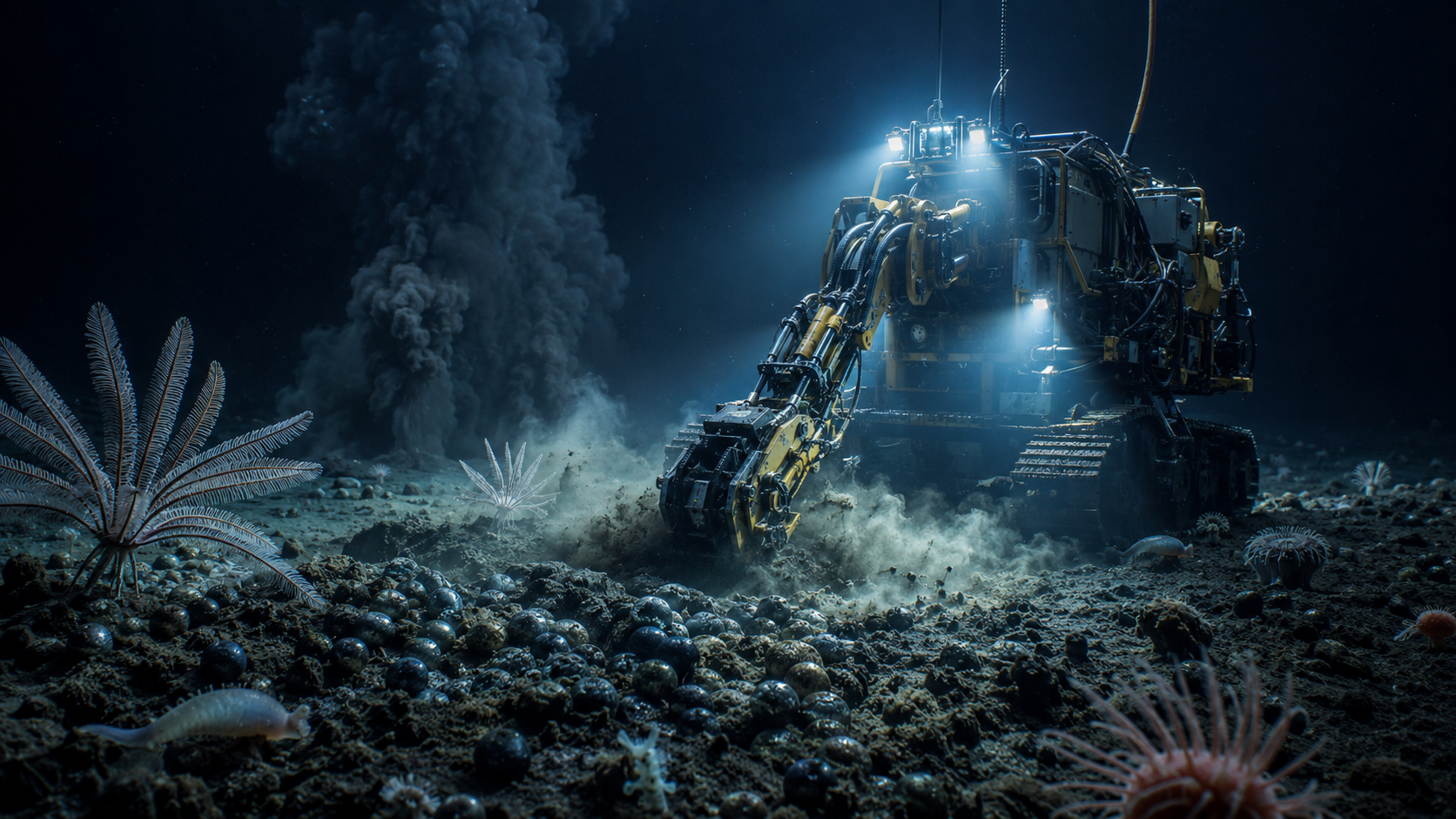
The most direct problem of deep-sea mining is not just scooping up polymetallic nodules but the comprehensive disturbance of the entire seabed environment. Mining machines crush over the sea floor, sediment rises, turbidity plumes spread; noise and light enter a world that was previously extremely stable darkness. For seabed organisms this is not merely temporary inconvenience during construction—it may be rewriting habitat structure, foraging conditions, reproductive pathways, and sensory systems. More troublingly, many ecological losses will not immediately become dramatic images. They might simply be some slow disappearance, some bottom-dwelling community that does not return, some evolutionary process lost before humans even understand it.
Black humor here: if a forest is cleared, the public at least knows this as destruction; but if a seabed plain is scraped by machines, because the scene lies outside our daily visual field, discussion tends to be compressed into mining efficiency and market demand. In other words, one of the deep sea's greatest dangers is not just mining itself, but that it is especially suited for civilization to pretend there are no immediate consequences.
Invisible Does Not Mean Irrelevant
Yuan Media AI's knowledge stance can provide important reminders on this issue. Many Indigenous Peoples' worldviews do not treat seas, mountains, rivers, or underground minerals simply as resources waiting to be extracted; they are relational fields, orders of continuous negotiation between life and life. Modern industrial societies habitually imagine invisible places as sacrifice zones, while Indigenous knowledge more often reminds us: distance does not dissolve responsibility, silence does not equal consent.
This does not mean all technology must be avoided; rather, before civilization decides to activate any technology it must re-answer more fundamental questions: do we truly want a cleaner future, or simply wish to maintain the same consumption pattern while moving dirtiness elsewhere? If the answer is the latter, then deep-sea mining is not progress but merely making greed deeper, darker, and harder to see.
Energy transition certainly needs resources; but a truly mature society will not ask only where resources lie—it will also ask who bears costs, who bears risks, how much recovery possibility exists, and whether those ecosystems sunk in darkness deserve to be treated as existing entities worth preserving. Otherwise so-called green future is just an old problem with changed color: the surface becomes cleaner while costs sink four thousand meters down.
Further Reading and Sources
- International Seabed Authority meeting materials
- Reporting on deep-sea mining applications and governance disputes
- Scientific assessments on sediment plumes, biodiversity, and deep-sea disturbance
AI use and content-safety disclosure
This article was organized and proofread by Yuan Media AI editorial workflow.