Deep Space Memory Project No. 7 / The Voyager Batteries Are Sleeping: Who Will Listen to Humanity's Last Voice?
Original Chinese title: 深空記憶計畫之七/旅行者號的電池正在睡著:人類最後的聲音,誰來聽?
Voyager's energy conservation is not just an engineering update; it is a lesson in civilization. As a probe that has flown for nearly half a century must shut down instruments one by one, humanity is forced to re-examine the relationship between memory, technology, restraint, and public choice.
Lawrence Lee | Technology Journalist, Science Fiction Critic, and Space Science Educator
# Deep Space Memory Project No. 7 / The Voyager Batteries Are Sleeping: Who Will Listen to Humanity's Last Voice?
A Probe Forces Humanity to Relearn Restraint
The Voyager batteries are sleeping, and humanity is finally forced to face something it has been reluctant to confront: memory has never had unlimited power.
On Earth, we have long gotten used to handing everything over to the cloud. Photos can be backed up infinitely, voice recordings transcribed in real time, videos sliced into short clips for endless replay, and platforms even use algorithms to decide which memories deserve another look. This lifestyle leads us to believe that civilization's storage space and power capacity are bottomless pits. But out at the edge of the solar system, Voyager is correcting us in the quietest way possible: not all signals can exist forever, nor do all memories deserve to be powered through to the end.
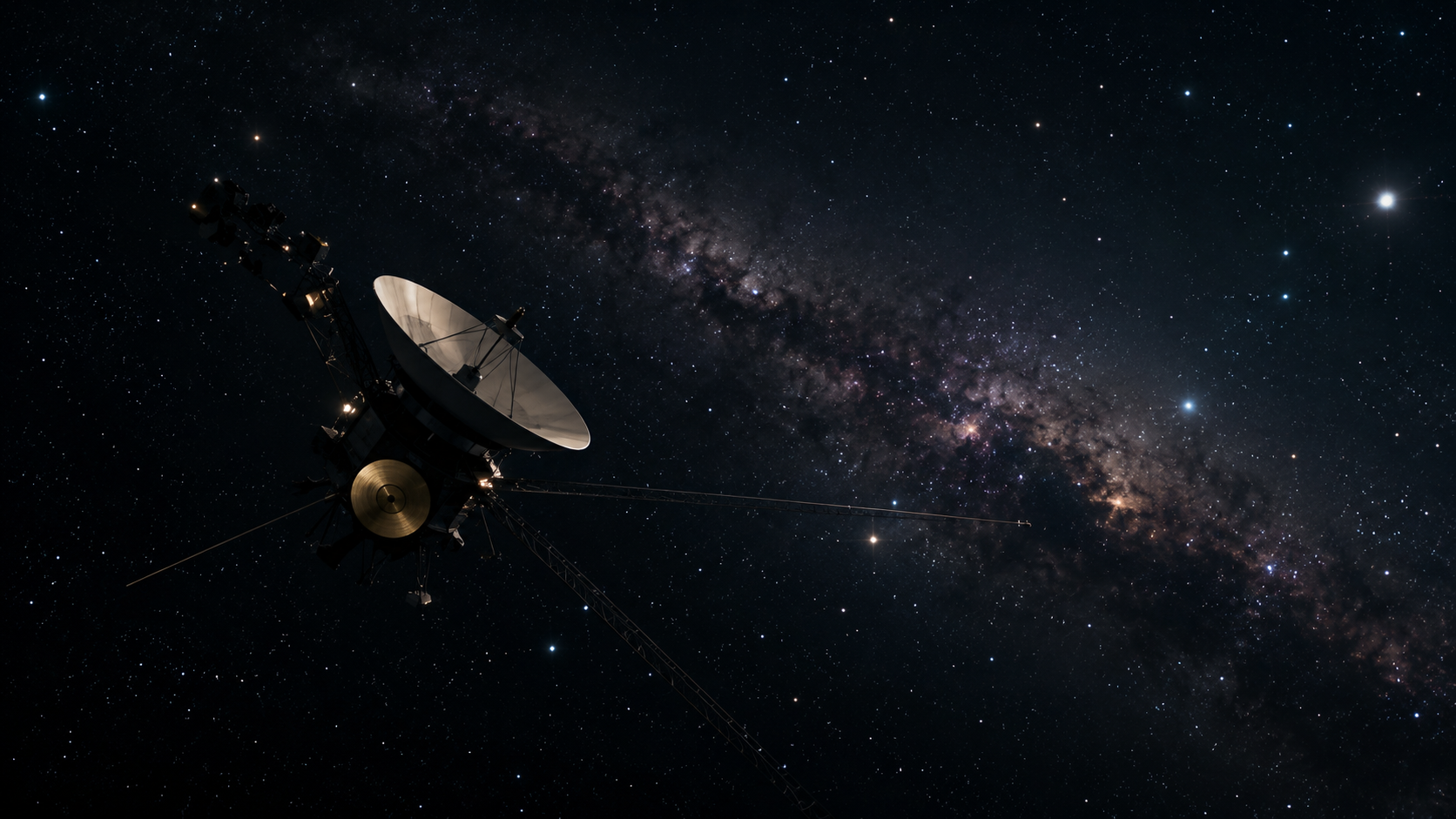
According to NASA mission updates, Voyager 1 and 2 are still operating in interstellar space, but their RTG nuclear batteries continue to lose power, forcing scientific instruments to be shut down one by one. This sounds like an engineering detail, yet it is actually a parable of civilization. As a probe that has flown for decades begins to learn how to turn itself off, humanity discovers that the real difficulty was never launch—it was choice. Which instrument goes first? Which data stream continues? Which signals are worth betting the last bit of energy on? These questions mirror our current situation with AI, databases, and public archive governance.
The Golden Record Is Not a Nostalgic Collection; It Is a Civilizational Self-Portrait
The most captivating part of Voyager is undoubtedly its golden record. It is not a cosmic album nor content marketing aimed at an alien market; it is humanity's self-introduction to the unknown world. Etched onto it are Earth's sounds, music, language greetings, and images—like a long letter sent to a recipient that may or may not ever read it. Its value lies not in its massive data volume but in the act of selection itself: within limited capacity, every item represents both inclusion and exclusion.
This is also what makes re-reading Voyager today so profoundly thought-provoking. In the AI age, we often assume that collecting more equals completeness, yet the golden record reminds us that true memory engineering is not about unlimited gathering but about bearing responsibility for choice. What goes in? Which language speaks for Earth? Who qualifies as Earth's voice? These questions existed already in 1977; back then data volumes were small, so the problems seemed elegant. Now models can ingest vast amounts of text, sound, and image, yet the issues have not vanished—they have become sharper: if a future civilization's golden record is curated by AI, will what gets preserved be truly important content or merely what platforms can most easily quantify?
The More AI Remembers, the Less Civilization Understands
Today's large models are learning voice, image, text, and multimodal data. From a technical standpoint this resembles another version of the golden record project: slicing human society into processable units so models can learn to recombine, imitate, generate, and respond. Yet Voyager's energy crisis punctures a myth—remembering more does not equal understanding deeper; storing more does not mean knowing what to keep.
Many platforms behave like overcompensations for civilizational anxiety. The more we fear forgetting, the more we try to hoard everything; the more we dread that the future cannot see the present, the more we turn every detail into a digital trace. The result is exploding data volumes without commensurate growth in judgment—like stuffing an entire supermarket onto a lifeboat and then still having to answer: what truly sustains life?
If this question is placed within Yuan Media AI's long-standing context, the answers become even more complex. Language, song, oral history, ritual sounds, local memories are not preserved simply by storing them. Some voices belong in public domains; others must remain within family or community contexts; some knowledge can be shared freely, while other knowledge requires boundaries. Voyager shows us that when humanity sends itself into the cosmos it naturally asks which voices represent us; but a truly mature civilization also learns to ask which voices should not be spoken on its behalf.
The Last Voice May Not Be the Loudest
Voyager's gradual power-down is not failure—it is a dignified twilight. It has not been mythologized at its brightest, nor lost meaning as it grows silent. On the contrary, precisely because its energy is dwindling we see more clearly what deserves to be sustained. This feels counterintuitive yet profoundly true: a civilization that is fully charged does not speak most honestly; rather, it is one that, even with fading power, chooses to preserve valuable content that truly matters.
Thus Deep Space Memory Project No. 7 asks not only when Voyager will fall completely silent, but whether humanity has used its remaining time to ask the right questions before it goes quiet. What do we leave for the future? A pile of high-speed generated, rapidly expiring content, or a judgment that can survive technological cycles? A loud self-introduction, or a civilization's etiquette that knows how to keep essential messages within limited energy?
The black humor lies in Earth's noisiest world needing an ever-quieter probe to remind us: what travels farthest is not necessarily the most lively content, but the voice with proper measure, responsibility, and clear sense of what should be said—and what must never be spoken carelessly. Voyager's batteries are sleeping, yet the questions it leaves behind have only just begun to wake up.
Further Reading and Sources
- NASA Voyager Mission Status
- NASA Voyager Golden Record Overview
- NASA/JPL Voyager mission updates and instrument power-management notes
AI use and content-safety disclosure
This article was compiled and edited by Yuan Media AI editorial workflow.