Migratory Birds Are Not Lost Masters: They Simply Read the Earth's Magnetic Field as a Navigation Map
Original Chinese title: 候鳥不是迷路大師:牠們只是把地球磁場看成導航地圖
Migratory birds remind us that navigation is not only about satellites and screens; it may also be hidden in starlight, scent, landmarks and the Earth's magnetic field.
莊溪
Recognized for plant knowledge and education dedication award recipient, long-term commitment to nature education, plant observation and ecological knowledge dissemination.
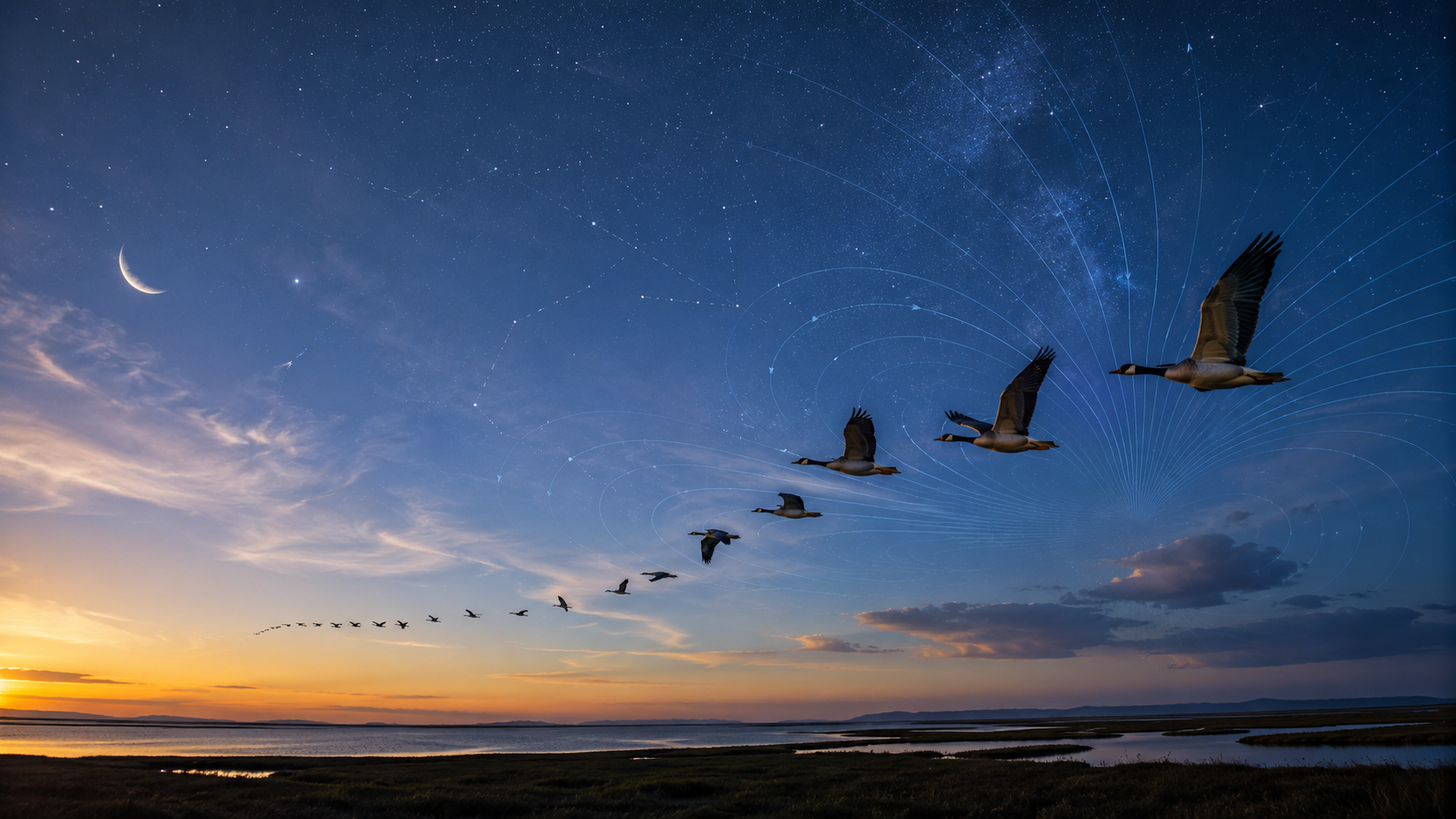
Every year, migratory birds cross oceans, deserts, cities and war boundaries. They have no Google Maps, no offline maps, and no flight attendant whispering 'keep flying ahead.' Yet they still arrive. Humans doubt their lives at every interchange; migratory birds read starlight, smell scents, feel magnetic fields in the night sky. This is not a fairy tale; it is a navigation system written by evolution. Even more frustrating: they do not need to subscribe.
The most fascinating aspect of bird migration is not just distance but precision. They fly from breeding grounds to wintering areas and back again; some routes cross continents, others traverse oceans, and some must even face storms, predators, disappearing wetlands and urban light pollution. Their bodies are like flying maps that record seasons, wind direction, starlight, scents and geomagnetic information. Humans tend to imagine intelligence as calculations in the brain, but migratory birds remind us that intelligence can also be distributed across bodies, senses, skies and the Earth.
Starlight Is Not Romantic; It Is Navigation Data
Many bird species use the sun, stars and landmarks for orientation. Night-migrating birds may discern direction from the rotation patterns of the starry sky; day-flying birds might rely on solar position, polarized light and terrain cues. This makes 'stargazing' suddenly less romantic—at least for migratory birds, it is not a poetry club activity but a life-or-death navigation interface.
What is even more refined is that migratory birds do not rely on just one sense. They may simultaneously use vision, olfaction, audition, landmark memory and geomagnetic sensing. This multi-sensory navigation system resembles nature's backup design. When human phones run out of battery we start to panic; the bird world is more resilient: night brings stars, thick clouds bring magnetic fields, changed routes bring scents and landscapes. Of course, this does not mean they never get lost; it just means their ability to get lost carries more dignity than humans constantly taking wrong exits on navigation.
Quantum Compass: The Bird Science That Looks Least Like Bird Science
One of the most fascinating research directions in recent years is that bird magnetoreception may involve cryptochrome proteins in the retina and the radical pair mechanism. This does not mean birds solve quantum mechanics; rather, their biological systems might harness microscopic physical effects to sense Earth's magnetic field. In other words, migratory birds may 'see' the Earth's magnetic field as directional information. They are not drifting aimlessly in the sky but reading an invisible magnetic map.
What makes this captivating is that it breaks human divisions of natural imagination. Quantum mechanics is usually placed in laboratories, cryogenic equipment, quantum computers and physics blackboards; migratory birds remind us that life may have already integrated certain microscopic effects into its evolutionary toolkit. Nature was not waiting for humans to invent terms before becoming clever. The most humble moments of science are often when we admit the world outsmarted our classifications.
Humans Have Brightened the Sky and Confused Bird Paths
But migratory birds are not sci-fi heroes. Their navigation systems, however exquisite, are increasingly disturbed by the human world. Urban light pollution attracts or confuses night-migrating birds; skyscraper glass causes collisions; disappearing wetlands remove stopover sites; climate change alters seasonal rhythms and food availability. Human development is like randomly sticking Post-it notes on a bird map: here becomes an industrial zone, there a highway, starlight covered by neon lights, coastal wetlands filled for land development.
We often frame conservation as protecting a species, but migratory bird conservation is more about protecting routes. They need not just breeding and wintering grounds but entire life corridors where they can stop, eat, find shelter from wind and cross safely. This poses challenges for policy because birds do not fly according to administrative boundaries. They do not queue at borders to stamp passports, nor do they alter migration timing based on local government budget cycles. Their routes demand we think across regions, across national borders and across species.
Yuan Media AI's Approach: Not Mythologizing, But Re-Understanding the Sky
This topic can also dialogue with Indigenous astronomical and landscape knowledge, but care must be taken not to force 'birds see stars' into some mystified symbol. Many traditional societies indeed value relationships between birds, seasons, celestial phenomena and livelihood activities; yet each group has its own knowledge rules that cannot be mixed into a bowl of 'ancestors understood nature' cultural soup. What truly matters is: both modern science and traditional knowledge remind us the sky is not background. The sky is a timetable, a navigation map, seasonal language and part of an ecological network.
Migratory birds are not lost masters. They are lives that read the Earth as multi-layered maps. When we see them flying over twilight wetlands and starry skies, perhaps what we should ask is not 'how do they know the way' but 'why have we narrowed our own paths so much.' If a bird can read starlight, magnetic fields and wind together, humans at least ought to learn to read the sky they are losing.
AI use and content-safety disclosure
This article was collaboratively organized by the Yuan Media AI editorial process and manually reviewed and published.