Breakfast without bees is quiet, so quiet it feels like a civilisation power outage
Original Chinese title: 沒有蜜蜂的早餐很安靜,安靜到像文明停電
Pollinating insects are not natural decorations but the smallest and most easily overlooked workers in our food system. Without them breakfast does not disappear overnight but becomes more expensive, scarcer and monotonous.
莊溪
Award-winning plant recognition and education contributor, skilled in plant taxonomy, diversity observation and science; this article focuses on plant–insect interactions and public science without making efficacy claims.
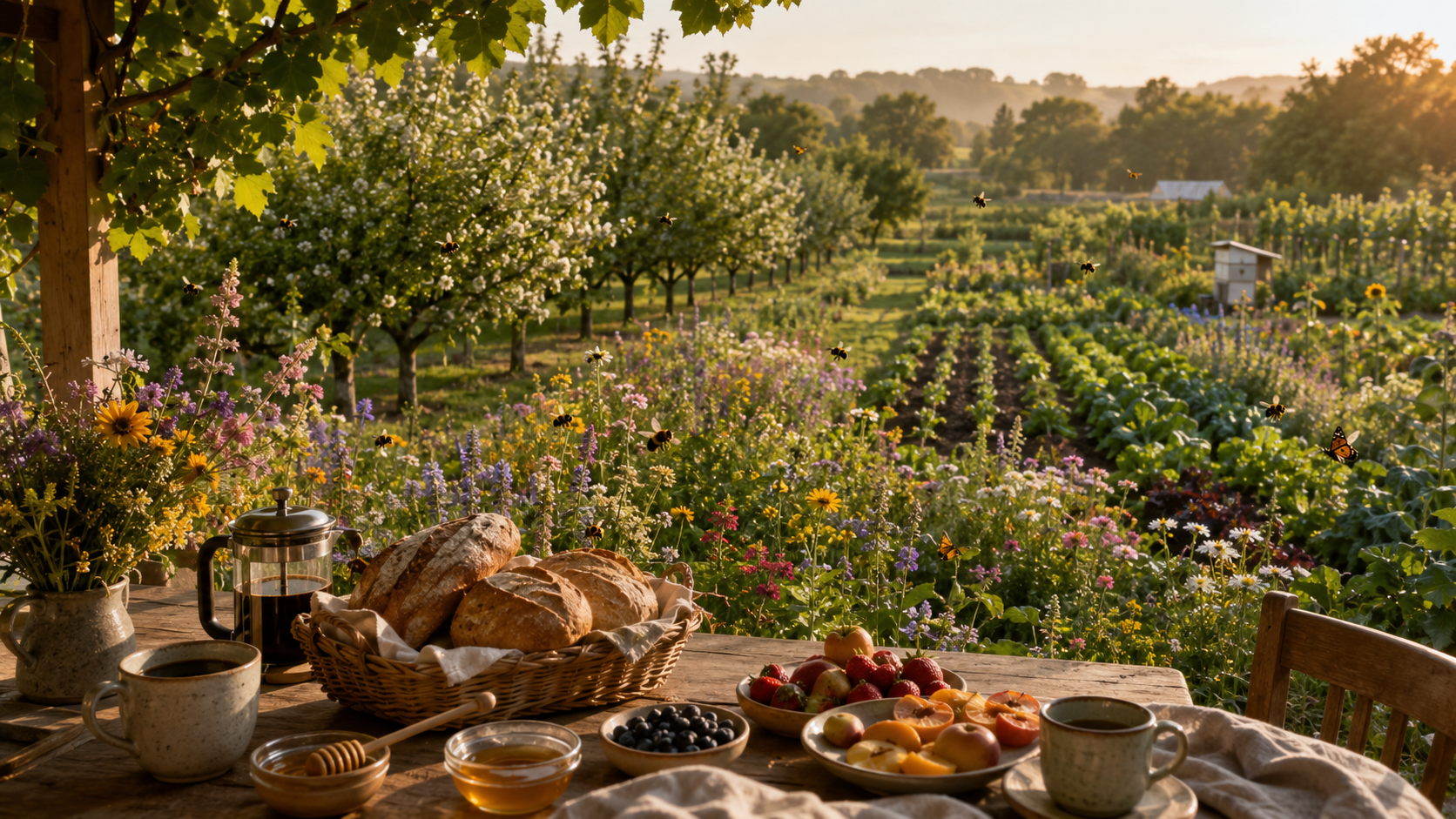
Breakfast is a civilisation ritual that is very good at masking ecological relationships. Coffee, jam, nuts, fruit, the little honey beside bread — it looks like supermarket shelf victory but is actually a fragile agreement completed by plants, insects, soil, weather and farmers together. Humans sitting at tables often think they are consumers; if we look closely we are more like high‑order parasites that are fed by insects yet rarely say thank you.
Pollinating insects have long been packaged as cute background elements. Bees are industrious, butterflies beautiful, children need them for drawing, tourist farms also need them. But pollination is not a fairy‑tale effect; it is basic engineering of the food system. The fruiting, quality and yield of many crops depend on animal pollination; countless wild plants rely on insects to complete reproduction. If the pollination network weakens the world may not lose breakfast tomorrow but breakfast will become more expensive, scarcer and monotonous. Civilisation’s end is not necessarily an explosion — it could be fruit sections gradually emptying out.
The problem is that pollinating insects face not a single enemy but a whole suite of modern gentle murders. Habitats are chopped up, floral sources reduced; pesticides and weed management make fields too clean; climate change disrupts flowering times and insect activity periods; urban expansion turns wild land into roads, parking lots and very designed lawns without life. Humans are good at tidying environments — tidying until even the small creatures that work for us cannot find workplaces.
What deserves reflection here is the word “efficiency”. Modern agriculture pursues neatness, predictability and high yield; this is not wrong. The issue is that efficiency calculated only on short‑term output, ignoring pollination, soil, natural enemies, habitats and water cycles, is like a company financial report listing employee health as an external cost until everyone collapses and the office becomes quiet. Pollinating insects are not free services but public infrastructure we have long failed to pay for or maintain properly.
Solutions need not start huge. Keeping flowering plants at field edges, reducing unnecessary pesticide use, establishing ecological corridors, preserving grasslands, allowing city parks and campuses diverse flowering periods all increase pollinator habitat and foraging opportunities. These seem small yet repair the chopped‑up world. For agriculture this is not romantic environmentalism but risk management; for cities it is not beautification projects but putting life back into design.
Taiwan’s mountain–sea and agricultural landscapes are especially suited to discuss this. Different altitudes, seasons, crops and wildflowers naturally form complex pollination rhythms. Many local farmers and forest workers know the relationships between flowering times, wind direction, rainy season and insect appearances — yet these experiences are often excluded from formal data systems. If Yuan Media AI were to build a Two-Eyed Seeing interface it should not only collect plant names but also learn to record relationships among plants and insects, weather and farm work, landscapes and livelihoods. Knowledge reduced to lists is like having cutlery without food.
Pollinating insects teach us an ironic lesson: the more complex civilisation becomes, the more it depends on tiny lives. Large projects easily get budgets because ribbon‑cutting photos look good; a patch of wildflowers, a grass ditch, a swarm of wild bees are often treated as messy. Yet when this “mess” disappears the world also loses flexibility. Breakfast without bees is quiet — so quiet it feels like a civilisation power outage. At that point humans may finally understand: nature is not scenery outside the table but the table itself.
Pollination issues are most easily shrunk to “protecting bees”, but the real problem is larger than bees. Wild bees, butterflies, moths, beetles, syrphid flies and even some birds and bats can play roles in different regions, plants and seasons. Single‑species rescue narratives are often turned into cute stickers yet insufficient to repair ecological networks. Food systems need diverse pollinators, diverse floral sources, diverse habitats and safe pathways allowing them to cross farmland, villages, streams and city edges.
This also lets us rethink “weeds”. In overly tidy management logic roadside flowers are seen as disorder needing removal; but for pollinators certain grasslands, wildflower strips, fence edges and fallow lands are refuelling stations. When cities trim all green spaces to short grass and farms treat all non‑crop plants as enemies the landscape looks clean yet ecology is like a cut line. Humans love neatness, insects need continuity. If these two needs cannot be coordinated only insects suffer in the end.
Climate change makes this net even more unstable. Earlier flowering, disrupted rainy seasons, increased extreme heat can desynchronise plant blooming times with pollinator activity periods. Such mismatches do not hit news like typhoons but slowly reflect in fruit set rates, seed quantities, crop quality and wild plant regeneration. Ecological crises are often not sudden breaks but relationships gradually misaligning. When flowers have already passed and insects arrive; when insects need pollen yet field edges remain concrete — food systems lose flexibility.
Thus protecting pollinators is not putting nature outside agriculture but returning agriculture inside nature. Schools can do flowering observations, communities build wildflower corners, farmers collaborate with researchers to record pollinator appearance times, local governments design roadside slopes, parks and irrigation channels as ecological corridors. These actions need not be expensive yet require aesthetic change: do not mistake vitality for messiness, do not treat silent insect labour as free background. Breakfast is lively because the world outside the table still works.
From this perspective pollinators are not minor natural‑class characters but indicators of food sovereignty and local resilience. Their presence signals floral sources, habitats and passages between farmland and wild land; their disappearance signals we have tidied the world until only human convenience remains. That convenience ultimately proves most expensive.
References: FAO Global Action on Pollination Services, IPBES pollinators assessment, Pollination services for sustainable agriculture and other public data sources.
AI use and content-safety disclosure
This article was compiled and edited through Yuan Media AI editorial workflow.