Fire Is Not the Enemy of Forests, It’s the Textbook Bureaucrats Fear Most
Original Chinese title: 火不是森林的敵人,是官僚最怕的課本
When modern governance treats fire only as a hazard, it also tends to manage forests like spreadsheets. Cultural fire reminds us that fire can be care as well as destruction; the real difficulty is not lighting fires but acknowledging that governance requires relationships, memory, and community leadership.
Two-Eyed Seeing Lab
Focused on Indigenous Peoples' knowledge, landscape governance, disaster risk translation, and public policy collaboration, emphasizing cultural context, community consent, and dialogue among multiple knowledge systems.
# Fire Is Not the Enemy of Forests, It’s the Textbook Bureaucrats Fear Most
In much modern governance language, fire is split into only two categories: danger that hasn’t happened yet, and disaster that has already gone out of control. So the policy verbs we habitually hear are very direct: ban, extinguish, monitor, report, fine. These measures certainly have their place because large wildfires can take lives, homes, forests, and infrastructure, and they can cause massive landscape loss in a short time. But the problem is that when systems treat all fire as an enemy, they also easily forget that many landscapes are not maintained by “zero-fire” but survive through more nuanced, restrained, relational management.
Fire Is Not Just Destruction; It Can Also Be Care
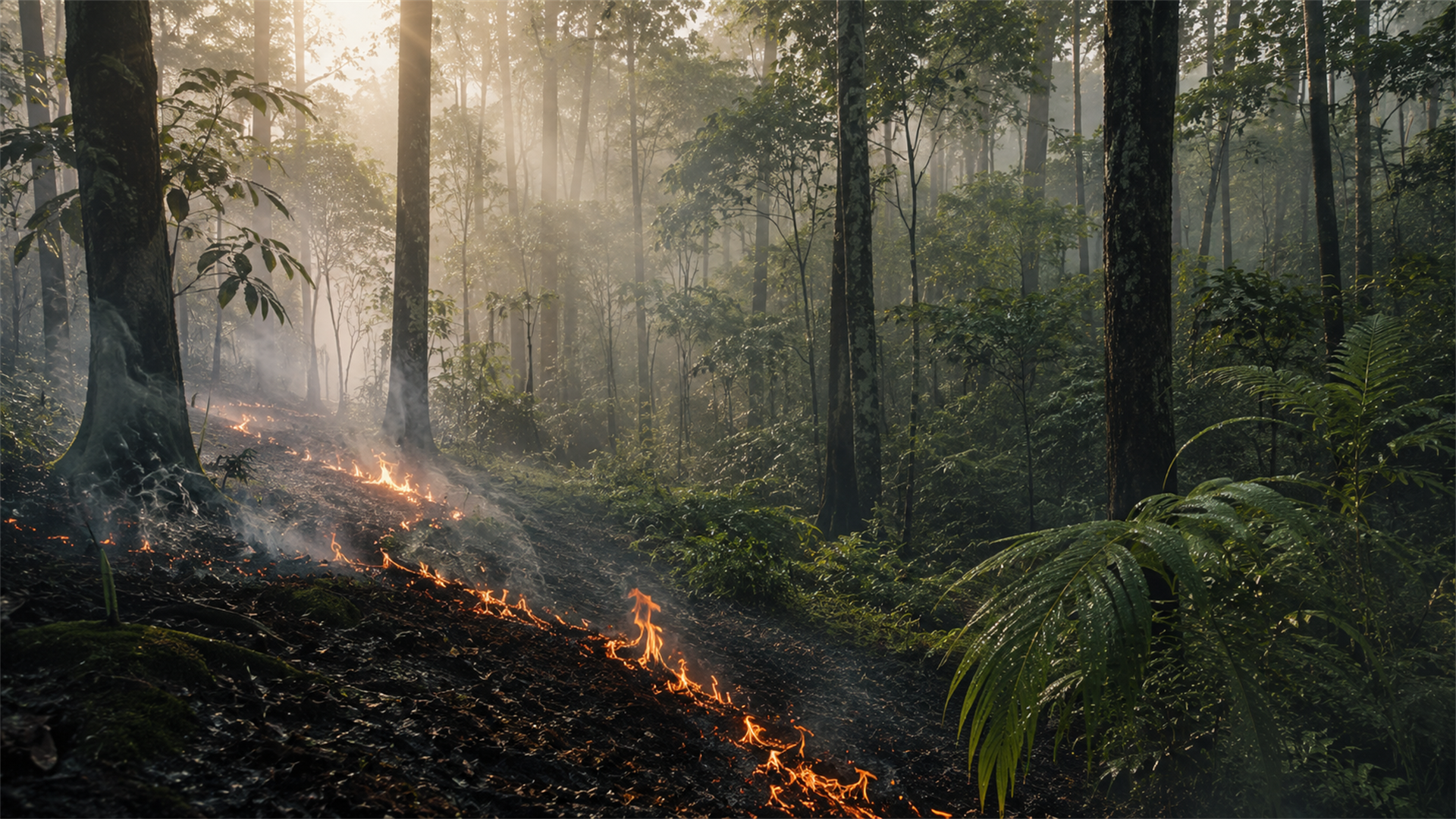
Many Indigenous Peoples’ communities have long known that fire does not necessarily equal destruction. Low-intensity, controlled cultural fire that fits seasonal and landscape conditions can clear the ground surface, promote certain plant regeneration, maintain biodiversity, care for harvesting resources, improve animal habitats, or serve as part of a land-use rhythm. It is not romanticized “ancestral wisdom” slogans nor lighting forests on fire hoping some mysterious force will finish it off. It is a detailed judgment about wind direction, humidity, slope, vegetation condition, human staffing, risk boundaries, and community norms.
In other words, cultural fire is not simply technical operation; it is relational knowledge. Fire here is not just a tool; it is also the grammar of landscape management. This grammar works not because an expert wrote a complete SOP but because it has long existed in people’s observation, experience, norms, and intergenerational memory. When governance wants to translate it into “low-intensity burning on a certain date at a certain place” as an engineering project, it often also erases the community conditions that make it possible.
The Real Danger Is Managing Land Like Excel
The knowledge most comfortable for bureaucratic systems is usually quantifiable, manageable, tabulatable, and verifiable. Fire does not have this character. It changes with wind, varies with humidity, shifts as surface fuels accumulate, and shows completely different consequences in different landscapes. When managers want to apply a single standard universally, they more easily turn land management into an Excel spreadsheet that looks neat but piles up risk.
After climate change intensifies, many places have found that long-term suppression, delay, or prohibition of landscape-level daily management has caused massive fuel accumulation. Once heatwaves, strong winds, or abnormal dry conditions occur, the fires that truly erupt become more intense and harder to control. This is why there are increasingly international discussions about rethinking cultural fire and low-intensity burning. Not because “fire is good,” but because not handling landscape fuel structure at all may cost even more.
Cultural Fire Is Not a Universal Technical Package
But what must be avoided here most of all is another kind of superficially progressive yet actually rough appropriation. Cultural fire is not a technical package that can be downloaded and applied directly; copying North American or Australian cases to any region will not necessarily work. Different landscapes, different vegetation, different seasons, different community norms may completely change the role and risk of fire. Some ecosystems are unsuitable for frequent burning; some sites, if ignited incorrectly, could cause greater harm. More importantly, different Indigenous Peoples’ groups have distinct knowledge, authority, and taboos about land management.
Therefore, the least desirable scenario is when external systems first long-term suppress, marginalize, or even criminalize Indigenous Peoples’ fire use and landscape management, then suddenly turn around when wildfire problems become severe: “Please provide your traditional knowledge so policy can look more progressive.” Without land rights, decision-making authority, responsibility sharing, training resources, and community leadership, cultural fire easily gets downgraded to policy decoration: photos look good, reports are easy to write, but real decision power remains elsewhere.
Two-Eyed Seeing Is Not Mutual Endorsement
Two-Eyed Seeing is not about using Indigenous Peoples’ knowledge to endorse modern science nor letting scientific systems audit whether Indigenous Peoples’ knowledge “qualifies” to exist. A more mature approach acknowledges that both knowledge systems face risks and are responsible for land, but their logic, rhythm, and verification methods differ. Scientific monitoring helps grasp weather, fuels, moisture, risk zones, and long-term trends; community knowledge provides landscape memory, local norms, species changes, and operational boundaries. True dialogue is not one swallowing the other but who is willing to admit their own view has limits.
For Taiwan to discuss fire ecology and cultural fire, this caution is especially needed. Because Taiwan’s mountain terrain is steep, settlements dense, land rights complex, and it involves overlapping governance of security forests, state-owned forests, protected areas, private lands, and traditional territories. Under these conditions, the first step is absolutely not rushing to demonstrate “how to light fires” but asking: which knowledge can be made public? Which sites hold historical memory? Who has authority to participate? Who bears risk? Who is responsible for stopping? Without such discussions, so-called cultural fire reform easily becomes another governance performance.
Fire Will Teach Systems a Lesson
Fire’s most terrifying aspect is not just that it spreads but that it exposes problems systems have long refused to face: do we treat landscape as a relationship needing daily care or only mobilize hastily after disasters? Banning is simple; understanding is hard. Extinguishing is intuitive; caring is troublesome. But climate change is turning these troubles into things we must handle. When extreme drought, heatwaves, and abnormal wind patterns become normal, fire will increasingly look like an exam paper rather than a sporadic news event.
The reminder cultural fire gives modern society is not just the cheap praise “Indigenous Peoples already knew the answer.” A heavier and more useful sentence: land is not space; it has memory. Fire is not a tool; it has relationships. When governance wants to use tools but refuses to acknowledge relationships, it will eventually be questioned by fire. Then forests won’t care how neatly we fill out our spreadsheets; they will follow wind direction, terrain, and accumulated management absences, making bureaucrats retake this course until the end.
AI use and content-safety disclosure
This article was co-authored with AI assistance, organized and commented on using publicly available information. Before publication, human editorial verification and cultural sensitivity review must be completed.