Robots Finally Learn to Move Boxes, Humans Finally Learn to Be Recorded
Original Chinese title: 機器人終於學會搬箱子,人類終於學會被錄影
Physical AI brings AI from screens into warehouses, factories and hospitals, carrying workers' gestures, gaze and operating habits into a new data economy. The real question is not whether robots will replace humans, but who has the right to turn people's work experience into model capabilities.
Lowerence Lee
Focuses on AI tools, agent business models, SaaS, cost control and productization practice; skilled at analyzing new technology from commercial, governance and product design perspectives.
# Robots Finally Learn to Move Boxes, Humans Finally Learn to Be Recorded
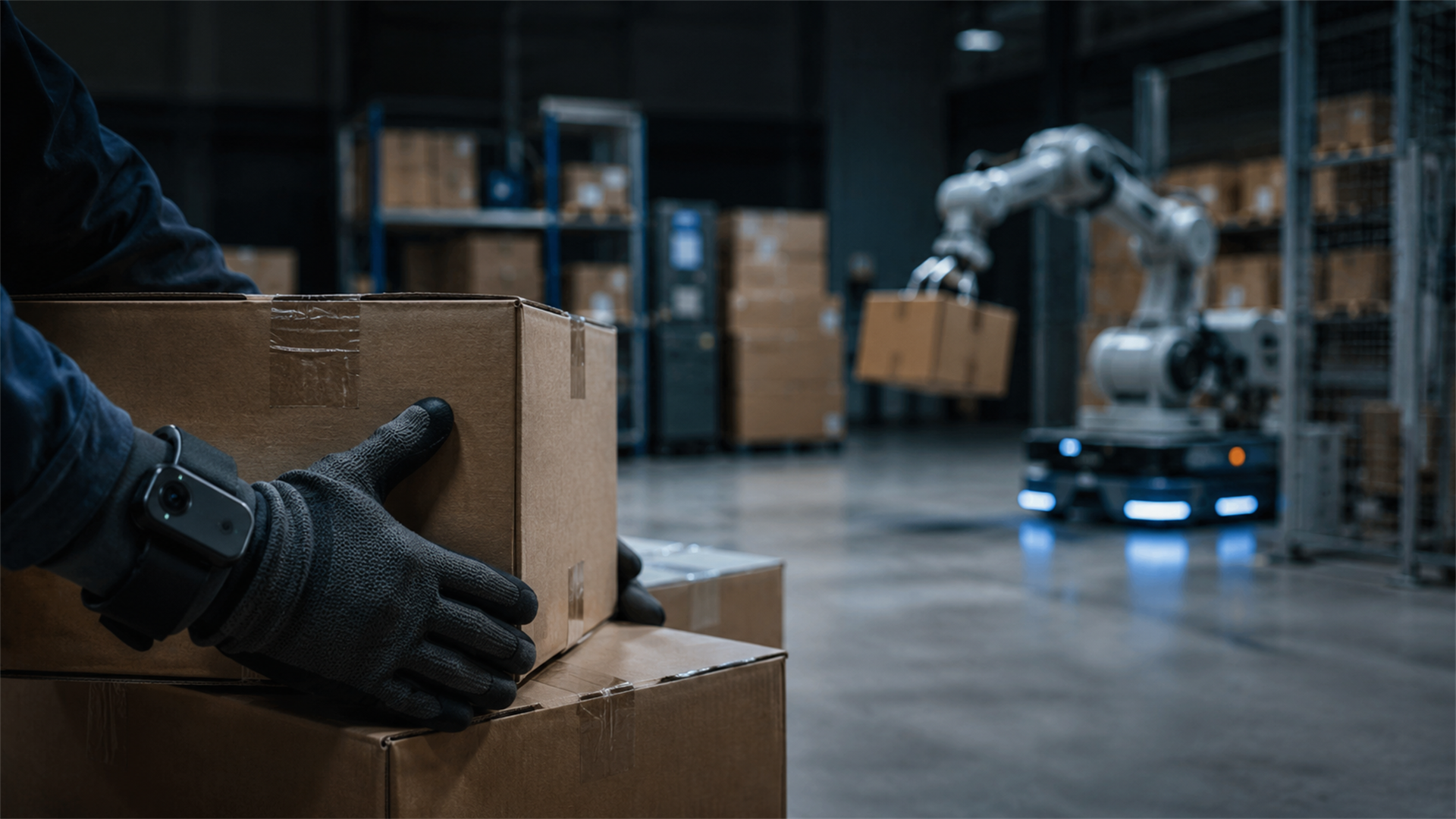
Physical AI in recent years is no longer just a demonstration at tech expos. It is entering warehouses, factories, distribution centers, medical support sites, and gradually moving into catering and care. Previously, AI excelled at moving text, images and tone on screens; now it learns to move boxes on the floor, grasp objects, open drawers, push carts, fold clothes and handle tools. This sounds like a victory of efficiency but also marks the start of a new form of data extraction. Robots do not know how to move boxes by nature; they must first observe humans doing so. Thus workers' gestures, gaze, paths, habits, pauses—and even those "unspeakable yet executable" skilled judgments—begin to be renamed as training data.
When Work Experience Is Translated into Datasets
Generative AI initially consumed web text and images; Physical AI consumes something more expensive and sensitive: human bodily memory. When warehouse workers move boxes of different shapes, how do they judge the center of gravity? How do medical support staff navigate around moving equipment? What do cleaners look at first when facing a messy space, and what action do they perform first? These things once classified as experience, skill, touch and eye-hand coordination are now regarded by tech companies as high-value embodied data.
The issue is not that technology cannot learn; it is how such learning occurs. When enterprises demand workers wear head-mounted cameras, sensors or trackers in the name of efficiency gains, digital transformation or safety records, do on-site laborers truly know what these data will be used for? To improve processes and enhance workplace safety, or to train a system that may later reduce human staffing needs? As the boundary between "work records" and "model training" blurs, informed consent can easily shrink into a standardized checkbox rather than an institutional arrangement with room for negotiation.
The Commercial Value of Physical AI Comes from Whose Body?
Many treat Physical AI as the next huge market. This is certainly not wrong: if a model can generalize across different warehouses, products and robotic arms, its commercial value will be substantial. But this also raises another harder question: where does model capability come from? Many capabilities do not emerge purely from simulation; they arise from real workers' judgments accumulated over years in real field settings.
If workers' experience is the source of model capability, then workers should not merely be filmed, quantified and anonymized into background roles. Today's AI discussions often ask only two questions: can the system become more accurate, and can the company lower costs further. In Physical AI scenarios, a third crucial question emerges: are data providers treated fairly? Do they have the right to know usage, limits, retention periods and future benefit models? If a highly successful warehouse model grows from the labor experience of thousands of workers, it is clearly unreasonable for benefits to stay only with platforms and equipment suppliers.
The Physical World Has No Regenerate Key
When chatbots speak incorrectly, at worst they make people roll their eyes; when robots act wrongly, they may hit people, crush hands, spill hot liquids or halt entire logistics lines. This is the biggest difference between Physical AI and general generative AI: it is not just information error but physical consequence. Therefore governance frameworks cannot rely solely on model cards, user terms or a disclaimer that "the system may be inaccurate." They must approach workplace safety, product liability, insurance, incident reporting, field validation and public oversight.
Many investment briefs portray Physical AI as an end-state efficiency solution: machines do not tire, do not take leave, can run 24/7. Yet once placed in real sites, problems become complex. The physical world is full of misaligned boxes, temporarily altered pathways, ambiguous lighting, sudden failures and non-standard human behavior. Robots that perform well only under ideal conditions are essentially expensive showpieces. This explains why enterprises increasingly want to collect on-site data: only by observing enough human operations can models appear "stable" in a chaotic world. But precisely this process turns the labor site into a data field.
Labor Data Governance Will Be the Next Real Competition
In coming years, AI competition will not be just about GPUs or who secures more high-quality text corpora; it will be about who can build high-quality work-action databases in sustainable, legal and socially acceptable ways. This involves not only privacy but also skill attribution. Workers are not merely "observed objects" but providers of technical knowledge. From this perspective, labor data governance will become as important as copyright, patents and platform rules.
More notably, this issue will not be limited to large warehouses or manufacturing. Caregiving, agriculture, crafts, forest patrols, maintenance, cleaning and local services—any domain with standardizable or semi-standardizable bodily operations—may become the next batch of data sources. Without early clear norms, we will see absurd scenarios: certain workers first teach systems how to imitate them, then are asked to compete with those systems, and finally must demonstrate to new colleagues how to collaborate with that system. This is not technological progress; it resembles capital turning human skill into canned goods for resale.
Not Against Robots, But Against Stealing Skills While Pretending Nothing Happened
This article does not oppose robots. Dangerous, repetitive, wear-and-tear work indeed deserves assistance or improvement through machines. The problem lies in welcoming Physical AI into sites without pretending its capabilities arise from nowhere. Its abilities often grow out of people. If knowledge is extracted from human actions, setbacks and corrections, then data governance cannot be treated as a secondary issue.
The next mature wave of Physical AI should not merely move boxes; it should know why it can move them so much like humans: because a group first demonstrated what work means under fatigue, noise and time pressure. A mature system should not only applaud the model but also clearly explain, reasonably compensate and preserve choice and negotiation rights for those who were filmed, labeled and treated as data sources. Otherwise, our automation may simply turn human skill into someone else's asset while telling humans this is the future.
AI use and content-safety disclosure
This article was co-authored with AI assistance; it has been organized and commented on using publicly available information. Before publication, manual fact-checking and editorial review must still be completed.