AI Weather Forecasts Can't Just Let Those With Computing Power Know Where the Rain Will Fall First
Original Chinese title: AI天氣預報跑得再快,也不能只讓有算力的人先知道雨會下在哪裡
In June 2026, NASA and NOAA data show El Niño has developed and continues to intensify. Meanwhile, AI weather and climate models are advancing rapidly, making forecasts faster, finer-grained, and more like real-time services. But the real issue isn't how smart the models are—it's who has access to data, computing power, observation stations, and translation capacity. If climate information only serves powerful nations and paying customers, AI forecasts will become a new form of unequal weather.
鄭淑禎
Commercial public policy, technology governance, industry strategy, and institutional analysis.
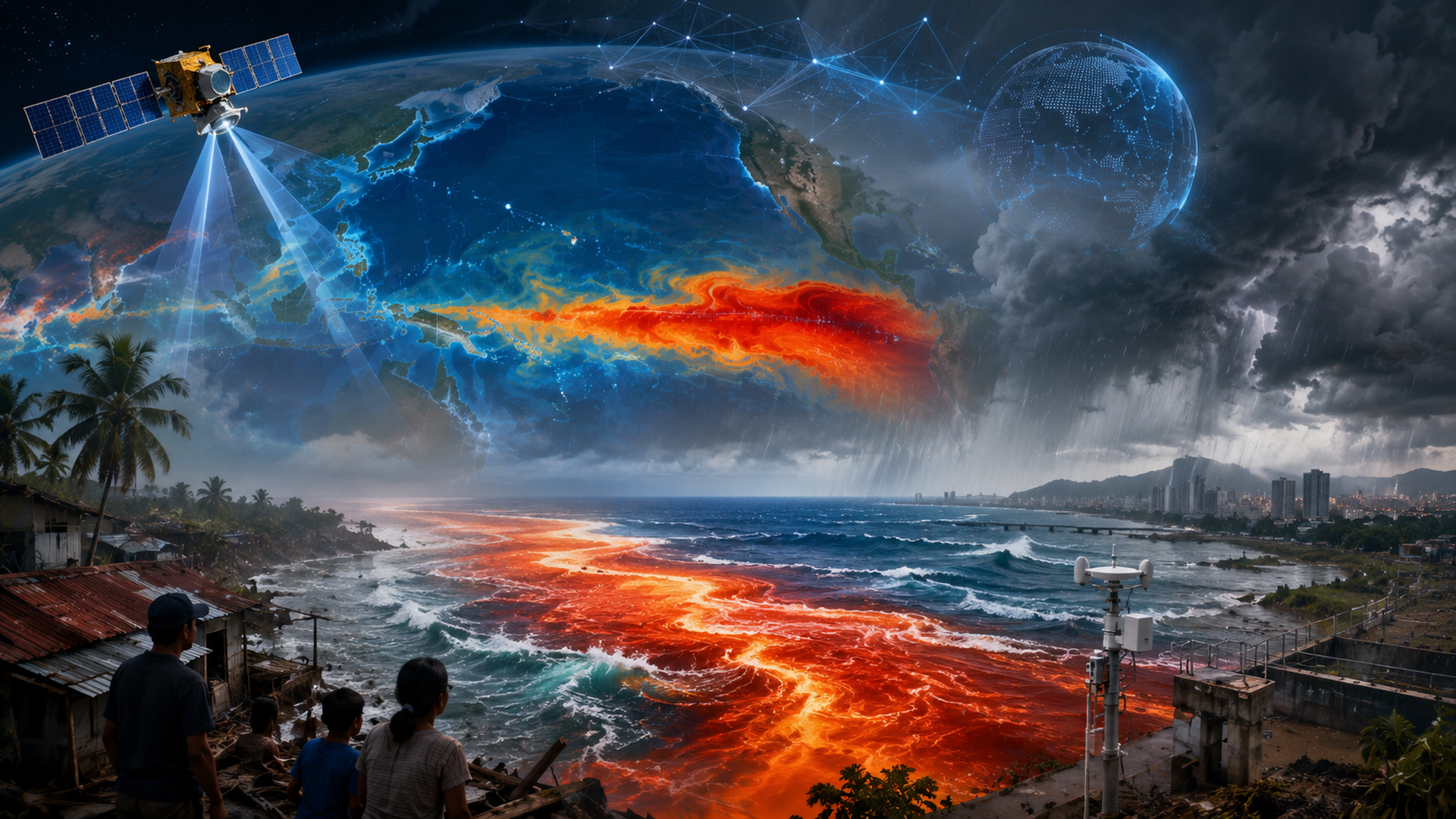
Weather Is Not a Pretty Model Image
AI weather forecasts are getting faster. Work that once required large numerical models, supercomputers, and complex physical calculations can now be partially generated by some AI models at astonishing speeds, even competing with traditional methods on certain scales. Tech companies like to call this a breakthrough; media likes to frame it as the future; investors imagine "weather" as the next subscription service. But weather is not a pretty model image. For farmers, fishermen, mountain roads, long-term care facilities, schools, coastal settlements, and Indigenous townships, climate information isn't a cool feature—it's the real question of whether to go out today, evacuate, harvest, or cancel school.
In June 2026, NASA Earth Observatory noted that satellite observations showed elevated sea surface heights in the central-eastern Pacific: El Niño has developed and is still intensifying. Such information matters greatly for global climate risk because El Niño alters rainfall patterns, droughts, heatwaves, fisheries, and agricultural conditions. The problem isn't just knowing "El Niño is coming"—the real challenge is translating those global-scale signals into locally actionable judgments. The Pacific warm water belt won't walk into village offices to tell farmers how to adjust irrigation next week.
The most popular claim now is that AI will make forecasts more democratic. That sounds beautiful, but democratization isn't just about putting models in the cloud. If users lack internet access, language interfaces, trusted local translation, or mobile resources, even precise forecasts are just scenery on someone else's screen. Meteorological technology that doesn't land into action ends up as high-resolution anxiety.
AI Is Fast, But Not Necessarily Fair
The most fascinating aspect of AI climate information is its potential to make predictions faster, finer-grained, and cheaper. If done well, it can help local governments grasp torrential rain risks earlier, assist agricultural units in simulating pest outbreaks and irrigation needs, and enable small communities to access risk alerts at lower thresholds. This is a public technology worth anticipating.
But the other side is equally glaring: AI models require data, computing power, engineering teams, operational budgets, and observation networks. These resources are distributed extremely unevenly globally. High-income countries, tech companies, and large research institutions can train models, buy satellite data, rent cloud compute, and hire talent; many places most vulnerable to climate impacts lack ground observation stations, stable internet, local-language warnings, and sustained maintenance budgets. So AI may make those who already see clearly see even more clearly, while those in the fog continue groping through rain.
This is the core of "climate information inequality." Disasters aren't caused only by wind and rain—they're also shaped by information gaps. If certain industries can get fine-grained forecasts early to adjust logistics, prices, and insurance; small farmers, fishing villages, and mountain settlements must wait for official alerts or group forwards, risk gets redistributed. Without public governance, AI forecasts may not save the vulnerable but turn disaster prevention into a VIP service.
From Model-Centric Back to Data- and Action-Centric
We often focus discussion on how strong models are, ignoring where data comes from. Weather and climate AI fed with biased data will output predictions carrying that bias. Places with sparse observation stations, complex terrain, or non-English/non-dominant knowledge systems describing climate experience may be seen more vaguely by the model. Models don't automatically become fair—they simply translate how the world was measured in the past into how it will be inferred in the future.
What's truly needed isn't making every place conform to one data format, but building a climate digital public infrastructure: open yet responsible climate data, local observation networks, community reporting mechanisms, local-language warnings, understandable risk explanations, and public services that can turn model results into action workflows. If AI only makes forecast images prettier without letting teachers, nurses, agricultural associations, fishing cooperatives, town offices, and tribal leaders know the next steps, it's just a decorative cloud painter.
This is also why government roles cannot disappear. Private firms can offer high-end forecasting services; insurance companies can buy risk models; shipping firms can purchase marine analysis; energy companies can get power generation forecasts. But public safety cannot rely entirely on market supply. Markets prioritize paying ability, yet disasters often strike those with the lowest payment capacity first. If climate information becomes a premium product, society will eventually discover: the wealthy buy early warnings; the poor receive post-disaster consolation.
Indigenous Township Resilience Can't Rely Solely on Central Pushes
Taiwan's mountain-sea terrain makes weather risks extremely fragmented. Within the same county, coastal flooding, mountain landslides, torrential rain surges, agricultural road closures, and school suspensions can occur simultaneously. For AI climate services to be useful, they cannot stop at island-wide scales nor serve only urban users. Indigenous township public services need actionable information: which roads might close? Which bridges or culverts require inspection first? Which communities must prepare water in advance? How are elderly and chronic disease patients transported? Do crops and greenhouses need early reinforcement?
These questions models can't answer alone. They require local knowledge, historical disaster memory, engineering data, agricultural experience, town office procedures, and community trust. AI can forecast, but trust is built through daily practice; AI can warn of risks, yet evacuation and care depend on human networks executing them. The best climate AI isn't a black box that excludes locals—it's one where communities can ask questions, report back, correct errors, and understand where the model is reliable or not.
For Indigenous townships, local language and message formats matter too. Alerts with only technical terms may let people know "there's a notice" but not "what to do." Truly effective messages must translate into routes, times, actions, and responsibility assignments: who checks the stream? Who notifies the elderly? Who confirms student transport? Who monitors slopes? Who moves farm tools to safe locations? AI can't replace community mutual aid relationships.
Public Information Should Not Become a Premium Product
In coming years, AI weather and climate services will certainly become new markets. Insurance, shipping, agriculture, energy, tourism, finance—all will buy them. That's not scary; the fear is public services lagging behind private subscriptions. When wealthy companies can adjust strategies before storms while vulnerable communities fill out post-disaster subsidy forms, technology isn't a neutral tool—it amplifies risk.
Climate information should be treated like roads, bridges, alerts, and drinking water: as public safety infrastructure. AI can make it faster, but governments and society must ensure fairness. If we chase model leaderboards without investing in ground observation, data quality, local translation, and public education, civilization will produce an awkward scene: we can use AI to accurately predict where rain falls, yet those who need the information most learn last.
AI weather forecasts running fast cannot just let those with computing power know where the rain will fall first. Real progress isn't calculating clouds more precisely—it's giving more people time before pressure drops to close doors, seal roads, and care for others. Climate crisis is already unfair; technology shouldn't add membership tiers to it.
AI Forecasts Cannot Replace Official Alerts
One final point must be clear: AI climate services cannot replace official alerts. Civilian models can provide early signals; academic models offer risk analysis; corporate platforms give decision support—but school closures, evacuations, road closures, debris flow warnings, and public service dispatches must still follow real-time notifications from official agencies and local government response mechanisms. Misusing AI forecasts as official commands only creates a second layer of chaos at disaster sites.
A truly good AI weather system should act like a calm co-pilot: early reminders, clear uncertainty markings, data source explanations, helping turn risks into action checklists—not snatching the steering wheel. When models are uncertain, they must say so; when data is insufficient, they must admit it; when official decisions are needed, they must guide people to official channels. Public technology without even this humility becomes a high-powered rumor generator for disasters.
AI use and content-safety disclosure
This article and cover image were co-created with generative AI assistance; editorial workflow included source verification and local disaster preparedness review.