The Deep Sea Is Like a Museum That Hasn't Opened Yet, But Humans Already Want to Remove the Air Conditioning
Original Chinese title: 深海像一座還沒開館的博物館,偏偏人類已經想先拆冷氣
A two-week survey off Brazil's continental shelf confirmed more than thirty new species. This isn't a deep-sea surprise blind box; it's a reminder that one of Earth's largest habitats still resembles an unopened museum. When deep-sea observation, ocean data, and international collaboration become fragile, the most absurd thing humans do is learn to cut marine budgets before they even know the sea.
山海資料庫筆記
Ocean, landscape, animal behavior, environmental data, and public science translation.
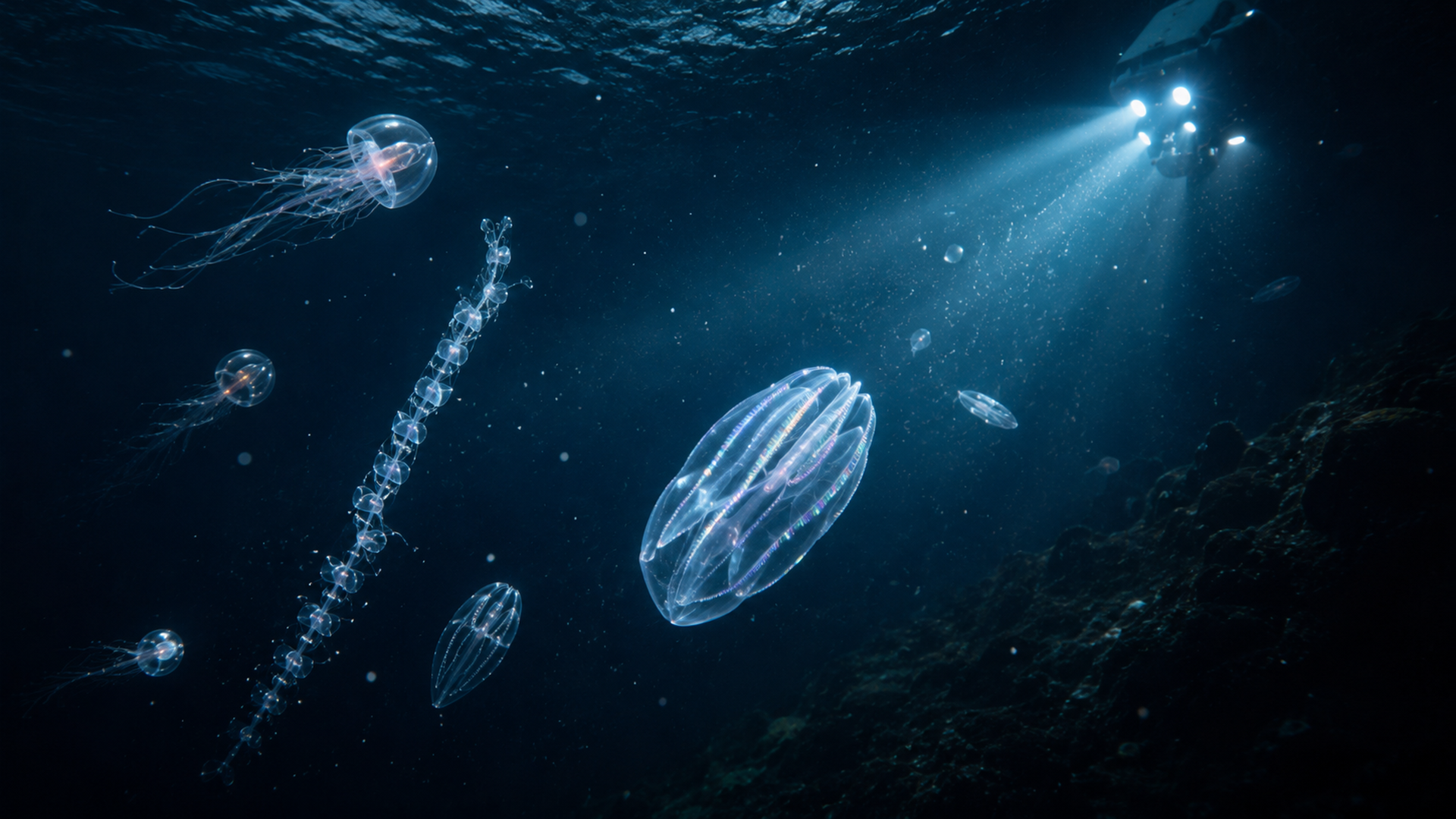
Don't Rush to Call Them Alien Creatures
Every so often, deep-sea news reminds humanity that Earth is far from familiar: a transparent, glowing creature—like glass candy or an extraterrestrial visitor—appears in the photos. Recently, a mid-water survey off Brazil's continental shelf confirmed more than thirty new species in just two weeks; headlines read as if nature were opening a surprise blind box. But the deep sea is not a blind box, and these creatures did not evolve to make social media scream. What truly deserves amazement is not "Wow, these organisms are so strange" but that we now know they exist there.
The mid-water zone lies between the sunlit surface and the seabed; it is one of Earth's largest and most unimaginable habitats in daily life. There are no coral reefs from tourist photos or giant whale silhouettes beloved by documentaries. More often, you find translucent bodies, mucus houses, floating tentacles, slowly moving bioluminescent organs, and a rhythm humans struggle to comprehend. If Earth were a building, the mid-water zone is not the basement; it is the largest, darkest, least-patrolled floor of the entire structure.
The charm of these new species lies not only in their fantasy-novel illustrations but in forcing us to admit that much life on Earth remains outside our classification tables. Humanity can launch satellites into orbit, let AI write business plans, slice stock-price volatility into millisecond trades, yet still knows very little about the largest water body on its own planet. This civilization is interesting: like someone who turned their living room into a smart home but never opened the under-sink plumbing.
Technology Turns Monsters Into Neighbors
The astonishing speed of this discovery stems not just from ships arriving in the right place, but from advances in observation tools. Research teams used high-resolution imaging, genetic analysis, specialized microscopy, and taxonomic experts to bring many organisms that once required years of work into a range where they could be discussed, described, and compared. Science is not magic; it simply rewrites "invisible" into "understandable."
Mid-water creatures are especially fragile. Many transparent gelatinous animals become unrecognizable blobs—sad jellyfish even to taxonomists—once removed from their pressure, temperature, and flow environment. Past trawl methods often yielded not the organisms' natural forms but their damaged remains after human interference. New-generation imaging, ROVs, onboard real-time analysis, and non-destructive observation let scientists visit neighbors politely for the first time rather than dismantling them to take back to labs.
A public-science reminder: deep-sea exploration is infrastructure, not a curiosity industry. Without long-term observation there are no reliable data; without reliable data we can only imagine oceans through sporadic expeditions and pretty photos. The problem is that the ocean bears too much for Earth: absorbing heat, storing carbon, regulating climate, supporting food webs, and swallowing human-generated noise, plastic, pollution, and temperature changes. If humanity briefly gasps at new species but then lets marine observation systems be consumed by budgets and politics, it's like praising smoke as art at a fire scene.
The diel vertical migration of deep-sea organisms also relates to carbon cycling. Many hide in the depths during the day and rise at night to feed, carrying energy and carbon back into deeper waters. This is not fairy tale; it is a massive but often overlooked transport network within Earth's climate system. They hold no meetings, own no carbon rights, and produce no sustainability reports, yet they perform daily work closer to sustainability than many corporate presentations.
Not Even Recognized Yet, Already Mining?
The most absurd situation in the deep sea is that humanity's rate of understanding may not keep pace with its appetite for exploitation. Minerals, fisheries, biological resources, submarine cables, military monitoring, and carbon-sequestration imaginings turn the deep sea into a new economic frontier. "Frontier" sounds adventurous, but it often politely means "no human law truly cares yet, so take first action."
Thus every new species discovery is not just natural news; it's a governance alarm. When we don't know an organism's life history, its position in the food web, or its sensitivity to oxygen, temperature, acidification, and sound, rushing to discuss seabed resource development isn't progress—it's dismantling bookshelves before cataloging them.
Deep-sea mining is most easily packaged as "humanity needs resources." But needing resources doesn't mean we can treat unknown ecosystems as free warehouses. Especially when demand comes from new energy, semiconductors, military, and global supply chains, language becomes lofty: for green transition, resilient supply, technological autonomy. Yet if the cost of green transition is pushing incomprehensible marine systems into irreversible risk, so-called "green" may simply be a different-colored plunder.
Public Science Should Not Rely Only on Heroic Expeditions
Deep-sea exploration requires ships, instruments, engineers, taxonomists, databases, long-term funding, and international collaboration. None of these fit neatly into thirty-second short videos, yet they are the eyes through which civilization understands Earth. When public science is forced to constantly prove its "usefulness," what gets hurt first is often this kind of foundational observation: no immediate box-office returns, but in the long run it determines whether we can know early how the world is changing.
Taxonomy is an undervalued slow craft in modern science. Naming a new organism isn't just labeling; it places it within evolution, morphology, genetics, distribution, and ecological relationships. Without taxonomy, biodiversity is like a library without a catalog: many books, but broken borrowing systems. Today everyone talks about AI, genes, satellites, big data, yet often forgets that the bottom layer of data still requires someone willing to confirm one species, one trait, one record at a time.
Yuan Media AI cares about the deep sea not to open an electronic pet shop for strange creatures but because the deep sea reminds us: knowledge is worth existing before there's a business model. Someone must keep seeing in places without applause. If marine data are handed only to few nations, institutions, or companies, our future understanding of the sea will become unequal maps. Whoever can see names it; whoever names sets rules; whoever sets rules more easily says "this area can be developed."
The deep sea is like a museum that hasn't opened yet: living collections, roaming exhibits, daily rewritten catalogs. What humanity needs most now is not to rush in with flashlights shouting discoveries but to learn how to watch quietly, long-term, responsibly. Those translucent small lives are not Earth's decorations; they are part of the Earth system. They don't need our amazement; they need us to admit we're still ignorant before acting on the ocean.
A Reminder for Island Societies
For island societies like Taiwan, the deep sea is not a distant spectacle. Fisheries, the Kuroshio Current, submarine cables, marine protected areas, research ship energy, youth science education, and Indigenous Peoples' ocean knowledge all relate to whether we understand the sea. When children learn about the deep sea only from short videos, they see monsters; when public science invests long-term, they see systems. The difference is huge: one makes people gasp, the other teaches society responsibility.
Future marine education should have less cheap awe of "the seabed is mysterious" and more focus on "how do we know." Why are transparent organisms transparent? Is bioluminescence for predation, defense, communication, or hiding? How does vertical migration affect carbon cycling? Why can ROVs and onboard microscopy change classification speed? These questions matter more than simply displaying strange shapes. The deep sea is not humanity's imagination trash bin; it is a real world where science, ethics, and governance have yet to catch up.
AI use and content-safety disclosure
This article and its cover image were co-created with generative AI; editorial workflow includes