Animals Are Not Sensors: After AI Tracks Wild Behavior, Who Preserves Their Right to Remain Unseen
Original Chinese title: 動物不是感測器:AI追蹤野生行為以後,誰替牠們保留不被看見的權利
From satellite tracking to AI image recognition, wildlife is being incorporated into unprecedented data networks. This can assist conservation, disease warning and climate research, yet also brings new ethical questions: when animals become environmental sensors, do we still remember they are not data devices serving humans?
莊溪
Ecological monitoring, soundscape data, environmental education and wilderness narrative.
Animals Are Uploading Their Lives
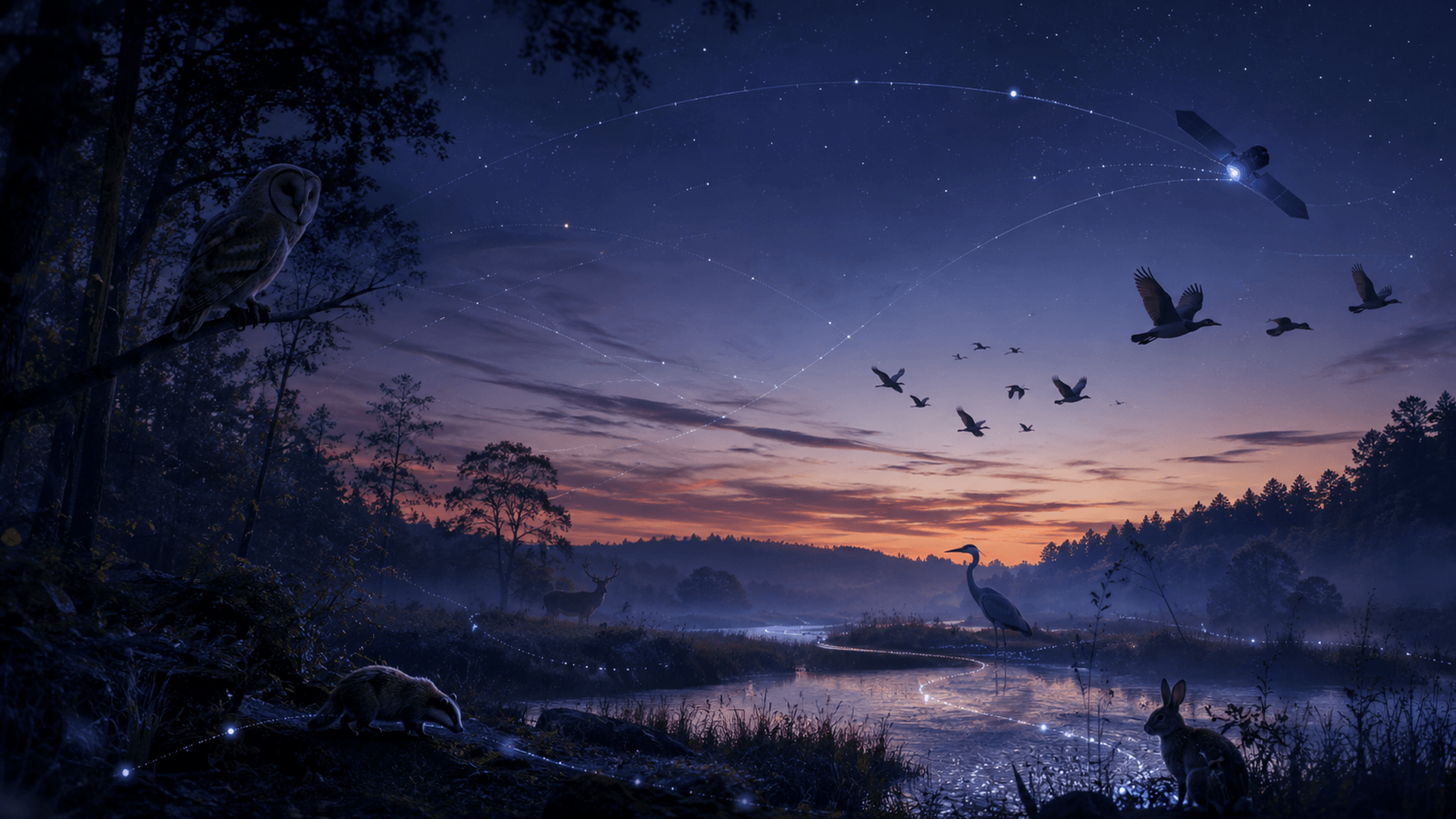
Past research on animal behavior required waiting, ambushing, guessing, and accepting a lot of failure. Birds flew away, fish dove deep, deer did not follow preset routes; researchers had to admit in mud, mosquitoes and bad weather that nature was not cooperating with human schedules. Now the situation has changed. Satellite tracking, micro-sensors, automatic cameras, soundscape recordings and AI recognition are pulling wildlife into a huge data network. When they migrate, where they stay, how their heartbeats change, whether they avoid human activity — all increasingly may be recorded, analyzed, predicted.
This is scientific progress, but also an ethical alarm bell. The conservation community certainly needs better data. Climate change is altering migration routes; habitat fragmentation forces animals to cross more roads and farmland; emerging diseases can spread via animal movement. If we could see abnormal behavior earlier, perhaps we could reduce roadkill, protect breeding grounds, detect epidemics, even understand ecosystem responses before and after disasters. But the problem lies in: when animals are described as “environmental sensors,” humans easily forget they are not equipment working for us.
Seeing Does Not Mean Understanding
The most fascinating aspect of AI image recognition is that it can turn data that was hard to process into analyzable patterns. Millions of automatic camera photos, once marked slowly by volunteers; now models can quickly identify species, individuals, behaviors and times. Soundscape data works similarly: bird calls, frog croaks, insect sounds and mechanical noise in the forest can be turned into signals of ecological change. These tools let researchers see more, and also make it easier for policy units to frame conservation as data.
But seeing does not mean understanding. A model may note “frequency of a species declining,” but it does not necessarily know whether climate, hunting, noise, food chains, moonlight, reproductive stress or camera location changes caused it. AI is best at finding patterns, yet it does not necessarily understand the life histories behind those patterns. Animal behavior is not an Excel field; it is the result of bodies, environments, dangers, learning and chance interwoven. If conservation policy only listens to models, ignoring local observers, hunters, rangers and long-term field researchers, data may increase but understanding need not deepen.
The Temptation of Disaster Warning
Humans have always tried to read disaster signals from animal behavior. Animals restless before earthquakes, birds moving before typhoons, fish changing routes after ocean warming — some stories have observational basis, others are post-hoc imagination. AI and satellite tracking make this old question resolutely scientific: if we can track many animals simultaneously, can we predict earthquakes, volcanoes, epidemics or climate disasters from their movement anomalies?
This direction is worth studying, but also most easily overhyped. Animals are not oracles; data are not crystal balls. A certain bird leaving early may be due to less food or more disturbance; a fish school moving north could be ocean temperature change or fishing pressure. If media package animal tracking as disaster prophecy, science becomes entertainment, conservation becomes instrumentalized. Worse, people may only protect animals when they “serve humans.”
Who Can Use Animals’ Locations
Wildlife data also carries a real risk: location information can be abused. Nest sites of rare species, migration stopover points, breeding grounds if made public could attract poachers, disturbance photography or illegal trade. Data openness is a scientific virtue, but conservation data cannot be naively published. Higher-resolution tracking data requires graded management. Not every piece of data should be instantly open; not every researcher, government unit or platform should have full access.
This also reminds us that data governance applies to animals too. Animals cannot sign consent forms, yet humans still have an obligation to establish protective boundaries for them. Research projects must ask whether sensors add burden, whether tracking collars affect behavior, whether data openness brings risk, whether model misjudgments cause wrong management. The stronger the technology, the less ethics can pretend to sleep.
Indigenous Knowledge Is Not a Footnote
In many forest and river-sea borderlands, local communities have long understood environments through bird flocks, insects, animal trails, fish runs, wind direction and sound changes. These observations need not be romanticized as mystical prophecies nor belittled as uninstrumented intuition; they are knowledge accumulated over long lives in landscapes. AI monitoring that respects local observation can let models see finer contexts; if it treats local knowledge merely as data labels, it will reproduce another kind of extraction.
Truly mature conservation technology should allow scientific data, local knowledge and policy decisions to cross-check each other. For example, when an automatic camera detects a species’ movement change, it could ask rangers whether they also observed food source shifts; when a soundscape model judges bird calls reduced in an area, it can be compared with logging, road construction or seasonal changes; when satellite tracking shows altered migration routes, local land use and human activity pressures must be understood. This is not downgrading AI, but letting AI have less blind confidence.
Letting the Unseen Remain a Little Unseen
The best use of conservation technology is not turning nature into an all-day surveillance factory, but helping humans more humbly adjust their own behavior. If AI tells us a road cuts off migration routes, we should modify the road; if soundscape data shows mechanical noise overwhelming breeding season calls, we should limit development; if satellite tracking points out marine heatwaves shifting fish schools, we should rethink fisheries management. The purpose of data is not to show off what we can see, but to force us to admit what we have caused.
Animals are not sensors; forests are not laboratory backyards. AI can bring us closer to the wild world, but closeness does not mean possession. Some data should be kept secret, some habitats left undisturbed, some behaviors left to animals themselves. The maturity of civilization may lie not in incorporating all life into surveillance, but in finally having the ability to see and still knowing how to turn eyes away a little.
Monitoring Also Has Costs
Many conservation technologies appear lightweight, yet actually are not without price. Collars, tags, sampling, drones, cameras and sound equipment can alter animal behavior, and also change human attitudes toward nature. Researchers placing an extra camera in the forest is not just adding an observation point; it adds a human gaze to that habitat. This gaze may help protection, but may become disturbance. Technology ethics should not be discussed only in medical or facial recognition contexts; wildlife research equally requires caution.
A deeper question is who can interpret this data. If satellite tracking and AI models serve only large research institutions, small conservation groups and local communities remain passive recipients of results, then data power concentrates. Good conservation technology should enable local rangers, school education, community conservation and research teams to use it together, rather than letting data stay forever on distant servers. When animals are seen, the most important thing is not turning them into more charts, but letting those charts return to protect where they truly live.
The goal of conservation should not be that every animal is tracked, but that they have opportunities in safer habitats without being tracked. Truly good data, ultimately, should make surveillance less, not always more.
If data can let habitats become quiet again, it has truly completed its task; if it only makes humans more excited to watch, conservation remains at the exhibition stage.
AI use and content-safety disclosure
This article and cover image were completed with generative AI assistance; the editorial process includes source verification, cultural context review and human editorial review.