Lunar Time Is Not a Watch Problem: Who Decides Space Standard Time Before Humans Return to the Moon
Original Chinese title: 月球時間不是手錶問題:人類重返月面以前,誰來決定太空的標準時間
Lunar time appears to be an engineering problem, but it is actually a civilizational one. As humanity prepares for simultaneous operation of lunar bases, probes, navigation satellites and commercial missions, time becomes not just markings on a watch, but the infrastructure of power, standards, coordination and trust.
Lawrence Lee | Technology Journalist, Science Fiction Critic, and Space Science Educator
Space exploration, science fiction criticism, science education and civilization narrative
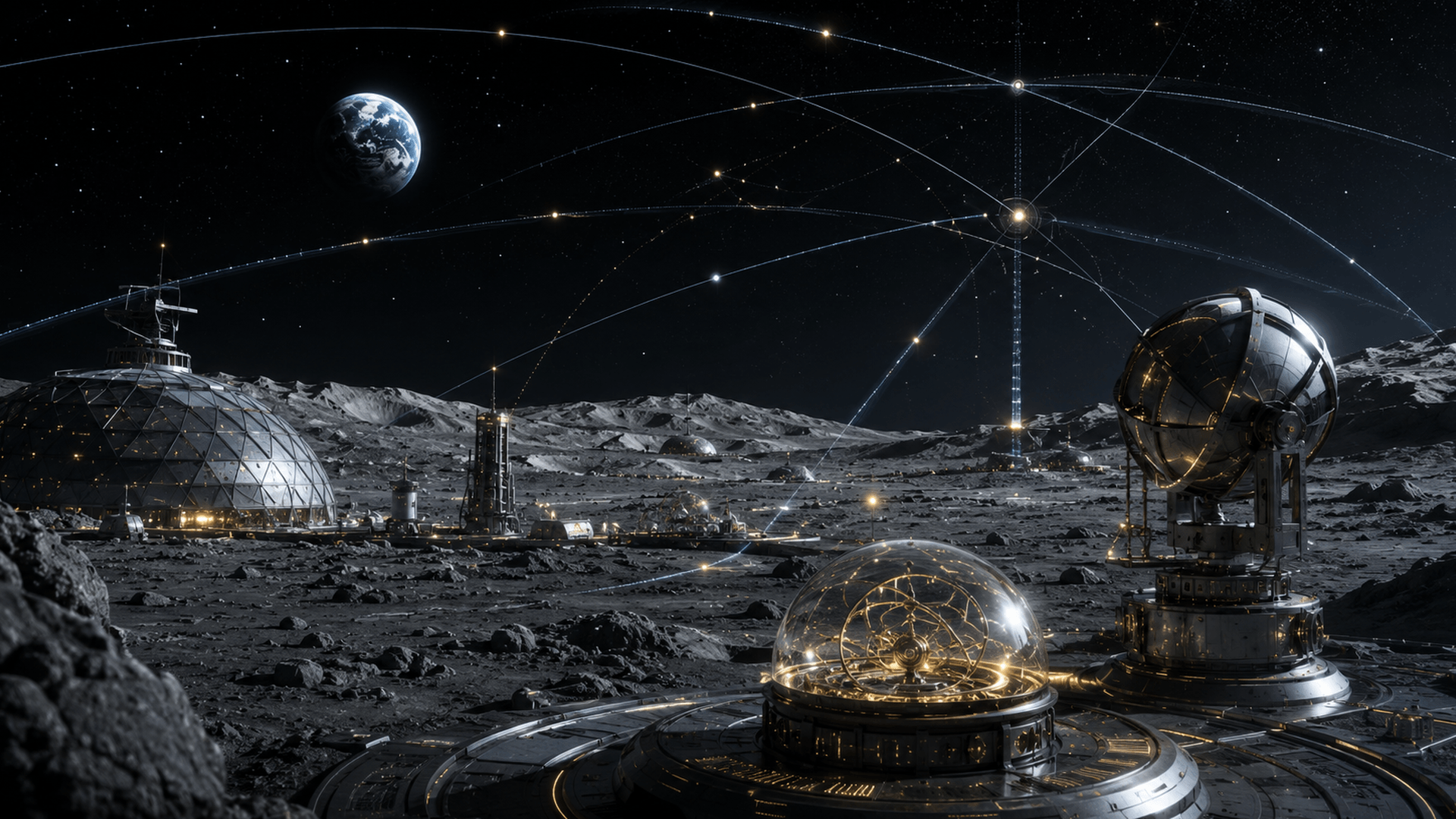
Lunar Time Is Not a Watch Problem: Who Decides Space Standard Time Before Humans Return to the Moon
The moon does not arrive late, nor does it lose a rotation because Earth people misadjust their watches. Yet once humanity prepares to return to the lunar surface, "lunar time" suddenly becomes a serious issue. This sounds like a detail only engineers in science fiction would argue over: whose timezone? Which atomic clock? Should the lunar base observe weekends? But the real trouble is not the clocks; it is that all missions must trust each other within the same temporal syntax. Probes need navigation, bases require scheduling, communications demand encryption, samples must be marked, rescues have to synchronize—any one-second error could turn "human civilization advancing into space" into an expensive meeting where no one can be found.
Earth's time system was never a natural phenomenon; it is the result of political, scientific and commercial compromise. We are accustomed to UTC, to time zones, to phones auto-calibrating, so we forget that standard time is a massive infrastructure. The moon exposes this again: under different gravitational environments, clocks do not flow exactly as on Earth; lunar surface, lunar orbit and Earth ground stations cannot simply rely on "everyone looking at the same watch." Lunar time seems cold, but it is humanity's first forced civilizational exam when moving order off Earth.
Whose Time, Whose Order
Space exploration is often packaged as a wholly human enterprise, yet standard-setting has never been neutral. Whoever proposes standards first, whoever controls equipment, whoever maintains networks, and whoever can afford participation costs will shape the future order of lunar activity. When the lunar surface hosts government missions alongside commercial mining, research bases, communication satellites and tourism imaginings, time becomes not just a synchronization tool but an entry threshold. Those excluded from standards may struggle to claim when their data is collected, when samples are exchanged, or when accidents occur.
This is why lunar time matters most to media: it is not "space nerd knowledge"; it is standard politics. When we say we must coordinate lunar time, the question is not only whether technology can achieve it, but also whether governance will be transparent, international participation fair, and data rights traceable. Otherwise humanity merely packages familiar Earth inequalities into prettier silver-white space equipment and displays them on the lunar surface.
Space's Public Infrastructure
If the moon truly sustains activity in the future, time will become public infrastructure alongside navigation, communications, energy and weather forecasting. It will not be as spectacular as rocket launches, yet it will determine whether everything after launch functions normally. Medical records at lunar bases, preservation timestamps for experimental samples, data labeling from seismometers and radiation monitors, robot path coordination—all depend on trustworthy time systems. Trust in space often comes not from handshakes but from verifiable timestamps.
But public infrastructure has an old problem: the more important it is, the less visible it becomes. People only notice its existence when it fails. Earth's power grids, networks and satellite positioning are no exception; lunar time will be too. When a probe cannot locate its base, when two missions' data timelines do not align, or when accident liability becomes hard to judge due to record discrepancies, people will realize that standards are not appendices but the skeleton of civilization.
AI Also Needs to Know What Time It Is
With AI entering space missions, time issues become sharper. Autonomous probes do not merely photograph and transmit; they must instantly decide which samples merit collection, which paths pose lower risk, and which anomalous signals require priority handling. Without reliable temporal context, models would be like searching a library without page numbers for evidence. Data ordering, event causality, delay correction, cross-mission comparison—all demand precise timekeeping. The smarter AI becomes, the more it needs an order that can be traced.
More importantly, time also affects accountability. If a probe causes loss through autonomous decision-making, Earth teams cannot simply say "the model judged so at the time." They must clarify exactly when the model acted, on what data, and under what latency. Space governance lacking such auditability will let AI make responsibility evaporate into vacuum.
Lunar Standards Should Not Be Just for the Strong
Standard-setting often carries a technical courtesy: it claims to serve compatibility, efficiency and safety. History shows standards also shape power. Language standards, telecom protocols, network agreements, maritime rules and satellite positioning systems have all granted certain nations and corporations greater institutional advantage. Without more open negotiation, lunar standards could similarly produce a surface-level common time that is actually defined by a few players.
This does not oppose advanced nations advancing lunar time; it demands they embed publicness into design from the start. Space exploration cannot be only flags, photos and commercial bids; it must include shared governance, data transparency, failure reporting, accident liability and institutional imagination for marginalized participation. Otherwise we merely relocate old-world unilateral decisions to a farther stage. The moon has no borders, yet humanity excels at projecting them everywhere.
The Moon Does Not Need Us, But We Need Humility
Lunar time reminds us that civilization does not automatically upgrade upon arrival somewhere. Humans can send rockets up but may still carry chaos, arrogance and standard hegemony. A truly mature space civilization is not just better at launching; it must be better at negotiating. It must recognize the moon as no single nation's, company's or engineering team's laboratory; it is humanity's shared imagined boundary and a test of whether we can build fair institutions.
The moon does not need humans to tell it time. Humans need a way to cooperate in darkness, delay and uncertainty. Time has never been just markings on a clock face. When moved to the moon, it becomes a mirror reflecting what kind of Earth we intend to carry into space.
From Telling Time to Living Together
Lunar standard time will ultimately land on very concrete life details. Spacepeople need rest; bases require shift rotations; remote centers must mitigate latency; cross-national missions exchange data; even future lunar commercial services must know what "the same moment" means. Without shared standards, all institutions would be like shouting in different languages to each other. It is not only scientists' calculation problem but an order issue engineers, lawyers, medical teams, insurers, rescue units and public governance bodies must jointly face.
Looking further ahead, lunar time will force us to rethink "human community." On Earth, time is often sliced by nation-states, work schedules, financial markets and transport systems; on the moon, time becomes a starting point for re-coordination. When humans stand on the lunar surface gazing at Earth, what they should remember most may not be that we finally left home, but that we still need a shared rhythm others can trust. If even one second on the moon requires negotiation, then conflicts on Earth have no reason to pretend unilateral commands suffice.
This is also where lunar time offers its greatest inspiration: it reveals that civilization advances not by escaping institutions but by making them more responsible. If time can be co-designed, space may become less a competition arena and more a practice ground for cooperation.
AI use and content-safety disclosure
This article and cover image were co-created with generative AI assistance; editorial workflow includes source verification, cultural context review and human editorial oversight.