Ocean Heatwaves Reshape the Table: Fisheries Resilience Is Not Waiting for Fish to Swim Back
Original Chinese title: 海洋熱浪改寫餐桌:漁業韌性不是等魚自己游回來
Ocean heatwaves are more than coral bleaching or distant science news; they shift fish distributions, raise fishing costs, affect coastal employment and table prices. Facing more frequent marine temperature anomalies, fisheries resilience cannot rely solely on subsidies and disaster relief; it requires advance data infrastructure, insurance, transition pathways, and collaboration with local knowledge.
山海資料室
Co-authors: 全明正, 農林漁牧傳統知識與科技如何改變當代科技
Marine, landscape, environmental technology, agricultural and fisheries traditional knowledge, and public policy translation.
Ocean Heatwaves Are Not Limited to Land
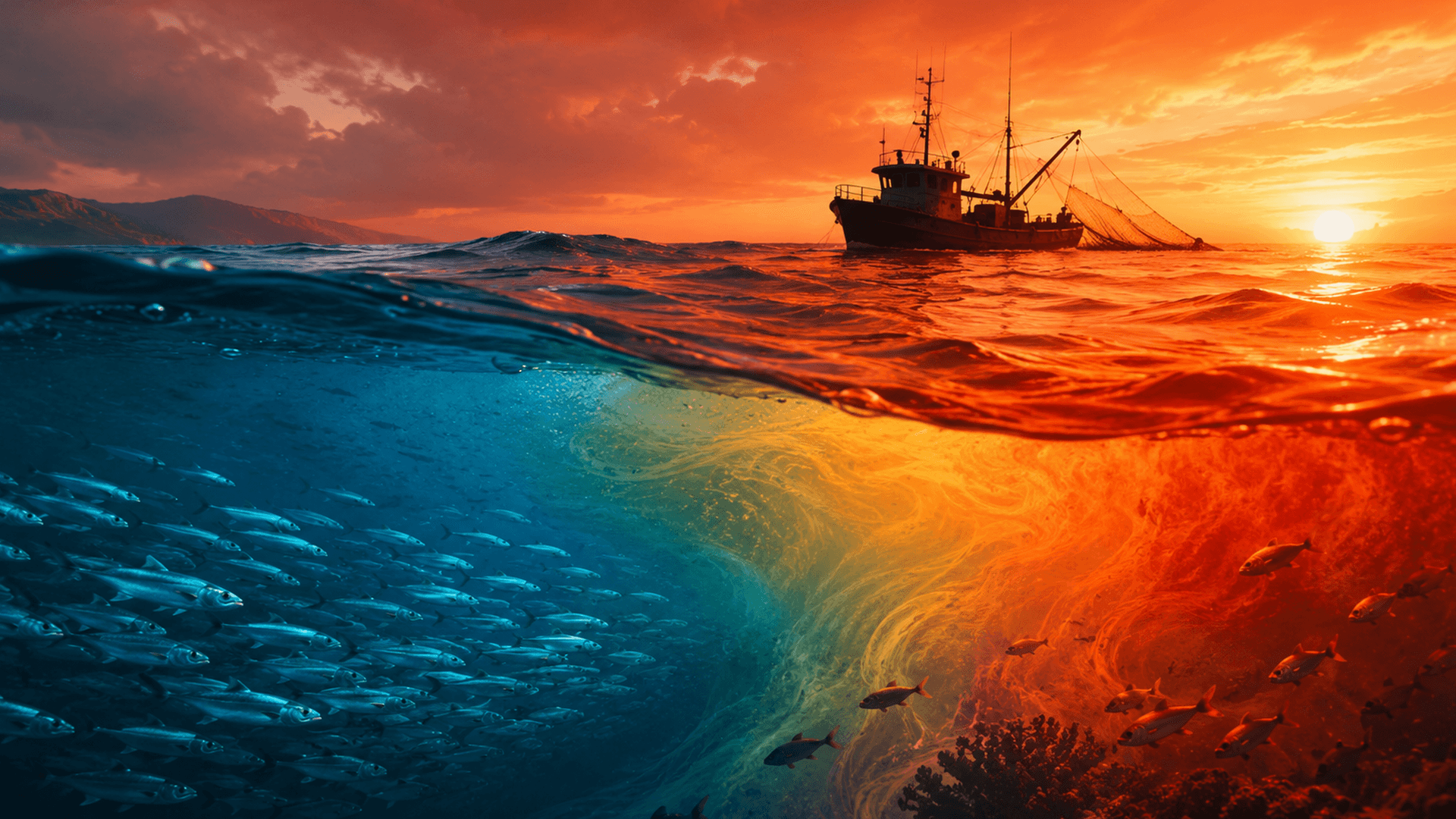
We habitually imagine heatwaves as scorching asphalt roads, city power outages, or elderly people suffering from heatstroke, yet we often forget that seas can also run a fever. Marine heatwaves are not merely waves that feel warmer; they represent large‑scale anomalies in sea surface temperature that persist long enough to alter biological behavior, ecological relationships, and fisheries order. They can cause coral bleaching, seagrass decline, and mollusk mortality, while also driving fish stocks to shift their routes, forcing fishermen to travel farther, incur higher costs, and face greater risks. Ultimately, these changes ripple back to markets and tables, though price tags rarely tell consumers that what they buy is not just a single fish but the outcome of an entire marine stress system.
The greatest fear for fisheries is not a day when no fish are caught, but not knowing where fish will be tomorrow. Traditional experience can judge seasons, tides, wind direction, and water color, yet when climate change makes anomalous sea temperatures more frequent, past knowledge must reconnect with new data. This does not mean that old fishermen’s knowledge has become obsolete; it means the sea itself is changing. True resilience is not calling on fishermen to adapt alone nor waiting for fish stocks to swim back; it requires updating local experience, scientific monitoring, market institutions, and policy tools together.
Fish Move, Institutions Often Stay Still
Marine heatwaves shift species distributions. Some fish migrate toward cooler waters; some fishing grounds may appear lively in the short term but lose stability over time. This complicates fisheries management because many systems are designed around fixed marine areas, fixed seasons, and fixed species. When fish cross administrative boundaries, protected area borders, or traditional fishing grounds, conflicts arise: who can harvest? How are quotas calculated? Who bears conservation responsibility? And how do market prices reflect risk?
More realistically, small‑scale fisheries have weaker capacity to absorb shocks. Large fleets can travel farther and possess cold chains, information systems, and capital; small fishermen are often tied down by fuel costs, equipment, weather, and household economics. If policy only provides subsidies after disasters, it effectively admits that institutions always lag behind. Marine heatwaves require proactive governance: real‑time sea temperature monitoring, fishing ground risk alerts, port cold chain adjustments, alternative income schemes, insurance design, and market communication. Otherwise each anomalous marine temperature event becomes an amplifier of social inequality.
Data Is Not Just for Experts
When discussing fisheries resilience, many first think of more satellites, more sensors, more models. These are certainly important, yet data that remains only in research institutions or central platforms may not be usable locally. Fishermen need information that is understandable, actionable, and feedback‑oriented: which marine areas show temperature anomalies? How will wind and waves behave over the next few days? Has the location of a particular fish species shifted? If fishing trips are reduced, are there alternative incomes or insurance mechanisms to support them? Data cannot be merely pretty dashboards; it must become decision tools.
Local knowledge also should not be treated as something only harvested. Fishermen, coastal communities, Indigenous marine knowledge holders, and long‑term observers often capture details that models initially miss: water color changes, odd currents, certain bird flocks failing to appear, or particular fish arriving earlier than expected. These signals should not be dismissed as “non‑scientific anecdotes” but designed into observation systems that can converse with scientific data. The concept of Two-Eyed Seeing in fisheries policy is not a cultural slogan; it is a method for improving risk assessment quality.
Cultural Imagery Can Become Environmental Memory
Marine and fisheries changes exist not only in datasets but also in images, songs, oral histories, photographs, and everyday memories. Cultural image workers capture more than scenery: they document how work occurs at the shore, how boats return to port, how fish are sorted, how elders judge wind, and how children understand the sea. If these images are preserved over time, they become another timeline of environmental change. When models report fish movement, imagery reminds us that what moves is not just fish but also people’s work, families, cooking, rituals, and local economies.
This is why fisheries resilience cannot be handed to a single department alone. Agriculture, marine affairs, meteorology, education, culture, economics, and local governments all lie on the same chain. When sea temperatures rise, the issue is not merely catch efficiency but how places preserve ways of life. If policy focuses only on output, it misses communities; if it looks only at price, it overlooks culture; if it emphasizes technology alone, it neglects the field. True resilience means allowing scientific data, local knowledge, and cultural memory to support one another.
Markets Must Bear Climate Costs
Climate risk is often pushed onto front‑line producers, yet the costs of marine heatwaves should not be absorbed solely by fishermen. Restaurants, retail channels, processing plants, cold chain logistics, consumers, and governments all sit within the food system. If markets pursue stable low prices without acknowledging the higher risks fisheries face, those who ultimately suffer are coastal livelihoods and marine resources. Sustainability cannot be merely a green label on menus; it must also reflect in procurement contracts, pricing mechanisms, and risk sharing.
For example, retail channels can establish longer‑term purchasing relationships with small‑scale fisheries to avoid transferring all risk when catches fluctuate; governments can support low‑carbon cold chains and local processing so fishermen do not have to sell urgently at the lowest prices; insurance and financial instruments can incorporate marine temperature anomaly indicators rather than only recognizing losses after disasters. These policies may sound unromantic, yet they are closer to the core of the problem than empty slogans about “protecting the ocean.”
Do Not Wait for the Sea to Declare Bankruptcy for Us
The terror of marine heatwaves lies not in each event resembling a disaster film but in their gradual rewriting of normalcy. Today fish arrive late; tomorrow costs rise; the day after young people refuse to take over; and within a few years fishing villages hollow out. When society finally notices, it is often no longer just an ecological issue but a shared crisis of local economies, cultural continuity, and food security.
Fisheries resilience does not mean waiting for fish to swim back nor relying on disaster subsidies to wipe away tears. It requires advance investment, integrating local knowledge into policy, having markets acknowledge climate costs, and treating the ocean as public infrastructure rather than an inexhaustible refrigerator. The sea will not write policy reports for us, yet it continuously reminds us through fish stocks, coral, currents, and prices: if institutions do not move, risk will shift onto the most vulnerable people.
The Table Is Actually a Risk Map
Consumers in markets see fish primarily as price, size, freshness, rarely noticing underlying sea temperatures, fuel costs, crew working hours, port cold chains, or fishing ground changes. Yet marine heatwaves are turning tables into risk maps. A particular fish becoming more expensive is not always market hype; a reduced catch for a season does not simply reflect fishermen’s effort. It may signal that the marine food web is shifting, that traditional work rhythms in certain places must change, and that policy has yet to keep pace with ocean speed.
Therefore fisheries resilience also demands new public communication. Governments should not only announce subsidies during disasters; media should not merely ask “why so expensive” when prices rise. We need consumers to understand that stable and responsible seafood supply requires someone to bear the costs of monitoring, conservation, transition, and risk sharing. When society is willing to discuss origin and fair trade for a cup of coffee, it must also be capable of discussing sea temperatures, fishing methods, and local livelihoods for a single fish. The future of fisheries does not rest solely on fishermen holding the line; it depends on whether the entire food system is willing to grow together.
Ocean heatwaves remind us that tables are not natural gifts but fragile social contracts. When the sea begins to change, institutions must also change; otherwise those forced to adapt will forever be the people closest to the water.
AI use and content-safety disclosure
This article and cover image were co‑created with generative AI; the editorial workflow includes source verification, cultural context review, and human editorial oversight.