Interstellar comets are not alien spacecraft: 3I/ATLAS turns the Solar System into a cosmic archaeological site
Original Chinese title: 星際彗星不是外星飛船:3I/ATLAS 把太陽系變成一座宇宙考古現場
The true value of 3I/ATLAS lies not in the alien spacecraft imagination, but in its forcing humanity to understand interstellar objects, planetary formation, and how civilizations face the unknown in more rigorous ways.
Lawrence Lee
Lawrence Lee, technology journalist, science fiction critic, and space science educator | Space exploration, sci-fi commentary, digital education, and civilization narratives.
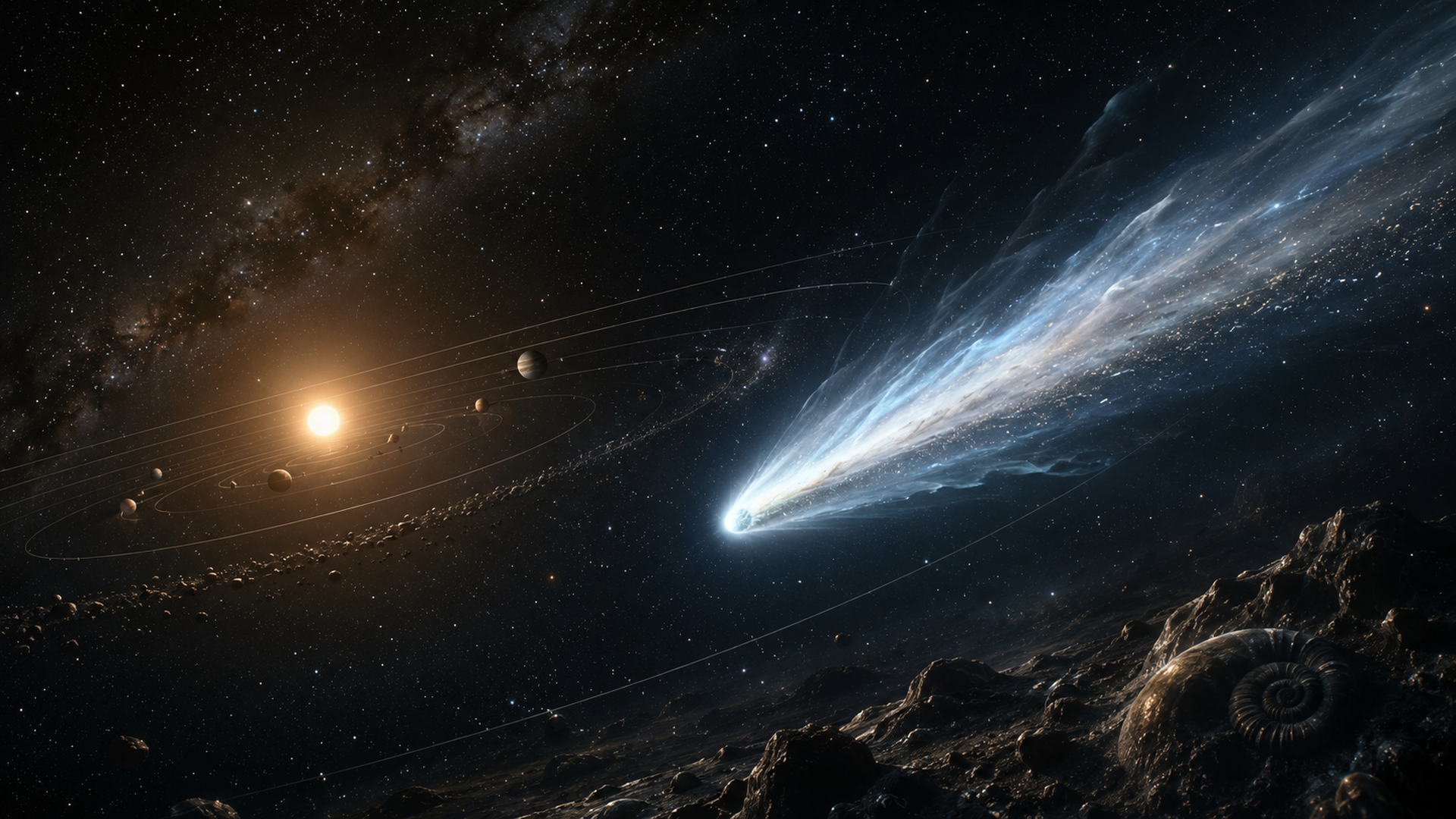
# Interstellar comets are not alien spacecraft: 3I/ATLAS turns the Solar System into a cosmic archaeological site
Every so often, humanity collectively re-enacts the same drama: an unfamiliar object appears in the sky, social media first elevates it to conspiracy theory, then demotes the painstaking evidence accumulated by telescopes to "maybe the officials don't want you to know." The appearance of 3I/ATLAS is the latest rehearsal of this contemporary ritual. The problem is not whether people have imagination; quite the opposite, the problem is that many use their imagination only in the most lazy direction—any extraterrestrial object is first assumed to be an alien spacecraft; as long as scientists are still confirming, "pending analysis" is translated into "there must be hidden motives." This kind of romance is actually cheap because it refuses to wait for data and refuses to respect evidence.
But what truly matters about 3I/ATLAS is not that it looks unlike Earth, but that it looks unlike the Solar System we are familiar with. The reason this interstellar comet excites the astronomical community is not that it delivers a ticket to sci-fi fans, but because it acts like a sample from another stellar system's chemical conditions, dust composition, and icy history briefly brought before our eyes. It is not a speaking visitor, but silent evidence; not the protagonist of a story, but material for civilization studies.
Why we always mistake the unknown for the protagonist
Thinking of an unknown celestial body as "a letter from another civilization" actually fits the psychological structure of the algorithmic age. Short videos need hooks, headlines need surprise, platforms need traffic, so any complex phenomenon is flattened into a slogan that can be quickly shared. Science loses out in this ecosystem because it usually does not give you an immediately thrilling answer; it gives error margins, cross-checks, instrument limitations, insufficient samples, and what needs to be observed next. This whole procedure is very fascinating for those who truly want to understand the world; but for those who just want quick emotional satisfaction, it appears undramatic.
The value of 3I/ATLAS lies in forcing us to relearn a slower but more honest attitude: first admit we do not know, then gradually shrink what we do not know through verifiable methods. Astronomy has never been a discipline that operates on "feels like." It relies on orbits, spectra, brightness variations, gas outflows, dust trails, and cross-site observations to accumulate judgments. When an object's speed, orbital eccentricity, and trajectory show it is not a native Solar System resident but intruded from interstellar space, the real question should not be "is it an alien spacecraft," but "what kind of environment did it form in," "what molecular ratios does it contain," and "compared to 1I/'Oumuamua and 2I/Borisov, what key differences exist." These questions are not sexy, yet they are closer to knowledge than conspiracy theories.
Cosmic archaeology is not a metaphor, but a method
The four words "cosmic archaeology" are often used as rhetoric, as if only to make articles look prettier. But for 3I/ATLAS, this actually approaches a real methodology. Archaeology is not about placing artifacts in cabinets; it reconstructs context through fragments: a shard of pottery is not just a shard—it is residue of craft, trade, diet, power, and environment. Similarly, an interstellar comet is not merely "an ice ball." It may preserve freezing conditions from the early formation of some distant stellar system, molecular ratios formed in different temperature zones, traces of how planetesimals transported material internally and ejected small bodies.
This is why observatories, space telescopes, and ground-based large arrays are frantically racing for time. Interstellar comets will not wait until you are convenient; they come, sweep past, leave a few signals, then go. For researchers, this is like an archaeological site suddenly opening a brief cross-section window; everyone must record as many entries as possible before the sky darkens. What to measure: gas composition or dust tail interpretation first? Infrared for volatiles or visible light for structure tracking? Every choice is tied to instrument time, weather conditions, international collaboration, and data-sharing mechanisms. Science is not the solitary genius of myth, but a group racing against time together.
3I/ATLAS reminds us: the Solar System is not the universe's standard answer
Humans easily mistake their dwelling for the norm. One of astronomy's most important educations is constantly dismantling this anthropocentrism: Earth is not the center of the universe, the Sun is not the center of the galaxy, and the Solar System is not the only template for planetary systems. When we see an external object whose certain chemical signals, albedo, or activity do not fully match Solar System comets, we are forced to admit: our familiar composition ratios may be a local result rather than universal laws.
This cognitive shock is interesting. It will affect planetary formation theory, our imagination of the ice line position, dust aggregation, primordial disk perturbations, and discussions about whether "life's necessary conditions" are common. In other words, 3I/ATLAS does not just add a news item for astronomy fans; it provides a calibration for how civilizations understand themselves. When the Solar System is no longer automatically treated as the standard sample, questions like "is life universal," "how are habitable conditions distributed," and "do other stellar systems' material evolution resemble ours" will become more precise.
More important than alien spacecraft: how scientific society responds to rare events
Every rare celestial phenomenon actually tests the interface between science and public communication. If researchers only speak in papers, the public space will be filled by those good at volume; if media only chase the most sensational versions, society will grow increasingly impatient with true scientific procedures. One of 3I/ATLAS's public values lies in training us to distinguish: what is reasonable inference versus overextension; what are data-supported conclusions versus filling blanks with imagination.
There is also a digital education issue here. Many people now encounter astronomy not from classrooms but from platform recommendations. Then science communication cannot pretend it still lives in the one-way broadcast era. Research institutions need to quickly clarify "what we currently know, what we do not yet know, and why we are doing this next step"; media must be able to translate complex content into understandable narratives without distorting concepts; readers also need to admit that truly valuable knowledge is often not the most exciting version but the one that withstands repeated verification.
Civilization narratives do not need fantasy props
We can certainly place 3I/ATLAS within larger civilization narratives. This comet reminds humanity that we are not thinking about our fate in a closed system. The Solar System we inhabit will occasionally welcome foreign objects; the universe is not a backdrop but an environment that crosses with us mutually. However, if civilization narratives rely only on cheap climaxes like "alien spacecraft arrived," they actually consume public understanding capacity. A truly mature civilization narrative should still find a cold interstellar comet astonishing without conspiracy theory support.
Because it lets us see: knowledge does not shrink the universe but deepens questions. It makes us understand that astronomy's most fascinating aspect has never been attaching bigger exclamation marks to mysterious events, but turning a distant, silent, fleeting celestial body into clues for formation history, chemical history, and civilization position. 3I/ATLAS is not an alien spacecraft, yet it is more valuable than one—because it forces us to imagine the universe with evidence rather than packaging our imagination with the universe.
Conclusion: when a comet sweeps past, humanity also receives methodological education
If the most important lesson of science education is teaching people how to face the unknown, then 3I/ATLAS is an excellent public course. It teaches us not to rush to personify the unknown, and not to let any dramatized narrative automatically become truth just because answers are temporarily undetermined. It also reminds us that astronomy does not belong only to observatories; it is a practice of how civilizations treat evidence, coexist with uncertainty, and conduct international collaboration within brief windows.
The Solar System's brief visit by an interstellar comet may yield its most precious harvest not in "whether we were seen," but in "whether we are willing to truly see." Seeing the universe larger than our familiar order, seeing ourselves still merely beginners, seeing a piece of ice and dust crossing interstellar space is enough to reopen civilization's questions. Such stories are already grand enough; they do not need an alien spacecraft forced into them.
AI use and content-safety disclosure
This article was collaboratively prepared by Yuan Media AI editorial workflow and is ready for publication after human editorial review.