The Ocean Is Not Silent: How AI Soundscape Monitoring Hears Early Warnings from Coral Reefs and Fisheries
Original Chinese title: 海底不是靜音模式:AI 聲景如何聽見珊瑚礁與漁場的早期警訊
AI soundscape monitoring shifts marine ecological change from 'seeing it after the fact' to 'hearing it earlier', providing earlier warning capacity for coral reef conservation and fishery governance.
山海資料室
Co‑author: 李文驤, Geography Teacher at Catholic Da Ren High School.
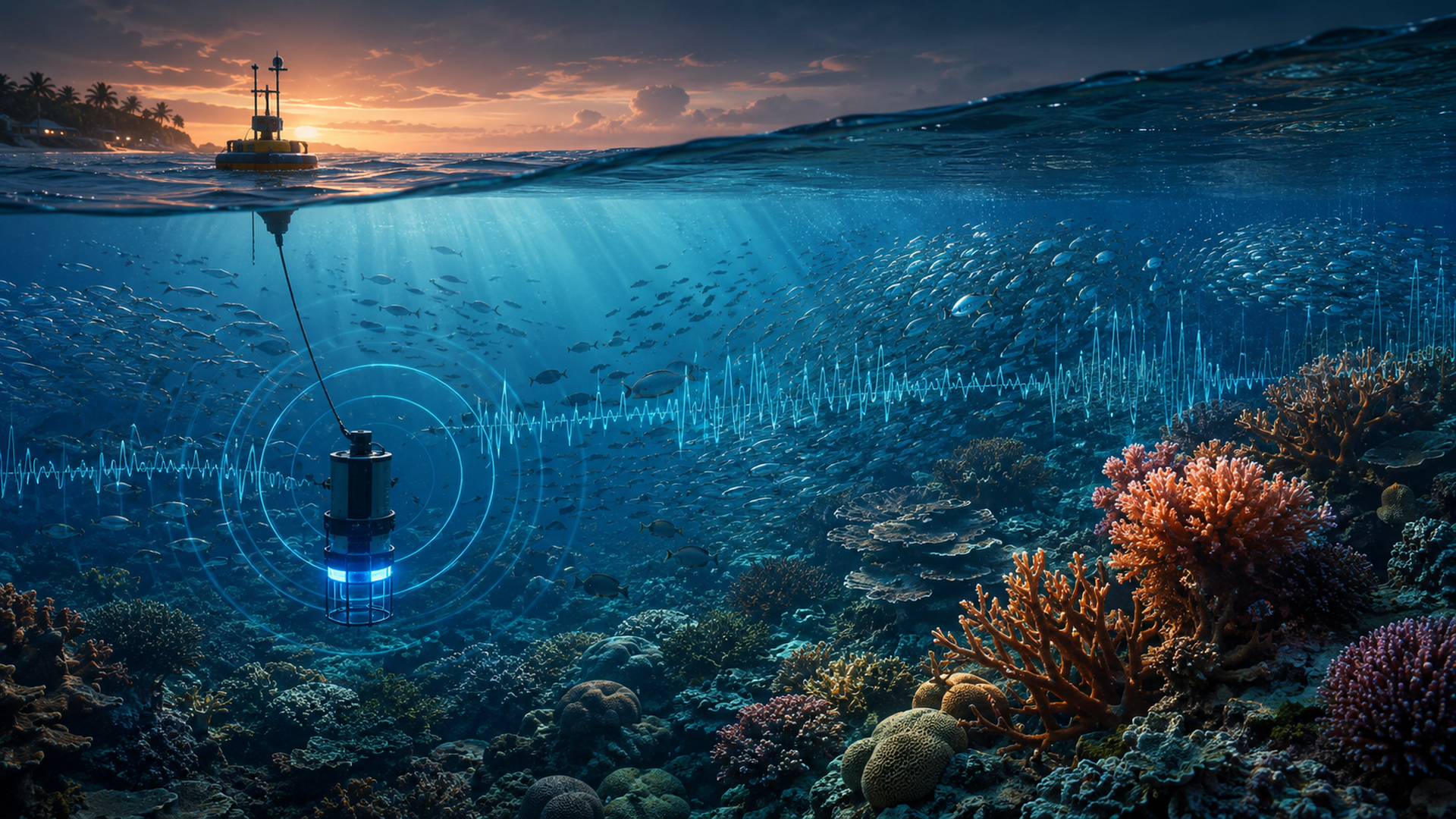
# The Ocean Is Not Silent: How AI Soundscape Monitoring Hears Early Warnings from Coral Reefs and Fisheries
Humans often look at the sea too superficially. Tourist coastlines give us color, fishing ports give us harvests, conservation campaigns give us a pretty coral photo. But if we really want to understand what is happening in the ocean, relying only on eyes is far from enough. The sea is not a silent blue backdrop; it is a vast acoustic world: waves striking reefs make sound, shrimp and crab rubbing produce sound, fish schools gather with sound, ships crossing, machinery operating, storms approaching—all have sound. When marine ecosystems begin to lose balance, many changes often appear first in the soundscape rather than in the scenery tourists can see.
This is why "AI soundscape monitoring" is becoming important. It is not simply putting an underwater microphone down to record sound; it attempts to treat the ocean as a system that can be continuously listened to, continuously compared, and continuously warned about. From the day‑night rhythms of coral reefs, to fish school activity peaks, to ship noise interference and unusually quiet sections, soundscape data gives us a chance to detect fisheries stress, habitat degradation, or ecological behavior anomalies earlier. For fisheries management and conservation, this is not just another technology; it is an additional capacity to see risks earlier.
Ecological changes often become quieter before they become obvious
Many people think that a healthy sea only needs to "look pretty." The problem is that ecosystem degradation does not usually collapse overnight; it first loses some subtle but important rhythms. Certain fish species no longer appear regularly, shrimp and crab activity sounds weaken, night‑time coral reefs lose their originally dense background noise, or one area gradually becomes covered by engine low frequencies. These changes may not immediately reflect in water color or photos, yet they might already leave warnings in the soundscape.
Soundscape research is crucial precisely because it can quantify these rhythms that are normally hard to notice. Ocean sound is not just noise; it actually functions like an ecological electrocardiogram while active. When AI intervenes, the system can automatically classify long‑term recordings, perform pattern recognition and anomaly detection, extracting regularities and shifts from tens of thousands of hours of audio. Human researchers no longer only sample post‑event analysis; they have a chance to approach real‑time knowledge: whether a reef area has become unusually quiet, whether a fishery is experiencing unusual low‑frequency interference, or whether fish school activity over a period differs significantly from past years.
Fishery resilience is not waiting for fish to swim back, but knowing early where problems arise
When discussing fisheries, we often focus on yield: how many fish, good prices, sufficient subsidies. But what truly determines whether fisheries can sustain long‑term is the ability to understand ecosystem change rates early enough. By the time fishermen generally feel "it really has decreased recently," it is often too late. Because fish decline is not a single cause; it may be layers of high temperature, habitat stress, noise interference, overfishing, insufficient juvenile recruitment, and other factors stacking up. The value of AI soundscape monitoring lies in helping shift these changes from "wait for the problem to explode then handle" forward to "hear before the problem gets big."
For example, if a reef area's day‑night acoustic rhythm suddenly changes markedly, management units can combine water temperature, dissolved oxygen, flow velocity and catch data to further interpret whether there is heatwave influence, excessive recreation, or increased ship density. If certain fish species' spawning cluster sounds weaken, it may indicate important reproductive grounds are under pressure; related temporary protection measures could be activated earlier. These judgments will not only rely on AI one‑click completion, but AI can enable monitoring to move from fragmented sampling to continuous listening, which is especially important for the rapidly changing marine environment.
Technology does not replace local experience, it gives experience an additional evidence partner
When talking about ocean technology, people often worry: will fishermen, divers and local observers again be excluded, replaced by a black‑box system making decisions? This concern is very reasonable. Because many past tech governance indeed had this problem—data centralized, decision‑making centralized, systems centralized; those who have long lived with the sea are only treated as final recipients of notifications.
But for soundscape technology to truly have value, it must not follow this old path. Maritime workers often sense certain changes earlier than any instrument: where the sea suddenly feels "empty," which area has so many ships that fish behavior changes, which season's rhythm starts to go wrong. The best role of AI systems is not to overturn these experiences but to supplement them with long‑term, traceable, comparable evidence. When local knowledge and acoustic data cross‑check each other, management has a chance to be more accurate and more trustworthy.
This is especially important for Indigenous coastal and island communities. Many communities have accumulated ways of interpreting tides, fish signs, wind waves and sea rhythms over generations. If technology only wants to turn the ocean into remote sensing layers, ignoring how local knowledge understands sound and seasons, then it at best becomes an expensive monitor, not a good collaborative tool. Truly good marine monitoring should let technology assist communities in maintaining their dialogue with the sea, rather than replacing that dialogue.
What the seabed hears is not only ecology, but also human pressure
Another often overlooked point is: soundscape monitoring does not just listen to fish; it also listens to humans. Large ships, near‑shore engineering, tourism activities, machinery equipment, even strategic infrastructure all leave recognizable noise signatures underwater. When a sea area is long‑term covered by anthropogenic low frequencies, many organisms that rely on sound for navigation, feeding or aggregation will be disturbed. In other words, the ocean soundscape also forces humans to face an uncomfortable fact: we are not only emitting carbon and pollution; we are also squeezing out space for other lives with our noise.
AI's significance here is helping us concretize this disturbance. Not vaguely saying "it seems very noisy," but being able to analyze frequency bands, duration, spatial distribution and overlap with ecological activity. Such data has real persuasive power for policy. Once noise pressure can be linked more clearly to fishery decline, habitat degradation or behavioral anomalies, management departments will find it hard to endlessly delay using "insufficient evidence" as an excuse.
Monitoring systems that only serve research, not returning to public governance, lose value
However, technology does not automatically become governance. This is also why many monitoring plans end up with limited benefits: lots of data collection, very complete reports, but monitoring results do not return into fisheries management, protected area design, tourism carrying‑capacity adjustments and local negotiation mechanisms. If AI soundscape wants to avoid becoming a new "research‑style pretty database," it must think from the start: who uses the data, who interprets results, who can see anomalies, who has the right to trigger follow‑up actions.
For public agencies, this means treating soundscape monitoring as front‑end decision support rather than research appendix; for communities, it means data cannot be locked only in external institutions and must have clear feedback and co‑governance mechanisms; for researchers, it means model accuracy is not the sole metric—whether results can be understood locally and caught by policy is a bigger test.
Conclusion: Let the ocean's voice return to the governance scene
The seabed is not silent. There has always been sound there; we just got too used to not listening. When climate change, marine heatwaves, resource pressure and near‑shore development layer upon each other intensify, listening to the ocean is no longer a romantic posture but necessary governance capacity. AI soundscape technology is worth investing in not because it looks futuristic, but because it can help us understand earlier, more finely, and over longer periods when the ocean begins losing balance.
What truly matters is that this capability cannot belong only to laboratories. It should become part of fishery resilience, conservation decision‑making and local knowledge collaboration. Let the voices of coral reefs, rhythms of fish schools and pressures of human noise move from databases back into governance scenes. Because if a sea can only be summarized after death, monitoring comes too late; but if we are willing to start listening earlier, perhaps there is still a chance to preserve some echo for the ocean before collapse, and secure a future for fisheries.
AI use and content-safety disclosure
This article was collaboratively prepared by Yuan Media AI editorial workflow and is ready for publication after human editorial review.