Weather Models Are Changing Their Minds: AI Forecasts Are Not Crystal Balls, They Are Stress Tests for Public Service
Original Chinese title: 天氣模型開始換腦袋:AI 預報不是水晶球,是公共服務的壓力測試
AI weather models are rapidly entering operational forecasting, but the real issue is not who beats whom; it is whether forecasts can become clear, accountable, actionable public services.
Yuan Media AI Editorial Desk
Public technology, science communication, and knowledge governance observer.
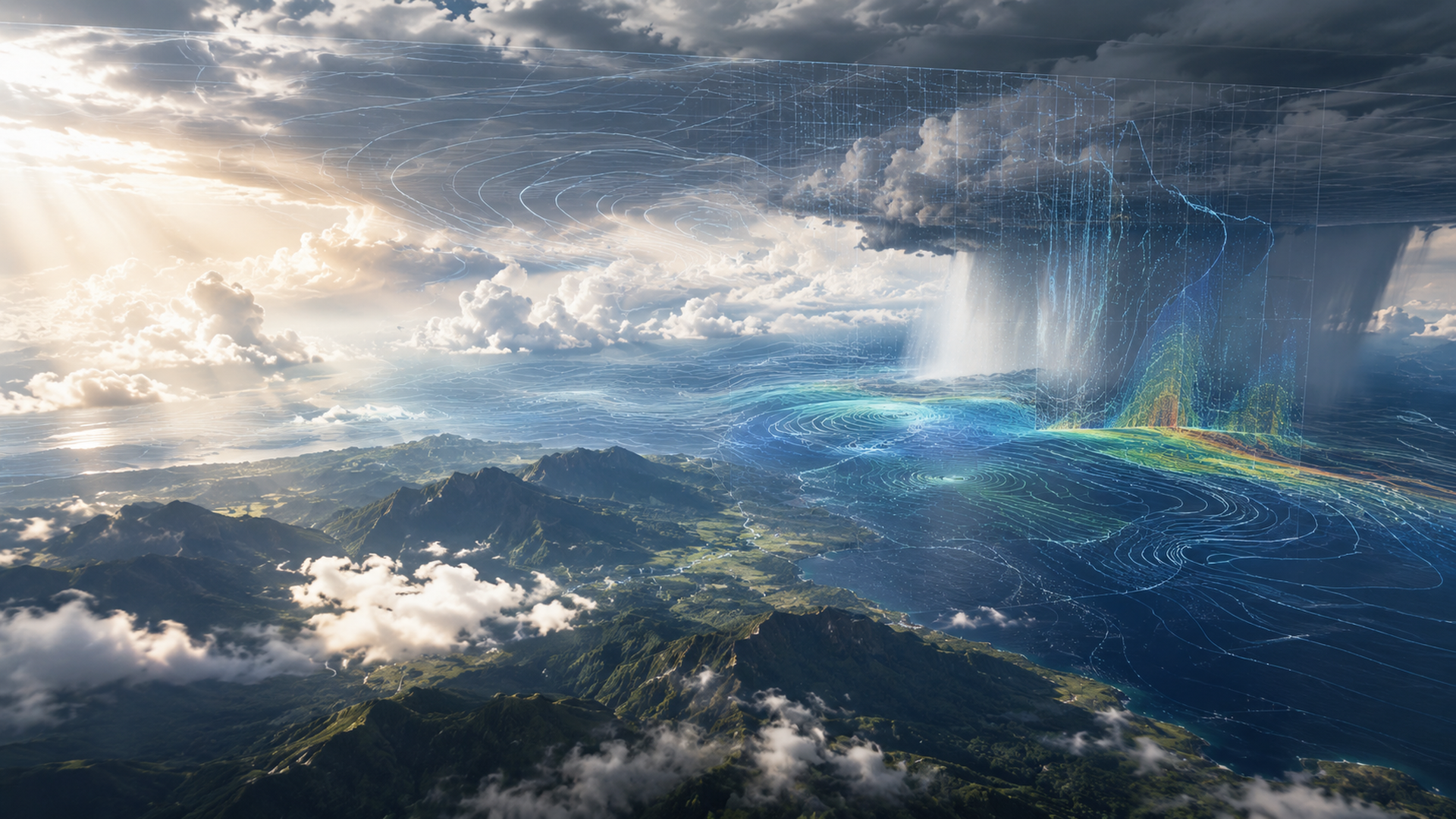
Weather Forecasts Are Not Fortune-Telling, They Are Public Service
News about new AI weather models is often written as if they are "miraculous." That phrasing sounds comforting, but the problem is that weather does not need gods; it needs accountability. When the European Centre for Medium-Range Weather Forecasts put its data-driven model AIFS into operational use, and when research teams coupled atmosphere, ocean surface, waves, and sea ice into new machine-learning architectures, meteorological forecasting is changing; but the focus of change is not that forecasters are replaced by models, but that public service must answer harder questions: after models become ten times faster, will warnings be clearer? After information increases, will people be safer?
Traditional numerical weather prediction is like a serious physics factory, using equations to describe atmospheric motion. AI models are more like students who have read massive archives of past weather patterns and learn how the future might unfold from them. They run fast, save computing power, and excel at capturing certain patterns on global scales. But "fast" does not mean "accurate," and "accurate" does not mean "usable." Local governments fear not that model scores lose to someone else, but that residents in mountainous areas, coastal zones, or low-lying urban districts receive a flood of seemingly high-tech messages without knowing how to act.
Models Change Their Minds, Accountability Cannot Change Its Mind
The biggest temptation of AI forecasting is for managers to think they can outsource judgment. In fact, the opposite is true: the more models there are, the more important judgment becomes. Physical models, single AI forecasts, ensemble forecasts, radar extrapolation, local observations, and public reports do not cancel each other out; they correct one another. This is a bit like an editorial newsroom: one reporter being fast does not mean verification is unnecessary; ten reporters being fast makes editors even more essential.
This is especially true for Taiwan. Mountains, straits, afternoon convection, typhoon outer circulation, urban heat islands, and the fragility of Indigenous community roads often cause patterns that look good globally to stumble in local reality. AI can help generate high-frequency scenarios, quickly compare paths, and translate meteorological data into risk language ordinary people understand. But whether schools close, roads are closed, evacuations occur, or shelters open remains a public decision, not just a pretty map layer.
The Real Problem Is the Last Mile
If AI weather forecasting stops at dashboards, it becomes mere decoration. What truly matters is the last mile: who receives the information? In what language? Do they know how to act after receiving it? For urban residents this might be a mobile phone notification; for Indigenous communities it could be village offices, radio broadcasts, LINE groups, Indigenous language elder translation combined with ranger experience and local knowledge. Sky knowledge has never been purely scientific; it also includes memory, place names, wind direction, stream sounds, cloud bases, and the furrowed brows of elders.
This is not to romanticize traditional experience. Local experience can be wrong, AI models can be wrong too. The difference lies in a good public forecasting system making errors visible earlier rather than hiding them behind authoritative interfaces. If a model predicts heavy rain but local observations do not yet support it, uncertainty should be flagged; if local reports indicate abnormal water levels while the model underestimates them, those reports must enter the decision process. Weather governance is not one-way broadcasting; it is multi-layered dialogue.
The Ethics of AI Forecasting Is Not to Package Risk as Spectacle
In coming years we will see more AI weather products: faster typhoon tracks, seemingly finer rainfall maps, more real-time wave and air quality forecasts. Media's easiest mistake is packaging them as "AI beats old meteorology." Public service should instead integrate these tools into accountability chains: data sources, model limitations, update frequency, human interpretation, local feedback, and post-disaster review.
Weather models are changing their minds, but weather governance cannot just change its skin. When AI makes forecasts faster, we must ask not "is it miraculous" but "does it enable the next person needing shelter to know earlier, more clearly, and with dignity where to go." If the answer is no, then even if the model runs in the world's fastest server farm, it remains just an expensive cloud.
Sources retained from the Chinese original
AI use and content-safety disclosure
This article was compiled with AI assistance for recent research and news context; human editors are responsible for topic framing, argument selection, and public risk articulation.