Fish stocks haven't disappeared, they've just moved: Ocean warming, eDNA and the next lesson in fisheries resilience
Original Chinese title: 魚群沒有消失,只是搬家了:海溫、eDNA 與漁業韌性的下一堂課
From ocean warming and eDNA monitoring to small-scale fisheries data rights, consider how institutions, ports and data governance must keep pace after fish stocks shift.
山海資料室
Co-author: 王振庭 / Technology policy researcher, digital transformation observer.
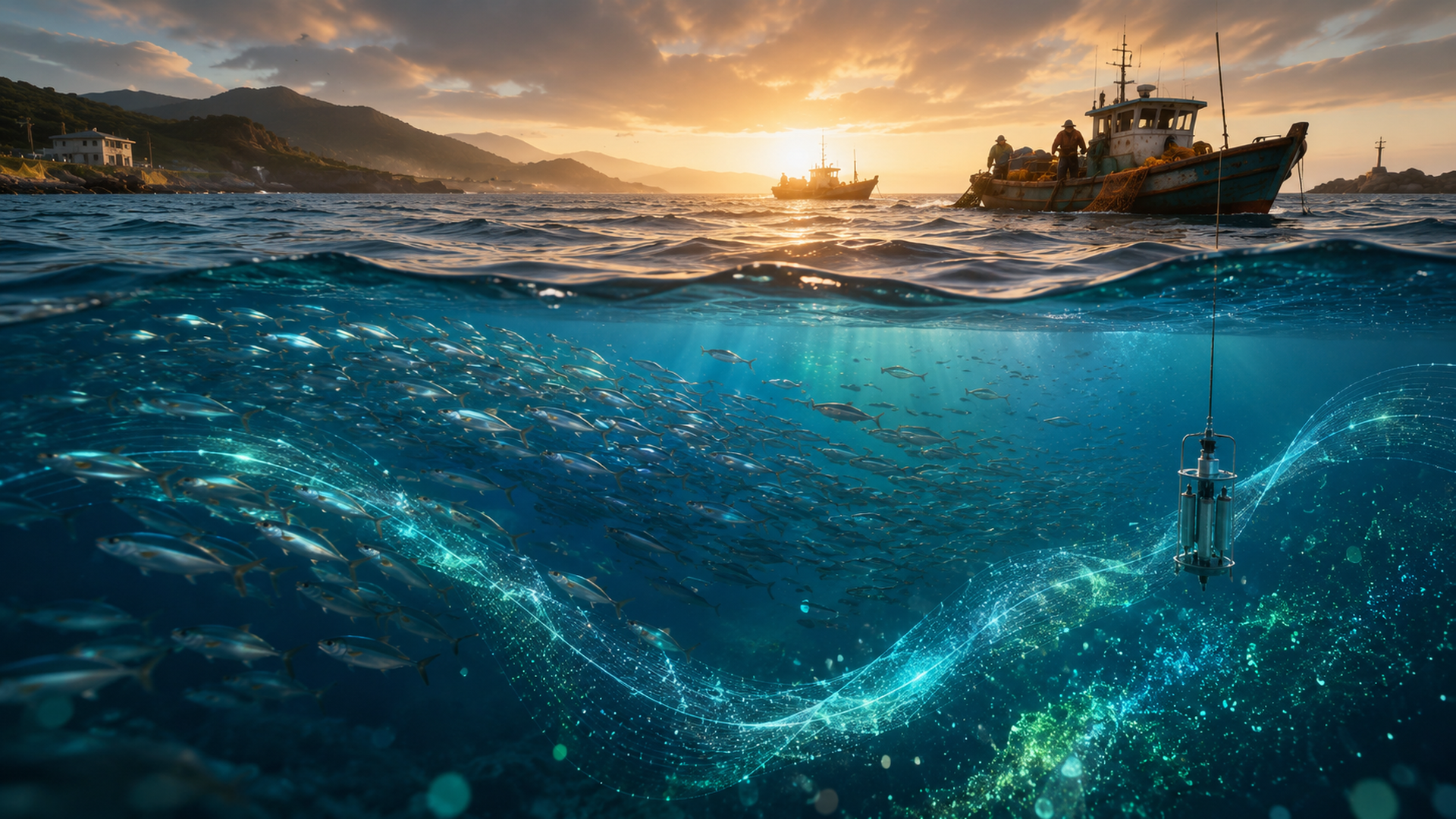
Fish stocks haven't disappeared, they've just moved
The cruellest misunderstanding in fisheries is treating the ocean as a refrigerator. Today it has fish, tomorrow it should have fish; this fishing ground had fish this year, so it should have them next year too. The problem is that the ocean isn't a warehouse—it's a living system that's warming up, flowing, noisy and pulled by humans. Fish don't sign long-term leases; they move with water temperature, food, currents, habitat and pressure. When fishermen say 'the fish are gone', science shouldn't immediately contradict them; a more honest statement is: the fish may have really decreased, or they've moved, while our monitoring methods are too slow.
Recent fisheries discussions are often torn apart by two languages. One side talks about international reports on fishing, aquaculture, food security and ocean warming; the other side speaks with local fishermen about fuel costs, ice blocks, piers, closed seasons and market prices. The former looks like satellite maps, the latter like ledgers. True fisheries resilience must connect both.
eDNA is a shredded-paper clue in seawater
Environmental DNA, or eDNA, offers an interesting entry point. As fish swim past, excrete or shed cells, molecular traces can remain in the water. Researchers collect samples, extract and sequence them—like picking up paper scraps from a shredder in seawater—to infer which species are nearby. It doesn't require trawling every time, catching rare species, or filling gaps where traditional surveys never reached.
But eDNA isn't Poseidon's QR code. DNA degrades, currents carry it away, and concentration doesn't always track abundance linearly. Anyone claiming 'one bottle of water tells you the whole sea' is not doing science; they're selling snake oil. A more reliable direction combines eDNA with acoustics, image recognition, catch reports, temperature data and local knowledge to build a fisheries sensing network closer to reality.
Fishermen aren't just data providers
In Taiwan's coastal areas linked to Indigenous lands, fisheries data are not only scientific—they're livelihood, family and place-based knowledge. Which season brings which wind, which river mouth turns muddy, which reef zone shouldn't be disturbed, which fish arrive early or late—these details become company model assets once platforms absorb them, turning fishermen into 'the studied' again. That isn't smart fisheries; it's recasting maritime labour as data colonialism.
A better approach writes data rights into system design before anything else: who uploads, who can view, who may use, how commercial use is compensated, how errors are corrected, and whether sensitive fishing grounds should be masked. Especially for small-scale fisheries, Indigenous community harvesting and traditional marine areas, full transparency doesn't mean everything must be public. Protecting resources sometimes requires openness; protecting places may require secrecy.
Fish move, institutions must move too
FAO's global data reminds us that aquaculture has become a major supply source while overfishing pressure persists; new ocean warming research shows long-term seabed heating alters biomass and population structure. These trends won't vanish because local markets still sell fish tomorrow. The problem is institutions often lag behind the fish. Fish have changed routes but subsidies follow old channels; habitats shift yet management sticks to outdated maps; data grows while decisions still read single spreadsheets.
Fisheries resilience isn't about fishermen holding on alone. It needs port cold chains, insurance, transition training, open-but-bounded data platforms and monitoring systems where fishermen can participate in interpretation. AI can identify images, organize reports, forecast conditions and help build finer risk maps. But if AI only serves large fleets and capital-intensive aquaculture, small-scale fisheries will be more precisely marginalized.
The ocean isn't a refrigerator; fish aren't fixed assets either. As water warms, species shift and monitoring tools sharpen, what truly needs upgrading isn't just models but our political imagination of the sea: seeing it as a shared living system rather than a freezer that should yield whenever opened.
Sources retained from the Chinese original
AI use and content-safety disclosure
This article was organized with AI assistance on international fisheries and environmental DNA research contexts; human editors are responsible for local interpretation and data rights perspectives.