Deep Space Memory Project No. 8: When Voyager Starts Practicing Silence
Original Chinese title: 深空記憶計畫之八|當旅行者號開始練習少說話
Voyager shuts down instruments as its power wanes, like a lesson in late-life data governance for civilization: not every sound can survive, but the final ones deserve careful selection.
Lawrence Lee
Technology journalist, science fiction critic, and space science educator
Subtitle: AI, Voyager, and humanity's last voice
A spaceship ages, and civilization begins to be honest
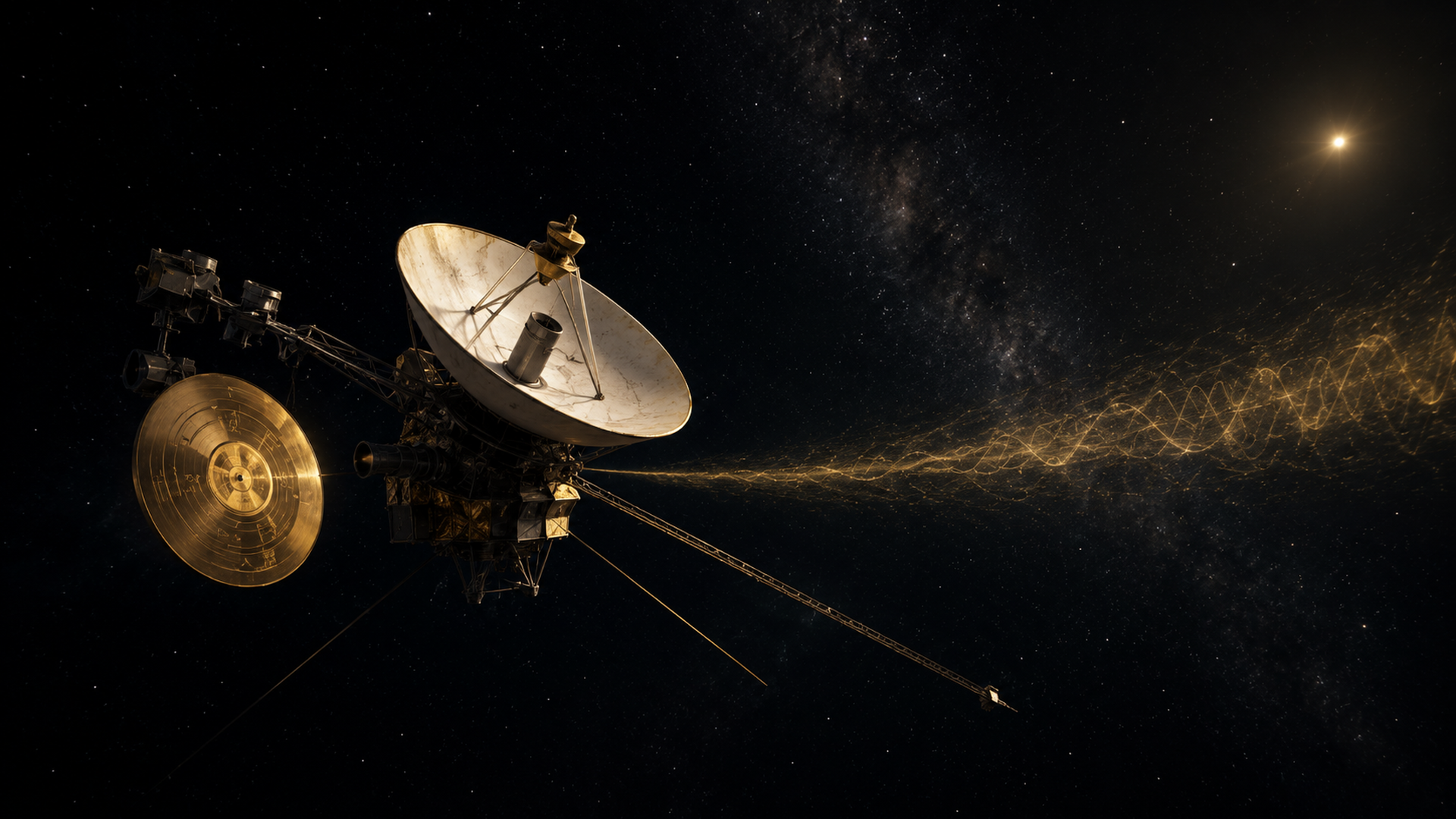
Voyager's most moving aspect is not how far it has flown, but that it is gradually losing its abilities yet still trying to reply. Humanity loves to write space exploration as a hero narrative: rockets launching, planets brushing by, the golden record handed to the cosmos. But in the mission's final stages, the true protagonist becomes an unglamorous job: power-saving, shutting down, waiting, calculating risks, then leaving the remaining voice where it matters most.
Voyager 1 has entered the moment of deciding which lights to turn off again. The low-energy charged particle instrument is being shut down—not because it is unimportant, but because every watt becomes political: who stays on, who goes silent, who still qualifies to speak for an old ship back to Earth. This resembles an aging newspaper cutting pages, or an Indigenous community memory archive deciding which sounds to prioritize when its hard drive fills up. The cosmos has no obligation to preserve everything for us.
Power-saving is not failure; it is the wisdom of late years
Voyager's nuclear battery has been declining since its 1977 launch. It cannot be recharged like a smartphone, nor can it call procurement to add server rooms like cloud services. In interstellar space it relies only on the backups, habits, and patience left by engineers decades ago. The so-called power-saving actions sound like science fiction, but they are simply swapping high-consumption components for low-consumption solutions to squeeze out a little more life from the probe. There is no miracle here—only maintenance manuals and refusal to give up.
This matters especially in the AI era. Today we talk about models with ever more parameters, larger data centers, longer contexts, and fancier GPUs. Voyager reminds us that the highest civilization technology may not be endless expansion; it may be knowing how to keep critical systems stable when resources shrink. True wisdom is not "I want everything" but "what can I still leave behind?"
The last voice is not the loudest voice
The golden record once delivered Earth's greetings to unknown listeners; now Voyager offers us another kind of greeting: if signals ever fade, how should civilization choose its final words? AI can help compress data, estimate failures, and simulate attitude control, and it can turn old missions into more accessible public knowledge. But AI cannot decide for humanity what deserves preservation—that is ethics, not algorithms.
We might use Voyager to reflect on our own data fetishism. Not all data will stay online forever; not all memories can be searched; not every voice should become training sets. When a probe two billion kilometers away chooses to keep magnetic field and plasma wave signals, it tells Earth: the first lesson of data governance is acknowledging limits.
What we give the future is not a victory declaration
Deep Space Memory Project No. 8 does not suit a grand finale. Voyager still flies, but it is not immortal. As its mission nears its end, it resembles a civilizational will: we once placed sounds, images, languages, music, and scientific instruments into darkness, hoping some patient receiver in the cosmos would hear them.
If future AI truly can organize interstellar memory for humanity, it should learn not only to generate grand narratives but also to recognize those low-frequency signals that are about to vanish. Because what civilization leaves at the end may not be the loudest slogans, but an old machine far away saying with its remaining power: I am still here.
---
Sources retained from the Chinese original
AI use and content-safety disclosure
This article was assisted by AI for data organization, structure drafting, and sentence polishing; human editors set viewpoints and fact-checking directions; it does not replace NASA or mission team announcements